Pacific Polytech targets 2,000 trades graduates by December
Institution says growing demand for skilled workers will see more than 2,000 graduates qualify by year-end.
Thursday 30 July 2026 | 16:30

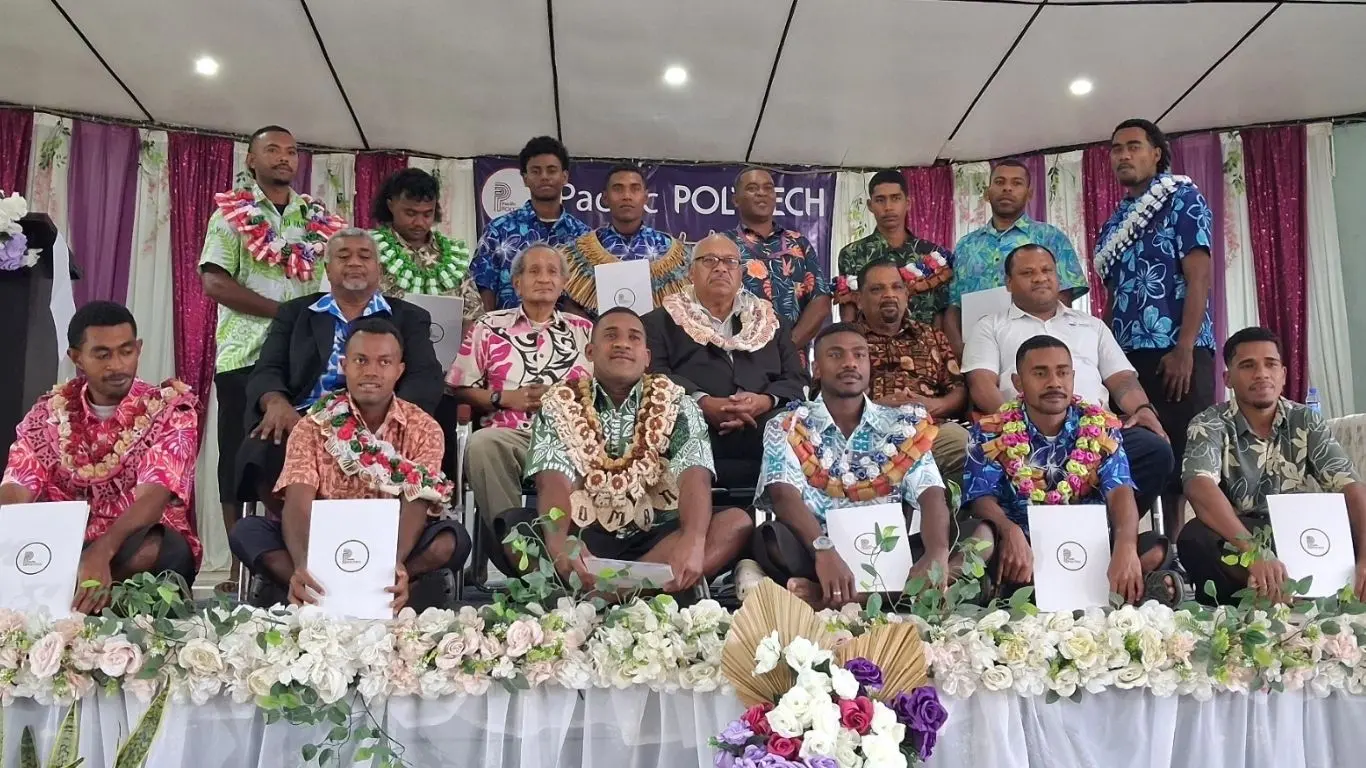
Chief Guest Ratu Josefa Dimuri (second row, third from left) with Pacific Polytech graduates and stakeholders at the Labasa Civic Centre on July 30, 2026.
Photo: Devisha Prakash
Pacific Polytech expects to produce more than 2,000 trades graduates across Fiji by December as demand for skilled workers continues to grow.
Chairperson Dr Ganesh Chand made the announcement during the institution's Cohort 6 graduation ceremony today, where 101 graduates from the Northern Division received their qualifications.
Dr Chand congratulated the graduates and said Fiji's growing economy required more skilled workers across a range of industries.
Related stories
The graduates were from the School of Agriculture, Fisheries and Forestry, completing the National Certificate in Agriculture (Crop Production) (Level 3), and the School of Trades and Technology.
Trades programmes included National Certificates in Automotive Mechanic, Automotive Electrical and Electronics Engineering, Carpentry, Electrical Fitter Mechanic, and Plumbing and Sheetmetal, all at Level 3.
Chief guest Ratu Josefa Dimuri said the ceremony celebrated more than academic success.
"It is a celebration of determination, resilience, perseverance and achievement," he said.
He acknowledged the support of families, trainers and industry partners in helping graduates complete their studies.
Ratu Josefa said Technical and Vocational Education and Training (TVET) remained critical to Fiji's development, with skilled professionals needed in sectors such as construction, agriculture, transport, healthcare and tourism.
"These are not simply occupations. They are professions that build nations."
He said Pacific Polytech continued to play a significant role in developing Fiji's skilled workforce through practical, industry-focused training.
Since 2023, the institution has graduated 2,604 students under National Qualification and Provider Qualification programmes, while a further 3,382 completed professional and micro-qualification courses.
Ratu Josefa encouraged graduates to continue learning, remain adaptable and use their skills to contribute to national development.
"Create employment rather than simply seek employment," he said.