Economists say Budget restores stability but offers little cost-of-living relief
Businesses welcome tax certainty while economists say families facing rising living costs needed stronger support.
Sunday 28 June 2026 | 08:00

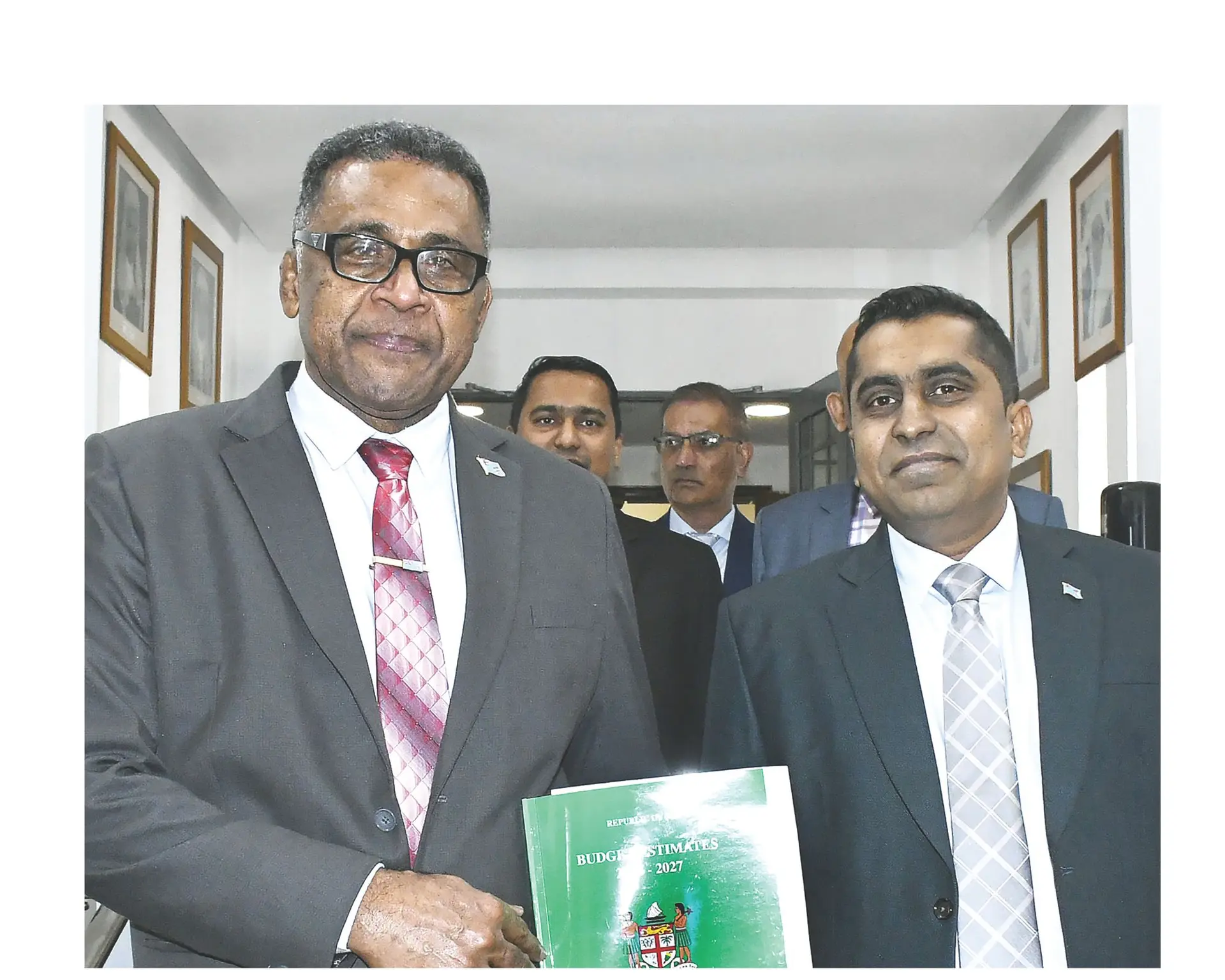
Minister for Finance Esrom Immanuel (left), with his permanent secretary, Shiri Gounder in Suva on June 26, 2026.
Photo: Ronald Kumar
The Coalition Government's 2026-2027 National Budget has won praise for restoring fiscal discipline and boosting business confidence, but economists say it falls short of providing meaningful relief for families struggling with the high cost of living.
University of the South Pacific senior lecturer in economics Dr Janesh Sami said the Budget gave businesses certainty by keeping the corporate tax rate unchanged but lacked bold measures to ease pressure on households.
"There are not sufficient measures in place to address the cost of living," Mr Sami said.
Related stories
He said reducing Value Added Tax (VAT) and expanding social welfare programmes would have delivered immediate relief to low-income families.
"The Government has not made that bold decision to reduce the VAT rate. I have not seen any major announcement in the Budget that expands social welfare schemes for the poor and vulnerable."
Mr Sami said exporters and businesses would benefit from tax incentives, but more was needed to encourage private sector investment.
Former Cabinet minister and economist Dr Mahendra Reddy said the Budget focused on repairing Government finances rather than transforming the economy.
He said fiscal consolidation was necessary because of Fiji's rising debt and growing recurrent expenditure but warned that spending cuts alone would not deliver long-term prosperity.
"Fiscal consolidation may restore stability. Only economic transformation will deliver lasting prosperity," he said.
Mr Reddy said the Budget lacked a broader strategy to lift productivity, attract investment, diversify exports and grow Government revenue over time.
The Fiji Commerce and Employers Federation (FCEF) welcomed the Budget, describing it as fair, responsible and supportive of private sector-led growth.
Chief executive officer Edward Bernard said retaining the corporate tax rate, extending fuel duty concessions and introducing incentives for manufacturers, exporters, construction companies and transport operators would strengthen the economy.
"We are happy that it prioritises the private sector as a major player in economic development," Mr Bernard said.
He rejected criticism that the Budget was not people-centred, saying existing social protection measures remained in place and that the wider economy would benefit.
"I don't think anybody will be on the losing end because there will be a lot of spin-offs," he said.
Finance Minister Esrom Immanuel acknowledged the Budget did not include salary increases but said the Government had provided as much support as it could during a difficult period.
"What we tell them is this is a difficult time, a crisis time. We've already provided the best that we can from the support that we have provided," he said.
Mr Immanuel said an expected reduction in fuel prices from next week should help ease living costs, although he did not specify when the price cut would take effect.