Sigatoka villagers demand answers over proposed iron sands mining
He also questioned who would provide alternative livelihoods if fishing grounds were damaged and who would be held accountable for possible soil erosion, flooding and damage to food crops.
Sunday 08 November 2026 | 18:00
Updated 08 November 2026 | 19:33 FJT

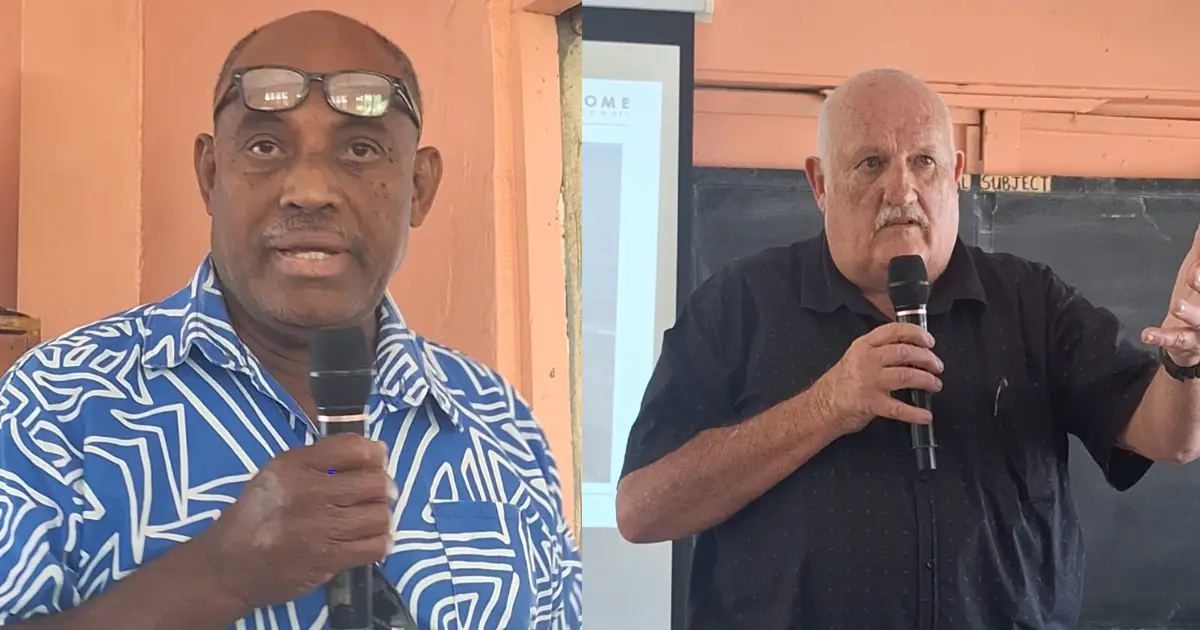
Mata ni Tikina Nahigatoka Josateki Taliga and Environmental Impact Assessment (EIA) consultant Robert Smith at Kulukulu Public Primary School, Nadroga, on November 7, 2026.
Photos: Katherine Naidu.
Who will be held accountable if the proposed iron sands mining project at Kulukulu in Nadroga damages fishing grounds, farmland and the livelihoods of families who depend on them?
This was the question raised by Mata ni Tikina Nahigatoka Josateki Taliga during a public consultation on the proposed mining project on Saturday.
Representing seven villages in the Tikina of Sigatoka, as well as Kulukulu Village and surrounding settlements, Mr Taliga questioned who would take responsibility if mining activities affected the natural resources that communities rely on for their daily survival.
Related stories
The concerns were raised during a public consultation on the Environmental Impact Assessment (EIA) for the proposed Special Prospecting Licence (SPL) 1495 – Kulukulu Sands, Sigatoka Iron Sands Project by Magma Mines Pte Ltd, held at Kulukulu Public Primary School in Nadroga.
“Looking at the site where the mining will be held, which is the riverbank and the sand dunes, what will happen to our families who depend on fishing and farming as a source of daily survival in the Tikina and in our province?” he asked.
Mr Taliga also questioned who would provide alternative livelihoods if fishing grounds were damaged and who would be accountable for possible soil erosion, flooding and damage to food crops.
“What kind of environment are we leaving for our children in years to come? Before you think about what you can gain, please, think about our people who stand to lose,” he said.
Responding to the concerns, EIA consultant Robert Smith said the current proposal focused on dry mining and did not involve mining within the Sigatoka River.
“Right now, the mining is only looking at dry mining. The river is off balance. There is also a River and Streams Act where there is a margin that is left between where you are and where the river bank is, which is actually six metres. It's written in the legislation,” Mr Smith said.
He said the mining plan was still being developed and any future proposal involving river dredging would require a separate study.
“And of course, if they do get to dredge in the river, then that's a whole new study that would have to be done to understand the hydrodynamics and everything else.”
Mr Smith said the current proposal would not involve the qoliqoli or fisheries, adding that further processes would become relevant once the definitive mining plan was established.