The Ghai and Khaiyum Constitutions: Setting the record straight
Correcting the record on seven years of false credit
Thursday 02 April 2026 | 08:00
Updated 02 April 2026 | 14:07 FJT

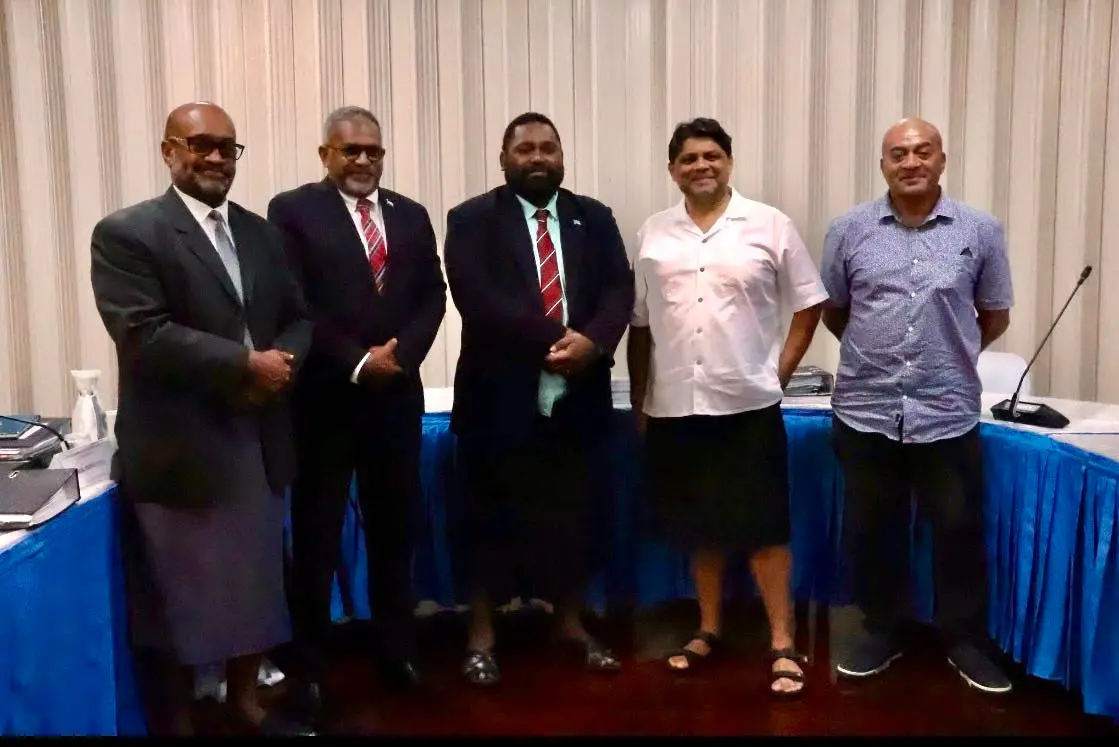
Members of the Standing Committee on Justice, Law and Human Rights with former Attorney-General Aiyaz Sayed-Khaiyum (fourth from left).
Photo: Parliament of Fiji
On March 31, 2026, former Attorney-General Aiyaz Sayed-Khaiyum appeared before the Standing Committee on Justice, Law and Human Rights and made a remarkable claim.
According to the Fiji Sun of April 1, 2026, he told the committee that seven years of intensive public consultation underpinned the 2013 Constitution, the most extensive in Fiji’s history.
He cited 1,256 National Council for Building a Better Fiji (NCBBF) consultations, 7,170 written submissions to the Yash Ghai Commission, 110 Ghai public hearings, 1,000 further government submissions, and his own attendance at 19 consultations. The claim is not merely misleading.
Related stories
It is a fundamental misrepresentation of documented constitutional history, delivered under parliamentary oath, that credits to one document the citizen participation conducted for an entirely different document that his own government burned in front of its author.
A deliberate conflation of three processes
The “seven years” figure is assembled by fusing three separate, legally distinct processes that produced three separate outcomes.
The first was the National Council for Building a Better Fiji, established on 10 October 2007 by Commodore Bainimarama after the December 2006 coup.
The NCBBF conducted more than 1,000 village and settlement consultations and delivered its product — the People’s Charter for Change, Peace and Progress — to the late President Ratu Josefa Iloilo on 15 December 2008.
The Charter was a governance vision document, not a constitution. It carried no constitutional force.
The second was the Fiji Constitution Commission, appointed in July 2012 and chaired by internationally acclaimed constitutional scholar Professor Yash Pal Ghai of Kenya.
The third was the secret in-house drafting team assembled in the Attorney-General’s chambers from January 2013 onwards. To conflate these three processes as a single seven-year consultation is not a simplification. It is a misrepresentation.
What the NCBBF actually produced
The NCBBF’s 1,256 consultations — which Sayed-Khaiyum cited before the committee — were conducted to produce the People’s Charter.
The Charter addressed electoral reform, anti-corruption measures, social cohesion, and economic direction. It was not a constitutional drafting instrument.
Critically, several of Fiji’s major political parties, the Methodist Church, the Fiji Muslim League, the Sangam organisation, and prominent figures including Wadan Narsey and Richard Naidu refused to participate.
A Fiji Times opinion poll conducted in April 2008 found public opinion split almost evenly, with 46.2 per cent opposed and 45.8 per cent in support.
The People’s Charter was endorsed by the President and became government policy in December 2008. It did not become a constitution, draft any constitution, or produce a constitutional text.
To present the NCBBF consultations as foundational to the 2013 Constitution is to appropriate credit for a process that produced an entirely separate document — one that Sayed-Khaiyum’s government subsequently treated as non-binding in any case.
The Ghai Commission: Legitimate andthen burned
The Fiji Constitution Commission was formally established by decree in July 2012. Chaired by Professor Ghai — notably, Sayed-Khaiyum’s own former professor — the five-member Commission included Professor Christina Murray of South Africa, Professor Satendra Nandan, Penelope Moore, and Taufa Vakatale. From July to October 2012, the Commission conducted 110 public hearings across Fiji and received 7,170 written submissions.
Those submissions and those hearings belong to the Ghai draft. They have no legal or moral connection to the document Sayed-Khaiyum’s team subsequently wrote. In December 2012, Professor Ghai released the Commission’s completed draft constitution. The response of the Bainimarama regime was swift and unmistakable.
Land Force Commander Colonel Mosese Tikoitoga declared the release illegal, demanded Ghai’s prosecution, and ordered all printed copies of the draft seized.
The shredded proofs were burned by police officers in the presence of a visibly distraught Professor Ghai. The Constitutional Commission was dissolved.
Ghai left Fiji hurriedly. Every submission, every hearing, every Fijian who travelled to a community meeting to give evidence — their contribution was committed to the flames.
The Public Never Addressed What Mattered
Even the Ghai Commission consultations — the most genuine element of the process — came with a fundamental limitation.
The Commission’s own data, later documented in academic analysis and reported by the Fiji Times in February 2025, showed that while 82 per cent of participants mentioned human rights, between 80 and 99 per cent failed to address 13 of the 17 required constitutional thematic areas.
Citizens did not speak to the electoral system, citizenship and ethnicity, language policy, leadership and integrity provisions, accountable government structures, the role of the military, coup culture, immunity and amnesty provisions, or transitional arrangements.
Research from Transparency International Fiji noted that in settlement workshops, participants were primarily concerned with job insecurity, living costs, food prices, and basic services — not constitutional architecture.
The Commission itself acknowledged a lack of civic education as a constraint, operating under severe resource and time pressure.
Sayed-Khaiyum cited these consultations before a parliamentary committee as proof of seven years of work that underpinned his constitution.
The consultations were neither for his constitution nor, by the data, comprehensive in their coverage of constitutional issues.
The January to September 2013 Secret Draft
On 10 January 2013, the Bainimarama government formally rejected the Ghai Commission draft on grounds described by the Lowy Institute as “dubious” and “nearly all without substance.”
The President’s rejection speech alleged that the Ghai draft would bring “financial and economic catastrophe and ruin” and claimed, baselessly, that the Commission had been influenced by foreign donors.
In January 2013, Human Rights Watch confirmed that the government had “handled duties to draw up the constitution to government legal officers in the attorney general’s chambers.”
A new Decree — the Fiji Constitutional Process (Adoption of Constitution) Decree 2013 (Decree No. 12, 2013) — was enacted in March 2013, repealing the earlier decree that had provided for a Constituent Assembly.
The promised people’s assembly, at which all parties and civil society would convene to deliberate on the draft, was abandoned without explanation.
A government draft was placed before the public in March 2013 with a tokenistic comment period later extended from April 5 to April 26. On 6 September 2013, the late President Ratu Epeli Nailatikau signed the 2013 Constitution into law.
The entire in-house drafting exercise, from rejection of the Ghai draft to promulgation, consumed approximately eight months.
A Constitution of structural divergence
The claim that the Ghai consultation underlies the 2013 Constitution is further demolished by the stark structural differences between the two documents.
The Ghai draft proposed four electorates; the 2013 Constitution imposed a single national electorate, removing regional representation — a feature Professor Ghai himself publicly criticised as favouring larger parties.
The Ghai draft required the military to submit to civilian control and granted immunity only on condition of a public oath of fidelity to constitutional rule; the 2013 Constitution embedded absolute and unconditional immunity for all coup participants, explicitly rendered unamendable.
The Ghai draft included detailed interim transitional arrangements requiring the regime to relinquish power before elections; the 2013 Constitution contained no such provision, allowing Bainimarama to remain in power until election day in September 2014.
On states of emergency, the Ghai draft required compliance with Fiji’s international law obligations and placed the National Security Council, including the opposition leader, in charge of any declaration; the 2013 Constitution gave the Prime Minister sweeping unilateral emergency powers.
Women’s rights protections were stronger in the Ghai draft; the Conciliation Resources comparative analysis of April 2013 documented the regression.
These are not footnotes. They are the architecture of governance.
Seven years that belonged to Ghai, not Khaiyum
Sayed-Khaiyum’s submission to the Standing Committee amounts to this: that the years of civic effort, consultation, submission-writing, and expert drafting conducted under the Ghai Commission and the NCBBF belong to the 2013 Constitution as its legitimising inheritance. The documented record says the opposite.
The NCBBF consultations produced the People’s Charter, not a constitution. The Ghai Commission consultations — 7,170 submissions, 110 hearings — produced a draft that the Bainimarama regime burned.
The 2013 Constitution was drafted by an anonymous legal team in the Attorney-General’s chambers over approximately eight months, without a Constituent Assembly, without a People’s Convention, without the participation of political parties, without the churches, and without the broad civil society that had engaged with Ghai.
The 1,000 additional submissions cited were gathered on a government draft released in March 2013 with a three-week window later barely extended. That is not seven years. That is, at best, three weeks.
History cannot be rewritten before a parliamentary committee. The 2013 Constitution carries the legitimacy its process earned — not the legitimacy it consumed from the process it destroyed.