Tribute: The dynastic anchor and jungle soldier - Ratu Epeli, the bridge between two worlds
A tribute to the late Ratu Epeli Nailatikau — soldier, chief, diplomat and former president — whose life bridged Pacific royalty, military restraint and the quiet power of servant leadership.
Thursday 16 April 2026 | 12:00
Updated 16 April 2026 | 13:41 FJT

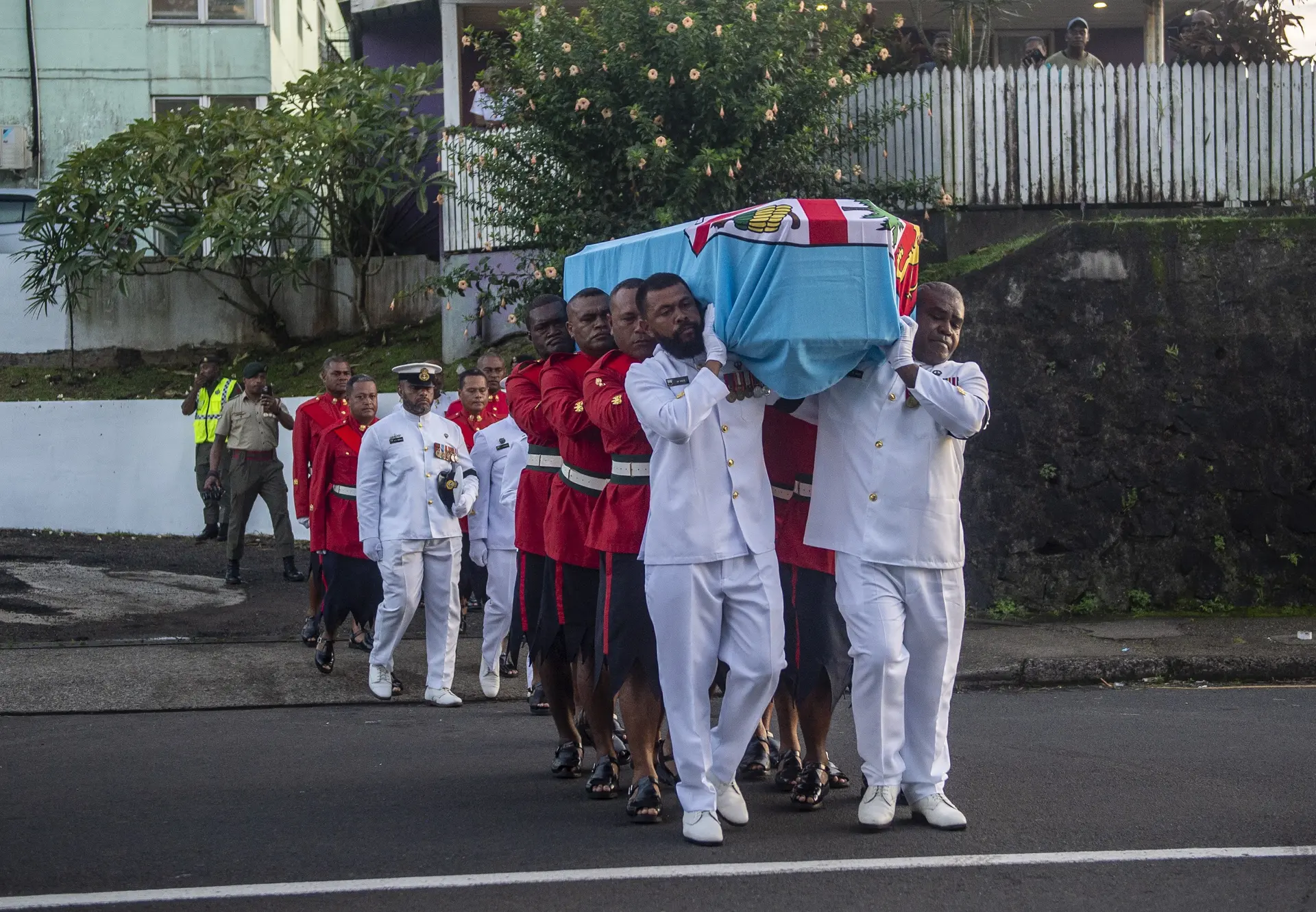
The casket of former President Ratu Epeli Nailatikau was gently carried by RFMF pallbearers from the Colonial War Memorial Hospital morgue and placed onto a gun carriage before the procession into Suva city on April 16, 2026.
Photo: Leon Lord
As Fiji reflects on the passing of Ratu Epeli Nailatikau, we celebrate a leader who seamlessly fused the ancient dignity of Pacific royalty with the humble heart of a servant-president.
The life and times of the late Ratu Epeli Nailatikau, 1941–2026
Related stories
On the morning of March 27, 2026, Roko Tui Bau Ratu Timoci Tavanavaua delivered the words that silenced a nation: Na Turaga mai Naisogolaca, Ratu Epeli Nailatikau, had passed away peacefully the night before at Oceania Private Hospital in Suva. He was 84 years old.
Prime Minister Sitiveni Rabuka, who had been attending traditional ceremonies at Nadala in Nadarivatu, halted proceedings immediately, a mark of respect for a man who served as a moral anchor for the state through its most turbulent decades. By nightfall, tributes were flooding in from across the globe: from the Tongan Royal Family to the ordinary Fijians who had simply met him in a queue at an ATM or in a Suva food court.
PM Rabuka has since declared a full state funeral, recognising that with his passing, Fiji has lost its most consequential figure, a man who was a living repository of Pacific royal lineage and a servant of the most humankind.
A Lineage Spanning Two Kingdoms
Born on 5 July 1941, Ratu Epeli Nailatikau carried in his blood the tectonic shifts of Pacific history.
On his father’s maternal side, he was the great-great-grandson of Ratu Seru Epenisa Cakobau, the warrior chief who ceded Fiji to Queen Victoria on 10 October 1874. This was not merely a distant historical fact; Ratu Epeli lived with the inherited responsibility of that Cession, understanding the delicate balance between indigenous sovereignty and global engagement.
His father, Ratu Sir Edward Tuivanuavou Tungi Cakobau, was a giant of the mid-century, serving as Deputy Prime Minister and commanding the Fijian Battalion with distinction during the Second World War.
Yet, Ratu Epeli’s heritage transcended the reef. Through his father's paternal line, Ratu Epeli was the grandson of King George Tupou II of Tonga.
This dynastic link made him a vital father figure within the Tongan Royal Family, a role emphasised as recently as July 2024 when Princess Salote Mafileʻo Pilolevu Tuita hosted a birthday dinner for the family’s last surviving uncle.
In 1981, his marriage to Adi Koila Mara—daughter of Fiji’s founding father Ratu Sir Kamisese Mara, united the two most powerful chiefly houses in Fijian history.
This was more than a marriage; it was a union of the nation's political and traditional foundations, placing Ratu Epeli at the literal and figurative centre of the national identity.
Scholar, Soldier, and Combat Veteran: The Sarawak Spirit
His education followed the path of the chiefly elite: Bau District School, Draiba Fijian School, Levuka Public School—where the instrument of Cession was signed—and finally, Queen Victoria School (QVS).
But Ratu Epeli was never content with the "ceremonial" life of a chief. He sought the forge of military discipline, entering New Zealand for rigorous training before being seconded to the 1st Battalion, Royal New Zealand Infantry Regiment in 1966.
This was the beginning of his "Sarawak Spirit." He saw active service in the "Konfrontasi" campaign—genuine, grit-and-dirt jungle warfare against Indonesian forces in the Bornean rainforest.
This was not a parade-ground exercise; it was high-stakes combat that tested his leadership in the stifling heat and psychological pressure of the jungle canopy.
He returned to Fiji a tested, combat-hardened officer who understood that leadership was not found in a manual, but in the marrow of one's bones.
By 1978, he became the founding field commander of Fiji’s UNIFIL peacekeeping troops in Lebanon. This mission established Fiji’s global reputation for professional military excellence.
He did not lead from the safety of a bunker; he was on the ground, instilling an ethos of empathy and restraint that remains the hallmark of the RFMF today.
He rose to Brigadier-General and Commander of the RFMF in 1982, holding the title of Colonel of the Regiment until his final days—a "Grandfather of the Army" who taught every recruit that the uniform was a burden of service, never a license for vanity.
The Crucible of 1987: The General Who Chose the Nation
The most defining test of Ratu Epeli’s military and moral steel occurred on 14 May 1987. At the time, he was the Commander of the Royal Fiji Military Forces (RFMF), but he was away in Australia on official duties.
In his absence, his third-in-command, Lieutenant-Colonel Sitiveni Rabuka, led ten-armed soldiers into Parliament, arresting the government of Dr. Timoci Bavadra.
This was the first time the gun had entered Fijian politics, and the institutional betrayal was absolute.
From Canberra, Ratu Epeli faced a choice that would determine the fate of thousands. As the rightful Commander, he could have issued a call for loyalist elements within the RFMF to launch a countercoup.
He was a combat veteran of the Sarawak jungle; he knew how to fight. However, he also knew that such a move would turn Suva into a battlefield, pitting Fijian soldier against Fijian soldier.
With a level of "grit" rarely seen in modern history, he chose the path of agonizing restraint. He famously declared he remained in command, but he refused to precipitate a civil war.
By stepping aside, he sacrificed his own military career to preserve the fragile peace of his country. It was an act of profound self-abnegation that marked him as a leader whose primary loyalty was to the people, not the rank.
Diplomatic Masterclass: From the Barracks to the Court of St. James
Following the events of 1987, Ratu Epeli transitioned into a new kind of service. He did not retire into the shadows; instead, he underwent a rigorous diplomatic transformation, including a Foreign Service Course at Oxford University. This wasn't a ceremonial "chiefly" posting—he became a genuine heavyweight in Fiji’s international relations.
As High Commissioner to the United Kingdom and Ambassador to Israel, Denmark, Germany, Egypt, and the Holy See, he spent seventeen years rebuilding Fiji’s reputation.
He moved through the halls of global power with the same quiet authority he once used on the parade ground.
In 1999, as permanent secretary for Foreign Affairs, he was again the man the nation turned to when the Speight coup of 2000 threatened to tear Fiji apart once more.
When the interim government was being formed in the wake of that crisis, the military nominated Ratu Epeli as the interim Prime Minister. In another act of extraordinary humility, he declined the ultimate prize.
He recognized that for the nation to heal, a civilian consensus candidate was needed. He chose instead to serve as Deputy Prime Minister and Minister for Fijian Affairs, providing the essential "chiefly mana" and professional calm that acted as the ballast for the interim administration.
His refusal to chase power, even when it was handed to him on a silver platter, remains one of the most significant examples of servant-leadership in the Pacific.
President of Fiji: Redrawing the National Blueprint
When Ratu Epeli Nailatikau was sworn in as President in 2009, he did not merely inherit a ceremonial office; he stepped into a nation in the midst of a profound structural metamorphosis.
His presidency (2009–2015) served as the primary bridge across which Fiji walked to return to the international community. The crowning achievement of his statecraft—and perhaps the most significant constitutional act in modern Pacific history—occurred on 6 September 2013. In a room thick with the gravity of the moment, he put his pen to Fiji’s fourth constitution.
For a man who was the direct descendant of the Vunivalu of Bau—the very heart of the traditional, hierarchical establishment—to sign a document that mandated a common electoral roll and the "one-person-one-vote" principle was a revolutionary synthesis.
He was effectively dismantling the race-based electoral structures that had haunted Fijian politics since the 1970 London Conference.
By doing so, he signalled to the world that the Fiji of the future would be a place where a descendant of a Girmitiya and a descendant of a High Chief stood on the exact same political floor, equal in the eyes of the law.
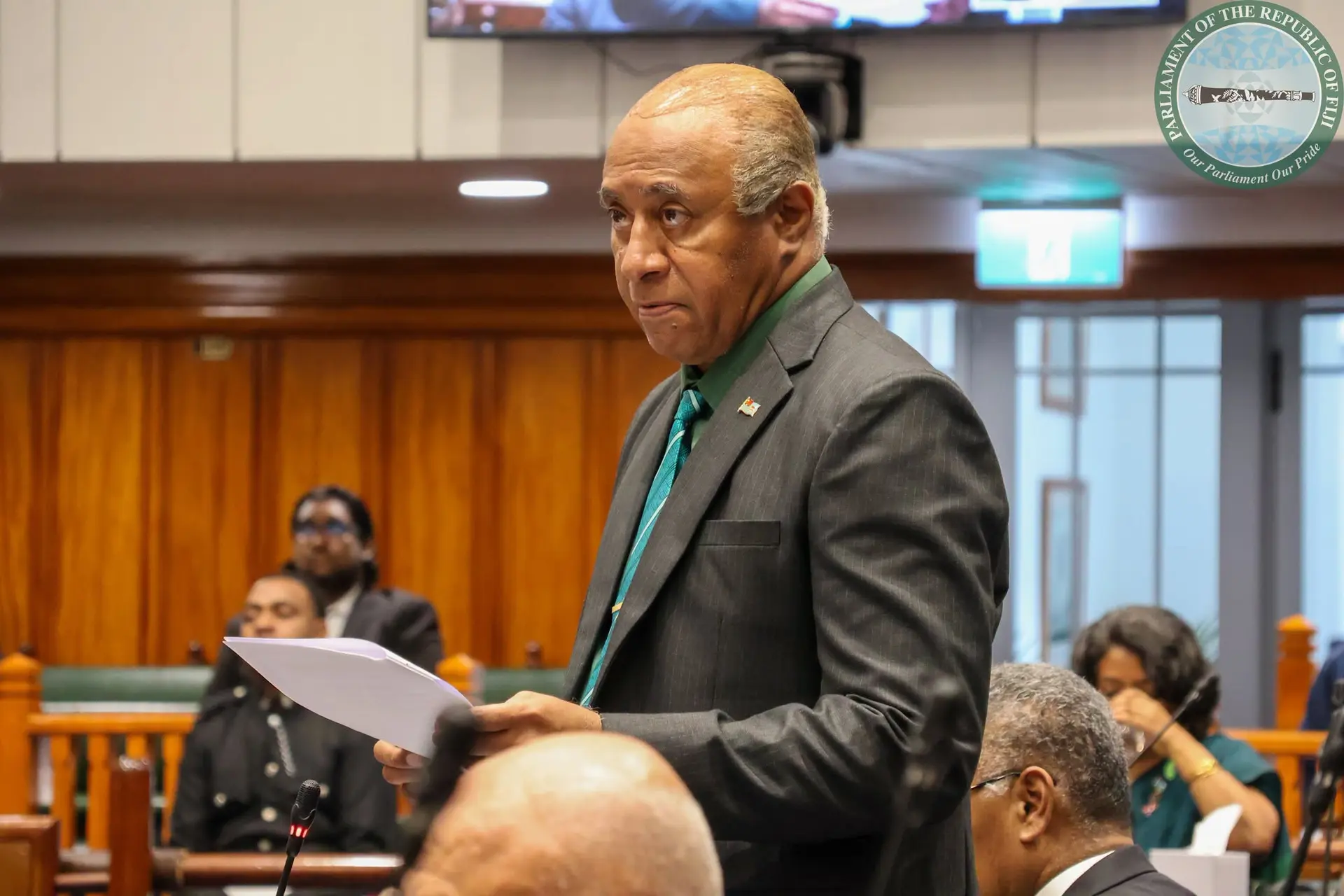
He didn't just sign a law; he validated a new social contract. Later, as Speaker of Parliament from 2019 to 2022, he brought this same steel to the House, using his deep, resonant voice to anchor the chamber in dignity and preventing the proceedings from sliding back into the ethnic vitriol of the past.
The People’s President: The Spirit of the Scrum
What distinguished Ratu Epeli’s "grit" was his refusal to be a prisoner of his own rank. He was famously the "ATM President," seen in the midday Suva heat, queuing at Westpac or ANZ alongside workers, students, and tourists, refusing to let a security detail bypass the common citizen. He ate in public food courts not for a photo-op, but because he genuinely felt at home among the people.
Justice Usaia Ratuvili captured this sentiment perfectly, noting that Ratu Epeli was a chief who “brought himself down to everyone’s level” to ensure that the dignity of the State House was accessible to every Fijian.
But his most courageous work happened in the shadows, far from the grand ballrooms. As a UNAIDS Special Representative, he took on the greatest taboo in Pacific culture: the HIV/AIDS epidemic.
At a time when many traditional and religious leaders chose silence, shame, or condemnation, Ratu Epeli chose the "Spirit of the Scrum." He famously told the youth of the nation that fighting a national crisis required the discipline of a rugby unit—binding together, protecting the weak, and pushing forward with collective strength.
He visited the "outcasts"—the HIV-positive, the LGBTQ+ community, and those on the fringes of society—shaking their hands and looking them in the eye.
He used his immense chiefly mana to shield those whom society had discarded, proving that true royalty is measured not by how many bow before you, but by how many you protect.
A Grand Farewell to a Pacific Giant
Ratu Epeli Nailatikau was the ultimate bridge. He was a soldier who chose peace over the gun, a diplomat who chose engagement over isolation, and a High Chief who chose the common citizen over the elite. He has completed his final tour of duty, leaving behind a nation that is more united, more modern, and more aware of its shared humanity because he walked amongst us.
As the Fiji flag flies at half-mast from the mountains of Nadarivatu to the sacred shores of Bau, we bid farewell to a leader like whom we shall not soon see again.
He belonged to two worlds, yet he made sure those worlds finally spoke to one another. Na Turaga mai Naisogolaca has gone to his rest, but the blueprint he drew for a fair, equal, and humble Fiji remains in our hands.
Moce Mada, Gone Turaga Bale. Sa Oti Na itavi, Sa Taucoko Na Sema. Ni Sa Vakacegu Ena Vakacegu Tawamudu.
(Farewell, Great High Chief. The duty is done; the connection is complete. Rest in eternal peace.)
[1932]
(Dr. Sushil K Sharma BA MA MEng (RMIT) PhD (Melbourne is World Meteorological Organisation Accredited Class 1 Professional Meteorologist, Former Aviation Meteorologist for British Aerospace, Royal Saudi Air Force, and Bahrain Air Navigation Directorate, Former Associate Professor of Meteorology, Fiji National University and Manager, Climate Research and Services Division, Fiji Meteorological Service. The views expressed are those of the author alone and do not represent the views of the Fiji Sun)