Pacific leaders train in solar technology as fuel costs rise
Representatives from Fiji, Tuvalu and Vanuatu gain practical solar skills amid rising fuel costs.
Monday 01 June 2026 | 09:30
Updated 01 June 2026 | 11:30 FJT

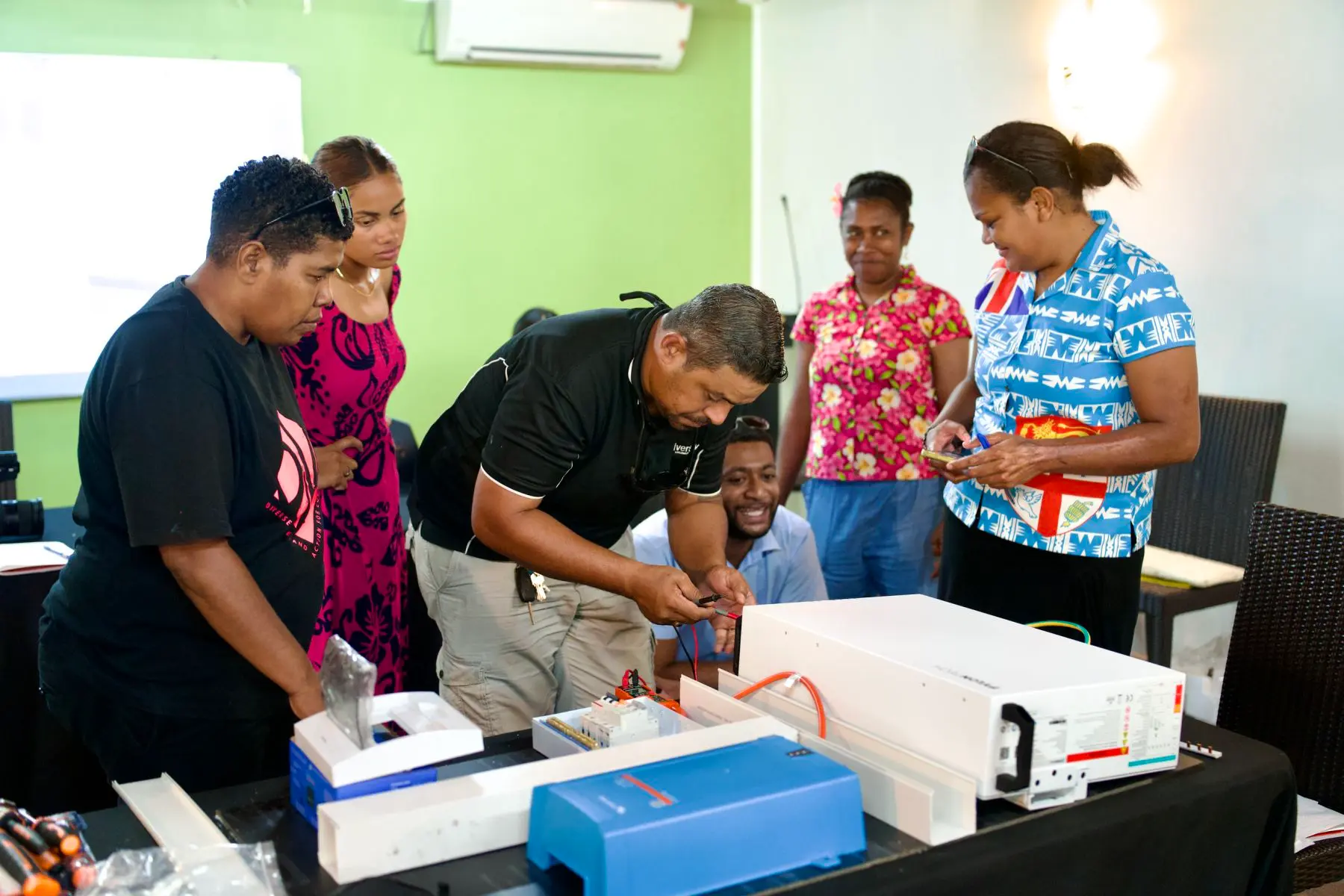
Pacific participants undergo hands-on training to assemble solar power systems during the training in Nadi.
Photo: 350.org Pacific
A deepening global fuel crisis is pushing Pacific communities towards energy independence, with leaders from Fiji, Tuvalu and Vanuatu training in solar technology to reduce dependence on imported fossil fuels.
With fuel and electricity costs rising across the Pacific, 15 community representatives gathered at the Grand West Villas in Wailoaloa, Nadi, last week to learn how to install and maintain solar power systems.
They participated in the Solar Scholars Initiative, a hands-on programme run by 350.org Pacific and the Institute for Climate and Sustainable Cities (ICSC), aimed at building local capacity in renewable energy.
Related stories
The training comes as volatile global energy markets, driven by geopolitical tensions and supply disruptions in the Middle East, continue to push up fuel and electricity prices across the region, exposing the Pacific's reliance on imported diesel and oil.
350.org Pacific organiser George Nacewa said the shift was about long-term community control of energy systems, not just reducing costs.
“We want to build a world beyond fossil fuels and develop solutions to the current energy crisis, and this training is the stone we cast into the ocean, with hopes that the ripples reach our communities and those that need it most,” Mr Nacewa said.
“We need to rethink a world that depends heavily on oil, gas and fossil fuels. We need to move towards energy sovereignty, where communities are empowered to build, own and manage their own energy systems.”
Participants received hands-on training in assembling, installing and maintaining photovoltaic (PV) solar systems, culminating in pilot installations at the Fiji Council of Social Services office in Lautoka and a kindergarten in Yavulo Village, Sigatoka.
Mr Nacewa said the systems would strengthen community resilience while helping households manage energy costs.
“This initiative is about empowering communities to not only own solar systems but also build, maintain and sustain them independently. These systems can power homes, provide lighting during blackouts and power outages, and help reduce household electricity expenses,” he said.
ICSC director for community resilience Arturo Tahup said the Pacific was facing a dual challenge of climate change and global energy instability.
“We are facing a climate crisis and a global energy crisis that are linked together. During the week of the conflict involving Iran, diesel, oil, food and basic commodity prices increased,” he said.
“Although the conflict is far away from us, the global energy crisis has affected us at home. We feel it every time we go to a petrol station and pay for fuel, and every time we receive our electricity bills.”
Mr Tahup said renewable energy offered the Pacific a practical pathway away from dependence on imported fuels.
“Let us transform the global energy crisis into an opportunity to transition away from imported fossil fuels and move towards local, renewable energy solutions.
“This is what we call energy democracy, giving people the opportunity not only to become energy users but also decision-makers and implementers of the energy transition in countries such as the Philippines, Fiji and across the Pacific.
“I believe a crisis can inspire people to become creative and make significant decisions. This training teaches the fundamentals of social technology. It is not overly technical and can be easily understood so that ordinary people can operate basic solar technology,” he said.