Business leaders urge productivity push amid slowing growth
Sunday 14 June 2026 | 12:00
Stakeholders warn that rising fuel costs, inflation and weaker growth prospects require greater productivity, innovation and economic resilience.
A series of conferences and economic forums held last week have provided valuable insight into Fiji's economic outlook, with many stakeholders warning that the country faces significant challenges arising from the ongoing global fuel crisis.
Dialogue Fiji's State of the Fijian Economy Dialogue 2026, the Fiji Business Excellence Conference and the Fiji Business Disaster Resilience Council's webinar, Fiji's Fuel Crisis: Price, People and Preparedness, brought together experts and industry leaders to assess Fiji's current economic position and future prospects.
Much of the discussion followed the Reserve Bank of Fiji's (RBF) release of its Revisions to the Macroeconomic Projections for the Fijian Economy (2025-2028).
Related stories
The report showed that escalating conflict in the Middle East and resulting increases in global oil prices had pushed inflation to 3.9 per cent in May, a significant turnaround from -3.8 per cent in September 2025.
The RBF said year-end inflation was now expected to exceed 6 per cent, driven largely by imported inflation, particularly higher fuel and food prices and their flow-on effects.
"As a result, the Fiji economy is projected to grow by 1.5 per cent, revised down from the 3 per cent forecast issued in November 2025, with downside risks remaining elevated," the RBF said.
"While Government has announced targeted support measures and is expected to maintain these in the 2026-2027 National Budget, given limited fiscal space, the revised growth outlook assumes Government expenditure will remain at a similar level."
The central bank forecasts growth of 2.5 per cent in 2027 before returning to its longer-term trend of about 3 per cent in 2028.
The services sector, particularly tourism, is expected to remain the primary driver of growth, supported by contributions from the industrial and primary sectors.
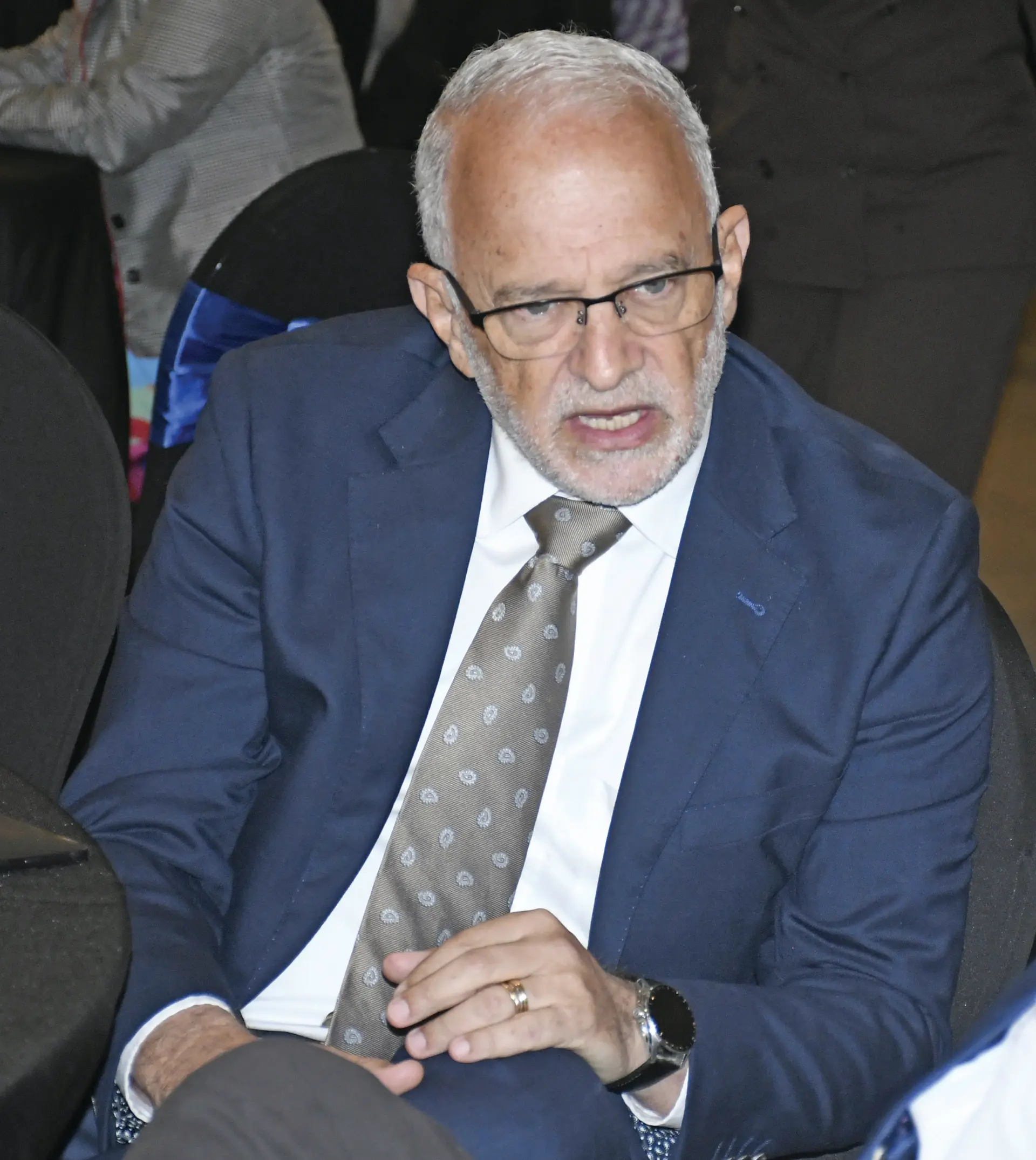
Mark One Apparel owner and managing director Mark Halabe said improving productivity must become a national priority if Fiji hopes to achieve sustainable economic growth, attract foreign investment and remain competitive in the global market.
Photo: Ronald Kumar
'Sobering but realistic'
Business leader and Mark One Apparel managing director Mark Halabe described the revised growth forecast as a sobering but realistic reflection of Fiji's vulnerability to external shocks.
"The ongoing conflict in the Middle East has directly driven up global oil prices, which we are already feeling on the ground in Fiji through increased production costs, higher freight charges and a sharp rise in imported inflation," he said.
"When year-end inflation is projected to exceed 6 per cent, it directly squeezes household spending power. We are already seeing consumers and retail businesses becoming far more cautious with spending."
Mr Halabe said tighter monetary conditions and energy security concerns in key tourism markets, including Australia, were also creating additional pressure on Fiji's economy.
However, he stressed that businesses could not afford to be complacent.
"We cannot use global geopolitical conflicts or domestic fiscal constraints as an excuse to stand still," he said.
"When margins are squeezed by rising fuel and operational costs, the answer is an aggressive shift towards productivity and innovation."
Mr Halabe urged businesses to eliminate inefficiencies, invest in digital infrastructure and adopt energy-efficient technologies to reduce their exposure to volatile fuel prices.
"At Mark One Apparel, we have proven that committing to a paperless environment, digital workflows and advanced automation allows local operations to remain competitive and globally reliable, even in a high-cost environment," he said.
He said the RBF's projections highlighted the need for businesses to improve efficiency if Fiji was to achieve sustainable economic growth.
Productivity push
Speaking at the Fiji Business Excellence Conference, Mr Halabe said Fiji's economic future depended on businesses taking responsibility for improving productivity rather than relying on Government intervention.
He said productivity must become a national priority if Fiji hoped to achieve sustainable growth, attract foreign investment and remain globally competitive.
Quoting Reserve Bank Governor Ariff Ali, Mr Halabe said: "You cannot depend on Government to improve productivity in this nation."
He warned that Fiji's current growth rate was below expectations and that the country risked falling behind if productivity challenges were not addressed.
"Fiji doesn't have oil or gas. We have some gold, but not enough to solve our debt problems," he said.
"What will make us a productive nation is what countries like Singapore have done. They don't have significant natural resources either. Their people are their greatest resource."
Mr Halabe said Fiji needed to foster a culture of continuous improvement through proven business excellence frameworks that improve efficiency, reduce costs and strengthen competitiveness.
He also called for incentives to encourage greater participation in business excellence programmes, suggesting tax incentives for companies that consistently demonstrate high standards.
"We need thousands. Every company in Fiji should be in this programme," he said.
He cautioned that rising labour costs, including increases to the minimum wage and discussions around a national living wage, would need to be matched by productivity gains.
"Unless we link productivity improvements to these initiatives, we're going to be outpriced. Businesses elsewhere can produce more efficiently, and Fiji risks being left behind."

World Bank senior economist Naomi Mathenge at tge State of the Fijian Economy Dialogue 2026 at Grand Pacific Hotel in Suva on June 9, 2026.
Photo: Ronald Kumar
Growth trajectory
At Dialogue Fiji's State of the Fijian Economy Dialogue 2026, World Bank senior economist for Fiji and Tuvalu Naomi Mathenge outlined Fiji's recent growth trends and long-term challenges.
She said Fiji demonstrated resilience over the past 10 to 15 years, with tourism driving average annual growth of 4.3 per cent between 2014 and 2018.
That momentum was interrupted by the COVID-19 pandemic.
Although Fiji returned to growth between 2023 and 2025, average growth has slowed to around 3 per cent.
Ms Mathenge said tourism remained critical because it accounted for about 40 per cent of Fiji's economy, both directly and indirectly.
However, she cautioned against focusing solely on headline growth figures.
"Growth has not translated into enough jobs for most people, and there remains an untapped labour supply," she said.
"Our recently released Pacific Economic Update shows that many workers remain in low-productivity agriculture and lower segments of the service sector."
She said labour force participation also remained a challenge, particularly among women and young people.
According to Ms Mathenge, 19 per cent of Fiji's youth are not in education, employment or training.
To achieve Fiji's aspiration of becoming a high-income country, she said the economy would need to grow by an average of 5.7 per cent annually over the long term.
This would require the creation of more jobs and greater investment in workforce skills and capacity.

Acting head of strategic planning at Government’s Ministry of Strategic Planning, Poonam Singh.
Responding to challenges
Acting head of strategic planning at the Ministry of Strategic Planning, Poonam Singh, said the revised growth outlook did not mean Fiji was heading into recession.
However, she noted that slower growth would result in fewer opportunities for businesses to expand, slower job creation and less fiscal space for development priorities.
While Fiji could not control global fuel prices or geopolitical tensions, Ms Singh said the country could strengthen its economic resilience and competitiveness.
"The challenge before us is not simply how to maintain growth, but how to position Fiji to grow faster, more sustainably and more inclusively over the medium and long term," she said.
"Our end-of-year inflation is expected to exceed 6 per cent. With fuel prices rising, we also need to consider the impact on key industries such as transport, Fiji Airways, tourism and the energy sector."