Change Lifestyle, Reduce Carbon Footprint: Camaibulu Urges
Ms Camaibulu is a second-year student at the Fiji National University who was working with other students and academics showcasing their different ideas on fighting climate change, sustainable livelihoods, and ways to cut down carbon footprints.
Saturday 22 October 2022 | 14:32
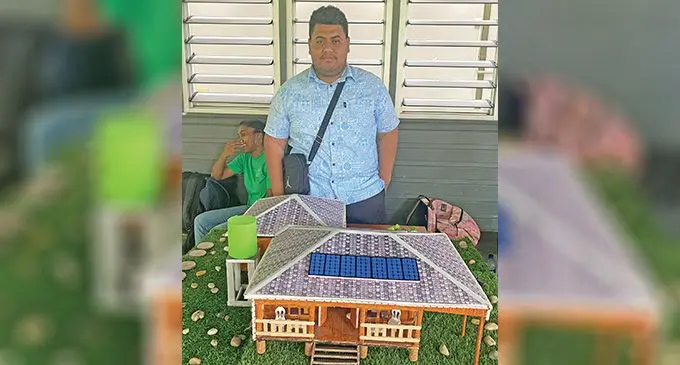
Fiji National University third-year Diploma in Architectural Drafting student, Ligovasa Petelama with his group’s project model at Derrick Campus, Samabula. Photo: Kelera Sovasiga-Tuisawau
Ms Camaibulu is a second-year student at the Fiji National University who was working with other students and academics showcasing their different ideas on fighting climate change, sustainable livelihoods, and ways to cut down carbon footprints.
Fiji, like its neighbours across the Pacific, remains one of the smallest contributors to global carbon emissions.
Yet, it faces some of the most devastating consequences of extreme weather patterns.
Related stories
This week, the Fiji National University (FNU) took on a leading role in promoting sustainable practices with its staff and students.
With the theme ‘Being Sustainable: Our Planet Our Responsibility’, the inaugural Sustainability Week campaign enabled FNU to utilise expertise to develop cost-effective, scalable solutions for climate change adaptation.
FIJIAN STUDENTS PROMOTE SUSTAINABILITY LIVING
As with climate action, sustainability can also be a lens for thinking about personal choices and behaviours.
Third-year College of Engineering School of Science student, Akisi Nabou is confident that people can change their daily habits in practising sustainable living.
“Sustainability is promoting social development for our present needs without compromising the resources for future generations,” Ms Nabou said.
“In our project model, we showcase how we can make use of the land and it resources as efficiently as possible to maintain it for our children and also how we can reduce carbon footprints in our daily living,”
The project model embodied a garden for agriculture purposes, solar for energy power, and a water tank for harvesting water.
Classmate, Mereani Domolola, also a third-year student said the three bedroom house model took about two weeks to complete.
“The resources we used to build this model from the ground up were all recyclables, whatever we could find in our labs, and we did not spend a single dollar on buying anything,” Ms Domolola said.
“Our project showcased the importance of self-sufficient energy systems by utilising solar, catching rainwater and following no waste policies through the use of composts,” she said.
The group of seven students did not realise they had made use of the available resources around them until the final touches of their project model was completed.
Ms Camaibulu had highlighted the importance of understanding how sustainable living reduces carbon footprints.
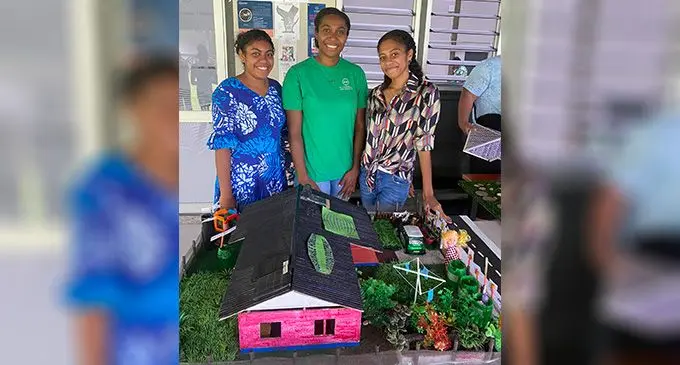
(From L-R) Mere Camaibulu, Mereani Domolola and Akisi Nabou from the College of Engineering School of Science, Nabua Campus with their project model. Photo: Kelera Sovasiga-Tuisawau
FRESHWATER IS SCARCE
Tuvalu’s geography and location has posed many challenges to the people that live there. Atolls are regularly inundated by high tides and storms. Freshwater is scarce.
“In Tuvalu, we are highly reliant on rainfall as the main source of fresh water. Tuvalu is not like Fiji and so for us, we have no rivers on the islands and groundwater is extremely limited.”
In the group architectural model, an underground water storage unit was included.
It is built underground due to the lack of space on the island.
“Our island is being swallowed by sea-rise and coastal erosion on a daily basis and we are fighting against climate change and fighting for
space, hence the underground unit,” he said.
“There were some ground water sources and traditionally, rainwater was caught off thatched roofs and trees,”
“The unit is made of concrete and there is a small tank on the top so from there, the main source of power is solar, and water is being pumped from that underground water storage unit into that overhead tank which then lets the water flow freely into the house.”
AGRICULTURE ALTERNATIVES
Due to the harsh variation in the climate, Tuvalu faces major setbacks in agricultural development.
Mr Petelama said the sustainable agriculture in Tuvalu is centred on creating a reliable food source that can survive the country’s harsh climate and soil conditions.
“Tuvalu has reef islands and atolls and its high level of soil salinisation makes the soil and land relatively poor to cultivate for food,” he said.
“To create a reliable food source, we have been taught to focus on home gardening, so our people know how to produce nutritious foods in their backyards to promote health,”
With this in mind, the project model incorporated a simple garden with a concrete base and has soil that is being cleansed by rainwater.
“Rainwater flows through it and it cleans the soil so we can plant our vegetables and we have done research on how we can plant using the shelves on the walls,” he said.
“What we are trying to do is to get at least the cheapest and most sustainable material that we can use instead of buying it, so we use the resources that are readily available in Tuvalu.”
Mr Petelama is currently doing his attachment.
His other two colleagues, Grace Anthony is in Labasa while Solomon Islander Lawrence Fosu is in his home country. All are doing their attachments before they graduate.
“This project model is an example of sustainability and adaptation in the face of a climate crisis,” he said.
“We hope to one day make this model a reality and build it in countries like Tuvalu who are facing the wrath of climate change on a daily basis.”
Feedbacks: adi.sovasiga@fijisun.com.fj