Islanders Living Off the Sea Tell of Struggle to Find their Catch
For communities in Fiji’s maritime islands, the ocean is a source of sustenance. For them, the ocean is life.
Saturday 25 June 2022 | 16:00

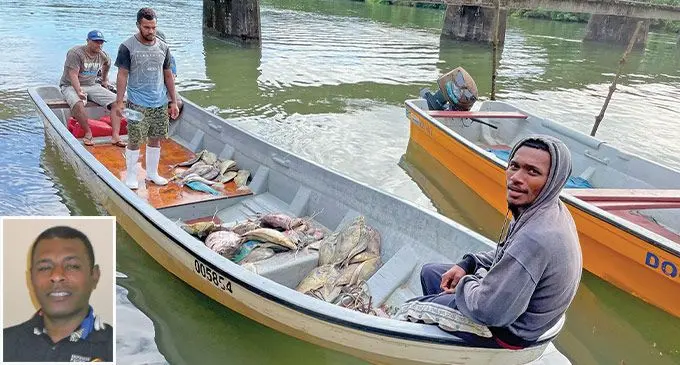
Inset: Fisherman Iliapi Tavunia. Fishermen and divers deliver their catch to the Labasa Fish Market. Photo: Nick Sas
For communities in Fiji’s maritime islands, the ocean is a source of sustenance. For them, the ocean is life.
They depend on it for food, and as a source of wealth and leisure.
This is no different for villages and communities off the coast of the Macuata Province.
Related stories
However, there is a strong trend that they’ve observed over the years - the depleting number of marine resources they are harvesting now compared to what they harvested some 10 to 15 years ago.
Fisherman, Iliapi Tavunia, can attest to this.
He grew up on his home island of Kavewa in the Nadogo District, Macuata.
The 45 year-old grew up depending solely on the harvest from the ocean to keep his family going.
Today, with the depleting marine resources, he has been forced to consider other alternatives.
“Before we wouldn’t have to go right into the deep ocean to be able to catch fish or other seafood, we would just walk a few metres and we would be greeted with so many marine resources,” he said.
“Now you can’t see that anymore. That is very rare."
“You can catch fish but not as much as before, we would sometimes assume that there is hardly anything left for us."
“It has really changed and we have been enlightened on it as well by various civil society organisations that visit us.”
WWF-Pacific
According to World Wildlife Fund (WWF)-Pacific, there may be a number of reasons for this including the over-harvest by the communities and surrounding communities themselves.
Fiji Conservation Director WWF-Pacific, Francis Areki, said over harvesting coupled with the impacts of climate change and recurring disasters have an impact on reef productivity such as coral bleaching and damages to reef systems during cyclones.
“It is a concern which WWF tries to address with communities such as promoting sustainable fisheries practices, establishing community protected areas and also linking this to resilient actions which strengthen their fishing grounds to recover and from further degradation.”
A Woman’s Perspective
Divuna Rukalesi, 65, of Druadrua, Namuka, Macuata has lived long enough to also notice changes in the ocean resources.
Ms Rukalesi said during her younger days, she would enjoy an abundance of seafood that she would harvest for her family.
“Before I would just fish out here and I would catch fish just near the mangrove swamp and I would get in a lot of fish, in abundance. Now that’s not the case.”

Divuna Rukalesi, 65, of Druadrua, Namuka, Macuata. Photo: Nick Sas
“I have been a fish market vendor for more than 10 years and I’ve noticed the drastic change.”
Ms Tara said they were often forced to sell fish at fluctuating prices depending on the harvest that are brought to them by the divers.
WWF Report
A recent study report released by the WWF during the Fiji Sea- scape Symposium earlier this year stated that strengthening marine protected areas should be executed to address the steep decline in fish stocks on the Fiji Great Sea Reef along the coast of Macuata.
The study revealed that there was a 33 per cent decline in fish abundance as well as a decline in fish sizes.
The study report on the Great Sea Reef is a culmination of findings made by Marine scientists in 2019 through the WWF.
The report recommended that existing marine protected areas should be expanded, and new effective conservation measures implemented.
It also suggested that strengthening fishing restrictions were needed as there was a decline in marine species population along the Great Sea Reef that stretches for over 450 kilometers surrounding the northern and western coasts of Fiji’s two main islands.
Feedback: inoke.rabonu@fijisun.com.fj
- The Fiji Sun would like to thank WWF Pacific, ABC International Development and the Australia Pacific Climate Partnership for their support for this story.