NatureFiji warns Fiji not ready for $1.4b Vuda waste project
NatureFiji-MareqetiViti director Nunia Thomas-Moko said weak regulation, outdated legislation and years of poor enforcement placed Fiji at serious risk if the project proceeds.
Wednesday 20 May 2026 | 17:00

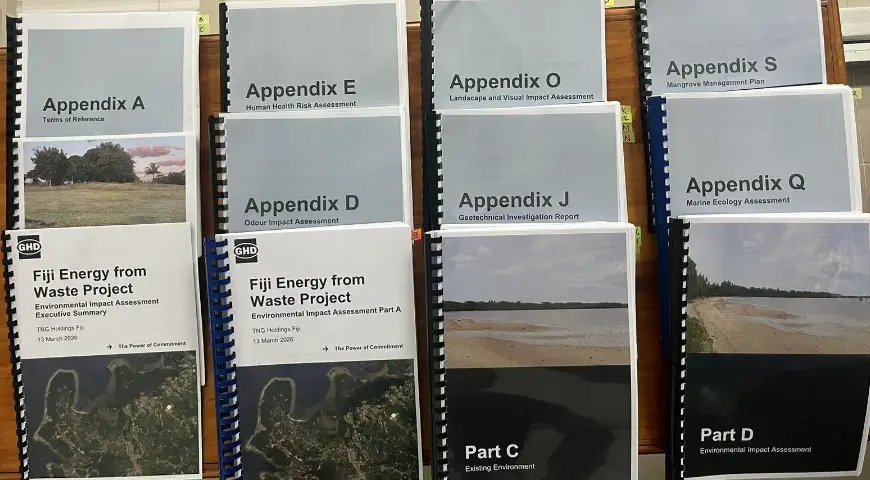
EIA for the proposed waste-to-energy project in Vuda Point (Saweni), Fiji, spearheaded by Australian businessman Ian Malouf and The Next Generation Fiji Pte Ltd, is currently under review, sparking significant debate and opposition as of March 2026.
A leading local nature conservation organisation has warned Fiji is “at least a generation away” from being ready to regulate and manage the proposed $1.4 billion waste-to-energy incinerator project at Naikorokoro Point in Vuda.
NatureFiji-MareqetiViti director Nunia Thomas-Moko said weak regulation, outdated legislation and years of poor enforcement placed Fiji at serious risk if the project proceeds.
“Someone has to tell some hard truths about where we are as a country,” Ms Thomas-Moko said.
Related stories
“Yes, we have a major household waste crisis in a number of parts of Fiji, but if the Vuda-Saweni proposal is given the go-ahead, there is no way that a $1.4 billion project can be properly regulated with what we have at the moment or in the short and medium term.”
TNG Fiji’s published timeline proposes site development to begin by the end of this year, with full operations planned for 2029.
The project aims to process up to 900,000 tonnes of household waste annually at an 85-hectare industrial park with a new deepwater port.
“If we’re not honest about our capabilities, all that will happen is that we will end up with two crises on our hands instead of one,” Ms Thomas-Moko said.
In an eight-page objection letter submitted to the Department of Environment on April 21, NatureFiji-MareqetiViti cited the controversial 12-megawatt Nabou biomass plant as an example of Fiji’s regulatory failures.
“Nabou received full Environmental Impact Assessment approval from the Government and opened in July 2017,” Ms Thomas-Moko said.
“Nabou was promoted as a sustainable green energy project providing baseload power to the national grid, just like the proposed Naikorokoro Point development.
“But the project never secured a sustainable source of biomass feedstock to keep the plant running throughout the year.”
The organisation claimed the plant now operates at below 10 per cent capacity, “scavenging wood from agricultural areas and tourism sites” without environmental oversight.
“That was a failure of the investors, but it was also a failure of several Government agencies and the lack of recognition of such a critical issue in the EIA process,” Ms Thomas-Moko said.
“Someone should have said ‘No’ to the investors and local political connections.”
NatureFiji-MareqetiViti also raised concerns that TNG Fiji’s Environmental Impact Assessment submissions contained no information about projected or confirmed waste supply agreements.
If approved, the Naikorokoro Point development would become the largest waste-to-energy incinerator in the Southern Hemisphere and more than twice the size of the largest facility in Australia.
TNG Fiji plans to supply 80 megawatts of baseload power into Energy Fiji Limited’s national grid.
“The Permanent Secretary of the Ministry of Environment and Climate Change has NFMV’s full support,” Ms Thomas-Moko said.
“Since 2023, his ministry has had a hard-working team doing important work. But it feels like we are at least a generation away from being empowered enough to impose controls and make demands of developers of a project of this size and complexity within a properly structured regulatory framework.”
“If we don’t get this right at the beginning, it will be the project developers who are giving orders and making demands on the Government.”
Ms Thomas-Moko said Fiji continued to struggle with basic environmental compliance issues involving utilities and major industries.
“Anyone who knows anything about Fiji knows we still have repeated basic issues with the country’s utilities and major industries, which again and again seem to operate as if they do not need to care about government rules on the environment, waste and pollution,” she said.
“We can’t even fix these simple things and now we’re expected to regulate this?”
Public consultations on the Environmental Impact Assessment for the proposed Vuda-Saweni waste-to-energy project closed on April 22.
More than 1500 pages of submissions from TNG Fiji Pte Ltd, community groups and stakeholders are now being reviewed by a taskforce appointed by the Ministry of Environment and Climate Change.