50 Years of Friendship with Limitless Future Possibilities!
Over the years, Indonesia has invested significantly in its rural areas to stimulate growth, create opportunities, and nearly eradicate extreme poverty.
Monday 17 June 2024 | 15:53
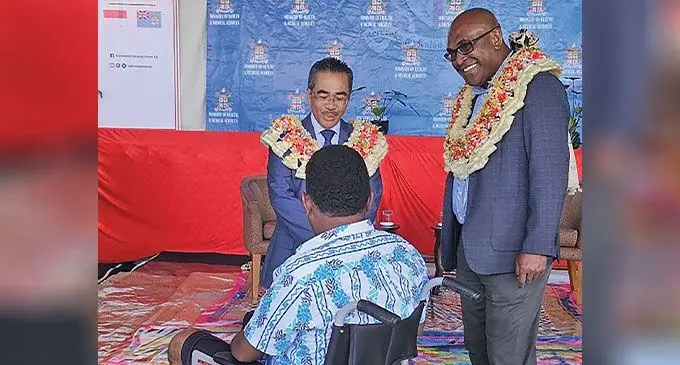
Indonesian Ambassador to Fiji, Dupito Simamora presenting the equipment to Health Minister Dr. Atonio Lalabalavu.
Indonesia and Fiji have enjoyed fifty years of friendship and diplomatic relations, and we have achieved much together in the last fifty years.
When Indonesia donated FJD 400,000 worth of medical equipment as part of the COVID-19 recovery grant for rural Fijians, it had a very carefully thought-out strategic basis around it.
The equipment includes electric hospital beds, electric wheelchairs, examination tables, medicine trolleys, and emergency trolleys.
Related stories
Over the years, Indonesia has invested significantly in its rural areas to stimulate growth, create opportunities, and nearly eradicate extreme poverty.
These are results that Fiji could emulate with collaboration with Indonesia.
You see, rural and maritime areas have tremendous potential almost anywhere you go, but, though nobody’s fault, some are not given enough attention and resources.
Therefore, empowering rural people is the best way to harness the tremendous potential that exists and, of course, incentivizes people to stay in (and even move to) rural areas because of the services and opportunities that we create.
Therefore, when the medical equipment was handed over to Fijian health officials to be used in health centres and medical facilities in rural and maritime areas of Fiji, the long-term vision was to empower
Take Indonesia’s vibrant rural population, for example.
As per 2022 data, 42% of the Indonesian population is rural.
The Indonesian government invests heavily in our rural population, particularly in the agricultural and health sectors, to empower them.
As a result, they have formed the backbone of Indonesia’s economy, helping us gain the status of a global leader in agriculture.
New crops can be explored, markets can be opened up in Indonesia and beyond, and existing crops can be grown more effectively if the two countries share knowledge, and expertise and undertake capacity building.
Indonesia, Southeast Asia’s largest economy, has rapidly developed into a decentralized democracy with a rapidly growing middle class in the last decade.
The country has become the tech and agricultural hub of the region.
The World Bank has stated that “the Indonesian government’s goal to eliminate extreme poverty by 2024 is basically met.”
These goals did not appear out of thin air but rather were the result of careful and well-planned-out strategies stemming from Indonesia’s 2005–2025 national development plan.
These are areas where Fiji and Indonesia have the opportunity to collaborate, boosting multiple industries and tackling poverty.
Empowering rural Fiji can not only stem the tide but reverse rural-to-urban drift because of the incredible opportunities that can be realized with agriculture, especially for Fiji with such fertile and lush land.
Fifty years ago, our two countries first established diplomatic ties, and if fifty years of friendship have shown us one thing, it is that we share many core values and beliefs.
Prosperity for all our people, for example, is something that forms the basis of government in most countries.World peace is another goal that we share, with Fiji’s Prime Minister, Honourable Sitiveni Rabuka, recently calling for the Pacific Ocean to be an ocean of peace—a sentiment we wholeheartedly agree with.
Both Fiji and Indonesia are ardent activists in the fight against climate change, and we have both felt the impact of the increase in intensity and frequency of climate-related natural disasters.
Our shared goals, beliefs, and first-hand experience of the dangers of the climate crisis bring us closer together, and the opportunity exists for further and deeper collaboration.
Indonesia envisions a future where Fiji is self-sustainable and truly independent, capable of driving its own development and growth.
This vision focuses on building capacity in key sectors such as agriculture, health, and technology.
By empowering Fiji through strategic investments and knowledge transfer in these areas, Indonesia hopes to help Fiji achieve long-term sustainability and economic resilience.
Testament is the medical equipment that was given to Fiji as part of the COVID-19 recovery grant and the Indonesian team that flew over to conduct extensive training on its usage for Fijian medical professionals.
It’s about more than just donating equipment; it’s about ensuring efficacy by providing local experts with the knowledge and skills they need.
Simply supplying resources is insufficient if it makes them dependent or unable to use the equipment efficiently.
Comprehensive training and capacity building, as well as material support, are required for sustainable growth.
Disaster risk management and response are also areas where Indonesia has already assisted Fiji, particularly after tropical cyclone Winston devastated the country.
A USD 1.9 million grant was given to rebuild the Queen Victoria School, which had its dormitories and classrooms heavily damaged.
But more than that, Indonesia is also a powerful voice alongside Fiji, advocating for immediate action to be taken to address the current crisis, and opportunities exist in this space for collaboration.
We must, after all, unite against climate change.
Further, the two countries can strongly collaborate on disaster response and, of course, preparedness, making capacity-building and direct support opportunities worth exploring.All in all, we have had a great fifty years, from the first contact in 1974 to the official opening of our embassy in 2002 in Fiji and the opening of the Fijian embassy in 2011 in Indonesia.
This serves as a strong foundation of mutual respect, trust, and a relationship that has limitless possibilities to grow.
Source: SUPPLIED