Buakonikai Primary Adopts Solar Power
“Science was one of the hardest subjects to teach without textbooks, but now with smart TV and internet access, students can visualise what they’re learning,” she said.
Thursday 27 February 2025 | 14:45

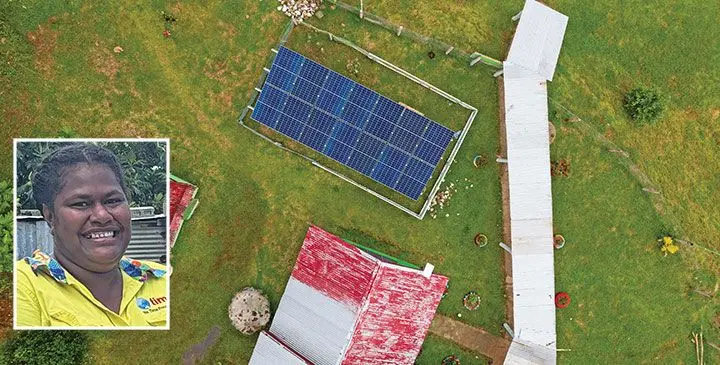
Solar power installed on Buakonikai Primary School on Rabi Island. Inset: Vasiti Talakubu, a licensed electrician specialising in installing solar and renewable energy.
Buakonikai Primary School on Rabi Island has become the first school in Fiji to benefit from a two-year off-grid renewable energy partnership, marking an early International Women’s Day celebration.
The project, funded through the Australian government’s Pacific Climate Infrastructure Financing Partnership (PCIFP) under the Australian Infrastructure Financing Facility for the Pacific (AIFFP), was facilitated by Its Time Foundation and aims to provide sustainable solar energy solutions for remote Fijian schools.
Education through solar power
Related stories
Since its establishment, the school faced challenges due to the absence of electricity, making it difficult for teachers to print worksheets, send emails, or access online resources from the Ministry of Education. Students had to rely on outdated textbooks, limiting their exposure to modern learning tools.
With the installation of a solar-powered energy system last November, the school’s four female teachers and 101 students now have access to electricity, modern education tools, and the internet for the first time.
Firsthand experiences
Head teacher Katarina Tubekoro highlighted that the provision of lights and internet access has significantly enhanced students’ digital learning experiences.
“Before, our students had to imagine what the world looked like, but now we can show them real-life science experiments, documentaries, and interactive lessons,” she said.
Teacher Margaret Corrie, originally from Rabi, shared how the project has revolutionised science education.
“Science was one of the hardest subjects to teach without textbooks, but now with smart TV and internet access, students can visualise what they’re learning,” she said.
“The first time they saw a digital television, they were amazed. Now, they don’t want to leave school because they’re eager to learn,” Ms Corrie said.
Women pioneering renewable energy
The success of this project is driven by women like Vasiti Talakubu, a licensed electrician specialising in solar and renewable energy. For over a decade, she has been installing solar systems in remote villages, bringing clean energy to schools, homes, and businesses.
“I grew up watching most of the girls in my class become teachers or nurses, but I wanted to do something different. I wanted to prove that women belong in this field too,” Ms Talakubu said.
About the project
The AIFFP, through PCIFP, has committed AUD75 million to renewable energy projects across the Pacific, ensuring sustainable, long-term access to power for schools, businesses, and households.
Feedback: shratikan@fijisun.com.fj