Coup actors face scrutiny under RFMF immunity removal proposal
Political leaders and commentators welcome accountability proposal.
Friday 03 July 2026 | 10:30
Updated 03 July 2026 | 15:49 FJT
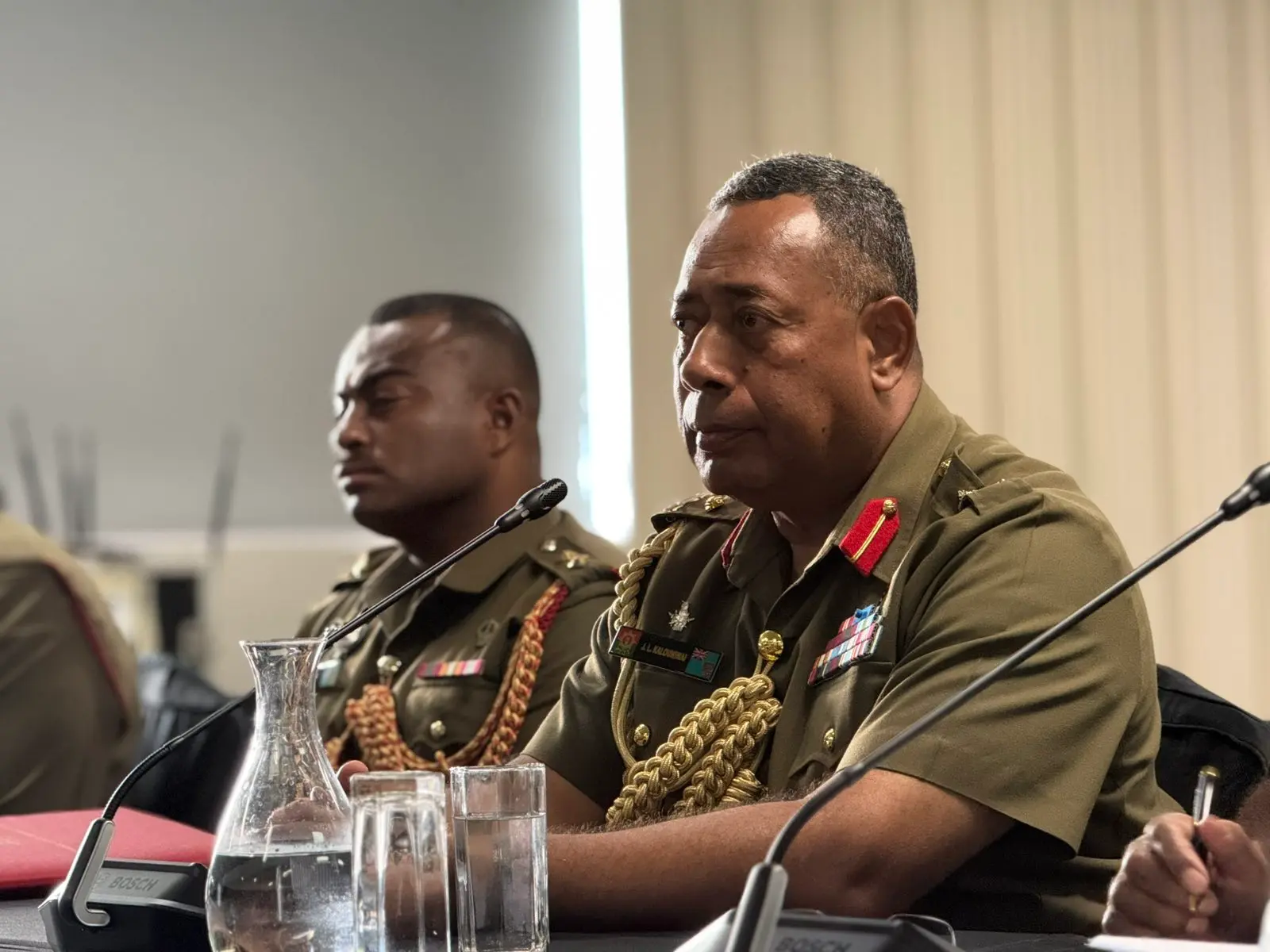
Republic of Fiji Military Forces Commander Major General Ro Jone Kalouniwai addressing the Constitutional Review Commission panel in Suva on July 2, 2026.
Photo: Sosiveta Korobiau
For the first time in Fiji's modern constitutional history, the Republic of Fiji Military Forces (RFMF) has proposed removing the immunity clause that has long protected individuals involved in the nation's coups.
The submission to the Constitutional Review Commission (CRC) marks a significant shift by an institution historically linked to political intervention.
RFMF Commander Major General Ro Jone Kalouniwai told the commission the current constitutional provisions create a "two-tier legal system" by shielding powerful actors from accountability while denying justice to others.
Related stories
He acknowledged the military's role in Fiji's political upheavals, saying the institution must also be prepared to face the consequences of reform.
If adopted, the proposal could open the door to legal scrutiny of events linked to the 1987, 2000 and 2006 coups, including the actions of military personnel, political leaders and other state actors.
Prime Minister Sitiveni Rabuka, who has publicly acknowledged his role in the two military coups of 1987, declined to comment directly on the RFMF submission.
"Nobody should comment on recommendations made to the CRC," Mr Rabuka said, reiterating earlier comments that there would be no political interference.
Mr Rabuka said the constitutional review process was a national movement reflecting the will, aspirations and diversity of Fiji's people.
Chapter 10 of the 2013 Constitution provides legal immunity to those involved in the 1987 and 2006 coups.
"We come before this commission carrying the weight of our own history. The systemic institutionalised pattern of political instability that has fractured this nation since 1987 was not merely witnessed by the Republic of Fiji Military Forces. At points, it was built and maintained by our own hands," Major General Kalouniwai said.
He said the RFMF was voluntarily stepping away from legal protections that had shielded the institution for decades.
He acknowledged the move could expose soldiers and officers to legal consequences but said Fiji's future depended on confronting its past.
"We know this will be seen by some of our own as a breach of loyalty, and that seeking this redemption places officers and soldiers, including our own, at legal risk.
"But the survival of any single institution can no longer be purchased at the expense of this nation's soul."
Calls for accountability
The proposal has received support from political commentators and party leaders, who say it represents a shift from constitutional immunity to accountability.
Dialogue Fiji executive director Nilesh Lal said the proposal could fundamentally change how responsibility for Fiji's political crises is addressed.
"This would mean that everyone connected with the political events of 1987, 2000 and 2006 could have to bear legal responsibility," he said.
"Politically, the incumbent Prime Minister has been protected under the immunity clauses in the 1990 Constitution preserved by the 2013 Constitution. So, the current PM will also become exposed to prosecution for his role in the 1987 coup. Similarly, military, police and other personnel could also become exposed."
Unity Fiji leader Savenaca Narube welcomed the submission, describing it as a "groundbreaking statement" that could strengthen the rule of law.
Mr Narube said the Commander's position was particularly significant because it came from an institution historically viewed as a source of political instability.
"Coming from the potential source of instability, that gives us a lot of comfort that there is stability," he said.
Fiji Labour Party leader Mahendra Chaudhry also expressed support for the submission.
Leader of the Opposition and People First Party leader Inia Seruiratu endorsed the RFMF proposal.
"Enough is enough and Fiji must move on. Remove the immunity clause, empower the current Truth and Reconciliation Commission, only then can politicians be made accountable for their actions that bring instability to this country in the past," Mr Seruiratu said.
The military's recommendations also include abolishing or strictly limiting blanket immunity clauses, reforming national security laws and introducing wider constitutional changes.
The RFMF has also proposed a United Nations-principled truth and reconciliation process to address decades of political division and institutional silence.
It supports constitutional reforms that would guarantee civilian supremacy, clearly define the military's role and remove legal ambiguity that has historically enabled military intervention in civilian affairs.
"We envision a Fiji where the RFMF is a symbol of humble service rather than a shadow of intervention."