Dreketi River & Estuary Shark And Ray Report Launched
WWF, the Ministry of Environment and other stakeholders will today launch its Dreketi River and Estuary Shark and Ray Survey report.
Tuesday 08 June 2021 | 06:30
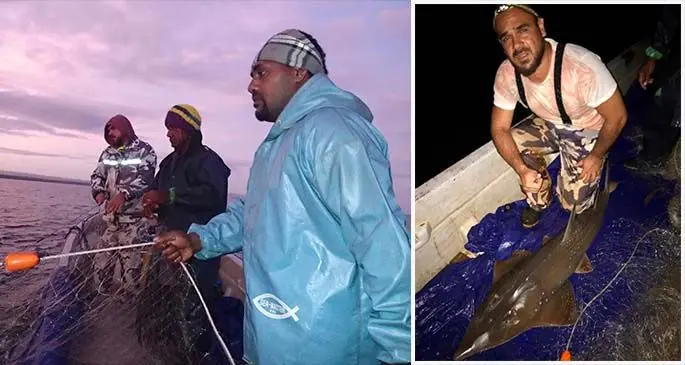
Left: Deploying the gill nets in the estuary of the Dreketi River. Pictured is community rep Solomone Tuqara. Right: A bottlenose wedgefish listed as Critically Endangered on the IUCN red list is caught by the mangroves at the mouth of the Dreketi River. Photos: WWF-Pacific
WWF, the Ministry of Environment and other stakeholders will today launch its Dreketi River and Estuary Shark and Ray Survey report.
With today being the World Oceans Day and this year’s theme, The Ocean: Life and Livelihoods, the WWF report provides a snapshot of the species of sharks and rays found within and around Fiji’s deepest river.
According to the WWF report, four species of shark – including the scalloped hammerhead (Sphyrna lewini), the blacktip (Carcharhinus limbatus), the great hammerhead (Sphyrna mokarran), and the bullshark (Carcharhinus leucas) and three species of ray; namely the ocellated eagle ray (Aetobatus ocellatus), pink whipray (Pateobatus fai) and bottlenose wedgefish (Rhynchobatus australiae), were found in and around the Dreketi river and estuary during a twenty day survey conducted in 2020 by
Related stories
Andrew Paris, a Masters student at the University of the South Pacific.
The great hammerhead shark, the scalloped hammerhead shark and the bottlenose wedgefish are listed on the IUCN Red List of Threatened Species as Critically Endangered.
The bull shark and blacktip shark are listed as Near Threatened with the ocellated eagle ray and the pink whipray listed as Vulnerable.
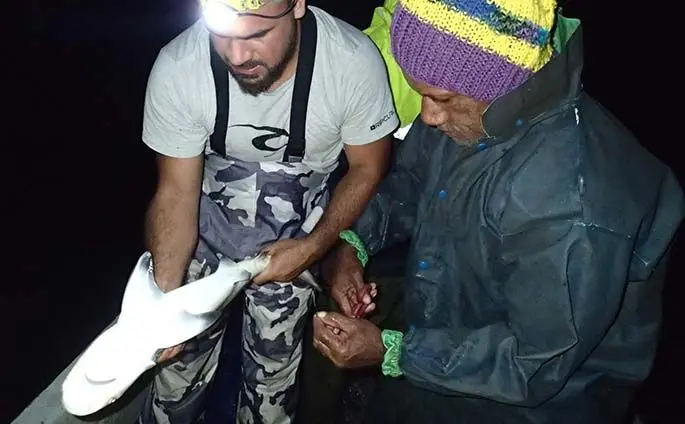
Researcher Andrew Paris with community rep Tomasi Bula through obtaining a fin clip for DNA analysis to explain how to identify the presence/absence of claspers which determine sex for a blacktip shark. Photo: WWF-Pacific / Opeti Vateitei.
“In 2016, Fiji also made history by becoming the first Pacific Island country to propose global trade restrictions on sharks and rays to ensure their survival and in doing so silky sharks, all three species of thresher sharks and nine species of mobula rays were listed in Appendix II of CITES after a series of landslide votes at the 17th CITES Conference of Parties in Johannesburg, South Africa,” Wycliffe said.
The Permanent Secretary further stated that the Ministry of Environment has continuously ensured through its EIA process that during the breeding seasons the breeding habitats of these sharks in Fijian waters are not disturbed and protected.
“Activities such as gravel extraction is not allowed during the breeding season.”
According to WWF, the report is timely given that global shark populations are rapidly declining.
Insufficient species-specific data continues to thwart global efforts to manage sharks and rays.
“It is important that we have adequate data to assist fisheries and environmental managers, communities, and other stakeholders to effectively protect these species. The findings of this report will provide much needed data to support on-going conservation and management efforts. We recognise that
more surveys need to be conducted in other riverine areas in Fiji due to the role of these critical habitats
in the life cycle of sharks and rays,” highlighted Vilisoni Tarabe, WWF-Pacific’s Fisheries Policy Officer.
The survey was implemented by WWF-Pacific and funded by the Mario Ferring Foundation through WWF-International and WWF-Netherlands, the Packard Foundation and the Secretariat of the Pacific Regional Environment Programme (SPREP) through the Pacific Ecosystems-based Adaptation to Climate
Change (PEBACC) project that is implemented by WWF-Pacific with close collaboration and support from the Ministry of Environment, Ministry of iTaukei Affairs and the Ministry of Fisheries.
Research provided by Dr Helen Sykes in 2018 highlighted that Fiji is home to at least 30 coastal and oceanic shark species with a quarter of these listed on the Convention on International Trade in Endangered Species of Wild Fauna and Flora (CITES) and the Convention on the Conservation of
Migratory Species of Wild Animals (CMS)2 .
About Us
WWF
WWF is one of the world's largest and most respected independent conservation organizations, with over 5 million supporters and a global network active in over 100 countries.
WWF's mission is to stop the degradation of the earth's natural environment and to build a future in which humans live in harmony with nature, by conserving the world's biological diversity, ensuring that the use of renewable natural resources is sustainable, and promoting the reduction of pollution and wasteful consumption.
More information: panda.org