Fighting NCDs starts in schools: Assistant Health Minister
Delegates at the Pacific School Food Talanoa heard calls for healthier school food environments and a return to traditional food systems to combat rising NCD rates.
Tuesday 02 June 2026 | 13:00
Updated 02 June 2026 | 14:04 FJT

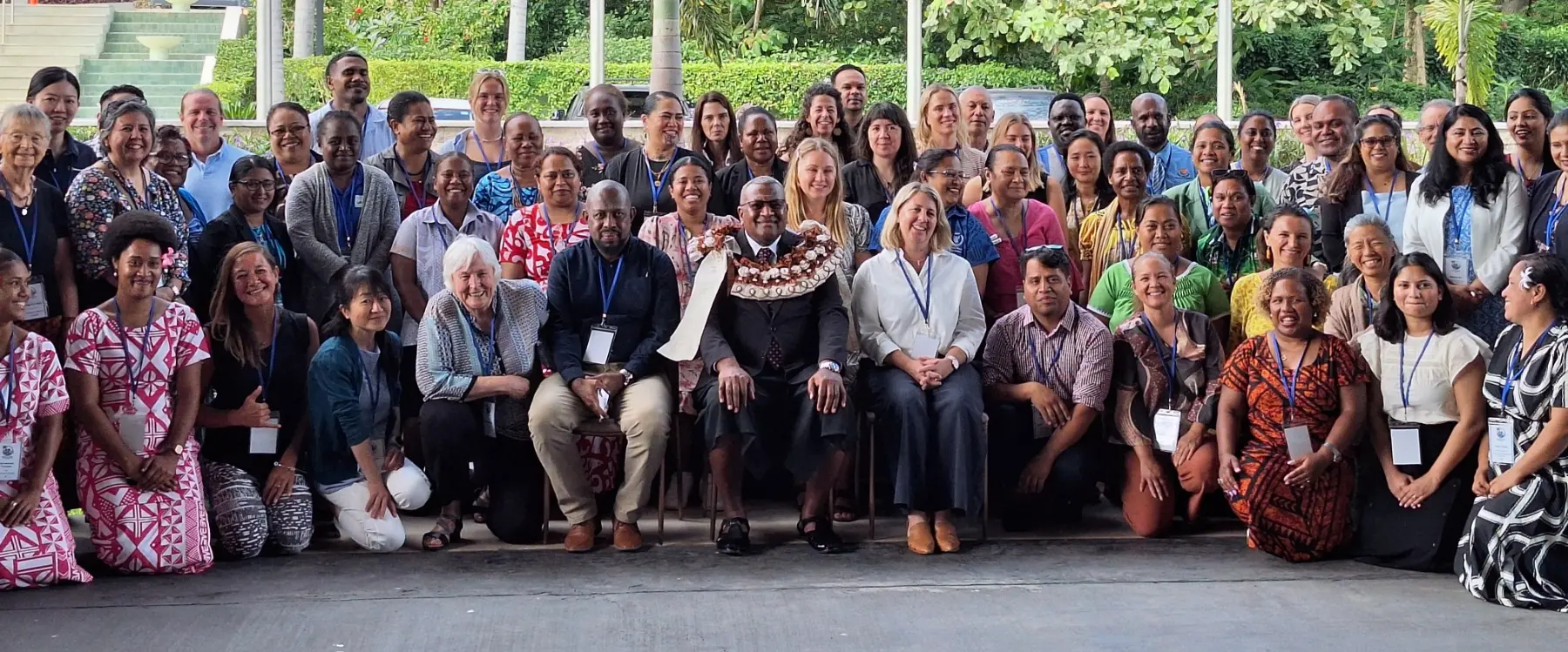
(Sitting from left) Pacific School Food Network Papua New Guinea country lead Lazarus Dawa, Assistant Minister for Health and Medical Services Penioni Ravunawa, Pacific School Food Network chair Sarah Burkhart, with the participants and delegates at the Pacific School Food Talanoa in Nadi.
Photo: Katherine Naidu
Schools must become the frontline in the Pacific's fight against non-communicable diseases (NCDs) as obesity, diabetes, heart disease and hypertension continue to affect people at increasingly younger ages.
Assistant Minister for Health and Medical Services Penioni Ravunawa delivered the message while opening the first Pacific School Food Talanoa at the Crowne Plaza Fiji Nadi Bay Resort and Spa in Wailoaloa, Nadi, today.
Mr Ravunawa said unhealthy eating habits often begin in childhood, making schools critical to efforts to reverse the region's growing NCD crisis.
Related stories
"We face a growing crisis, which is well known to all of us, non-communicable diseases, which continue to place a heavy burden on our communities and our health systems," he said.
"Obesity, diabetes, heart disease and hypertension are affecting our people at increasingly young ages. They are a leading cause of premature death and family tragedy in our communities."
He said meaningful change would require governments, schools, parents, farmers, food producers and development partners to work together to create healthier food environments for children.
"The reality is that many unhealthy dietary habits begin in childhood and often continue throughout a lifetime.
"If we are serious about changing the future of health in the Pacific, then we must begin where our children learn, grow and develop lifelong habits, and that is in our schools," he said.
Mr Ravunawa said schools play a role far beyond education and can help shape healthier futures for Pacific communities.
"Every healthy meal served, every healthy choice encouraged, and every positive environment created is an investment in stronger, healthier and more resilient Pacific nations," he said.
He also called on countries to draw on traditional food systems to tackle modern health challenges.
"Our ancestors understood the value of healthy local foods. They nurtured food systems that sustained families, strengthened communities and protected their well-being.
"The wisdom of our traditional food systems remains one of our greatest assets as we seek solutions to today's challenges," he said.
Pacific School Food Network chair Sarah Burkhart said the gathering provided an opportunity for countries and organisations to share ideas and strengthen regional action.
"At the moment, we are looking at how we translate and evolve to be more Pacific-led and driven," Ms Burkhart said.
"The network does not intend to duplicate what is happening around the region, so we are excited to bring everyone together to share what they are working on and discuss how we can support those efforts."
The three-day talanoa has brought together policymakers, researchers, educators, development partners and practitioners from across the Pacific to strengthen healthy, resilient and culturally grounded school food environments.
The Pacific School Food Talanoa aims to place Pacific nations at the centre of efforts to improve school food systems by bringing together regional stakeholders to share experiences, forge partnerships and develop a Pacific-driven action plan.
Guided by the Talanoa approach, the gathering provides a platform for Pacific communities, governments and partners to shape and lead school food initiatives that reflect local priorities and cultural values.