Fiji collaborates with Japan on Geohazards
“Our partnership has been a cornerstone of Fiji’s efforts to mitigate the impact of natural hazards and adapt to the challenges posed by climate change,” he said.
Saturday 19 October 2024 | 15:35

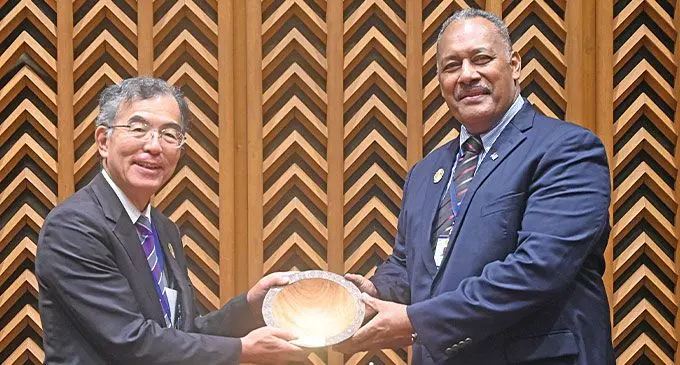
Minister for Rural and Maritime Development and Disaster Management, Sakiasi Ditoka (right) hands over a token gift to Japan’s Vice Minister for Policy Coordination Hara Hiroaki following their bilateral meeting, held at the margins of the Asia Pacific Ministerial Conference on Disaster Risk Reduction (APMCDRR) presently underway in Manila, Philippines. Photo: Ministry of Rural and Maritime Development and Disaster Management
Fiji will be participating in the Asian Disaster Reduction Centre (ADRC) in Japan to strengthen its regional collaboration in disaster management.
Minister for Rural and Maritime Development and Disaster Management Sakiasi Ditoka made the statement in the bilateral meeting held at the margins of the Asia Pacific Ministerial Conference on Disaster Risk Reduction (APMCDRR) in Manila, Philippines on Thursday.
“We are especially grateful to the Government of Japan for its support in facilitating Fiji’s participation in the ADRC,” he said.
Related stories
“Which has opened new doors for capacity building, knowledge sharing, and the exchange of best practices that will undoubtedly enhance our disaster risk management efforts.”
Mr Ditoka had expressed gratitude to the Government of Japan and Japanese International Cooperation Agency (JICA) for their commitment to strengthen disaster risk management and resilience in Fiji over the years.
“Our partnership has been a cornerstone of Fiji’s efforts to mitigate the impact of natural hazards and adapt to the challenges posed by climate change,” he said.
“The invaluable lessons we have drawn from Japan’s extensive risk management have significantly shaped our approach.”
Mr Ditoka said Fiji has been able to strengthen its disaster risk management systems and better safeguard its communities through the technical assistance and financial support from the Japanese Government and JICA.
“The Memorandum of Cooperation for the Early Warning Satellite System (EWSS) using Japan’s Quasi-Zenith Satellite System (QZSS), signed earlier this year represents a groundbreaking step forward,” he said.
“This collaboration with Japan’s National Space Policy Secretariat is set to transform Fiji’s early warning systems for tsunamis and other hazards, enabling us to respond more swiftly and effectively to emergencies, thus safeguarding our communities from future disasters.”
Mr Ditoka had also acknowledged the ongoing collaboration between the government of Japan and Fiji regarding geohazards based disaster.
Geohazards are associated with potentially destructive processes such as vulcanism, earthquakes, tsunamis, landslides and floods.
The term would also encompass the presence of strong rocks and duricrusts, or insidious soil conditions such as acid sulfates and even sulfate- reducing bacteria.
“The Mainstreaming Disaster Risk Reduction (DRR) Project which was initiated with JICA’s support and has enhanced Fiji’s capacity to integrate disaster risk reduction into both national and local planning frameworks,” he said.
“This initiative has empowered the National Disaster Management Office (NDMO) to improve hazard assessments and promote investments in disaster resilience, particularly within our most vulnerable communities.”
Feedback: ioane.asioli@fijisun.com.fj