Gift of sight brings hope to 73 Fijians
For 10 days, a team of specialist medical professionals worked at Labasa Hospital, restoring sight and transforming lives through cataract and laser surgeries. The programme concluded last Friday.
Sunday 31 May 2026 | 15:30
Updated 31 May 2026 | 16:30 FJT
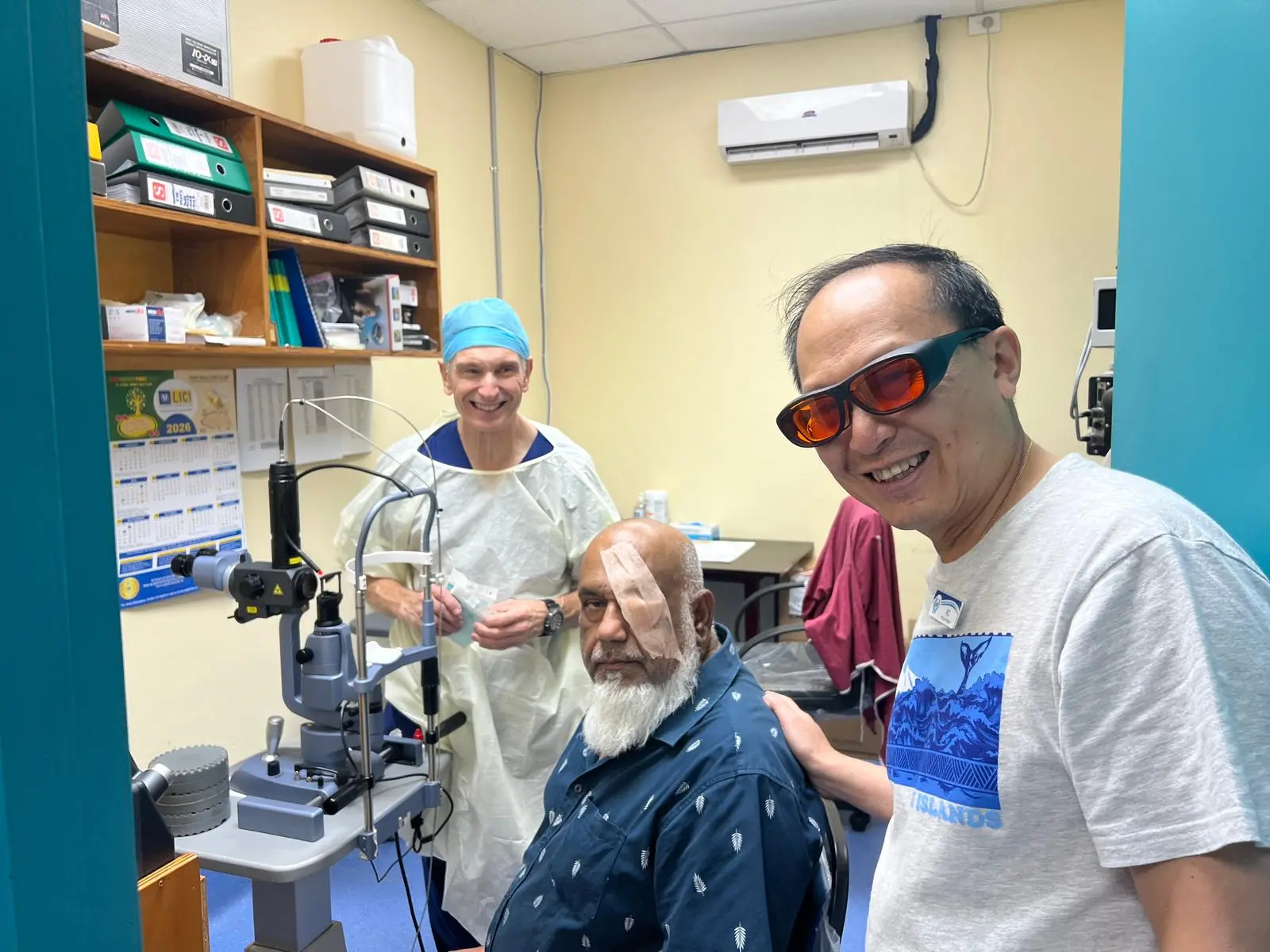
The medical team from The Fiji Eye Project Incorporation assisting patients at Labasa Hospital on May 27, 2026.
Photo: Supplied
For 70-year-old Narayan Mudaliar, seeing his wife's face clearly again after 35 years was a moment he thought would never come.
Mr Mudaliar was among 73 Fijians who received free eye surgeries through a programme organised by The Fiji Eye Project Incorporation, an Australian-based non-government organisation.
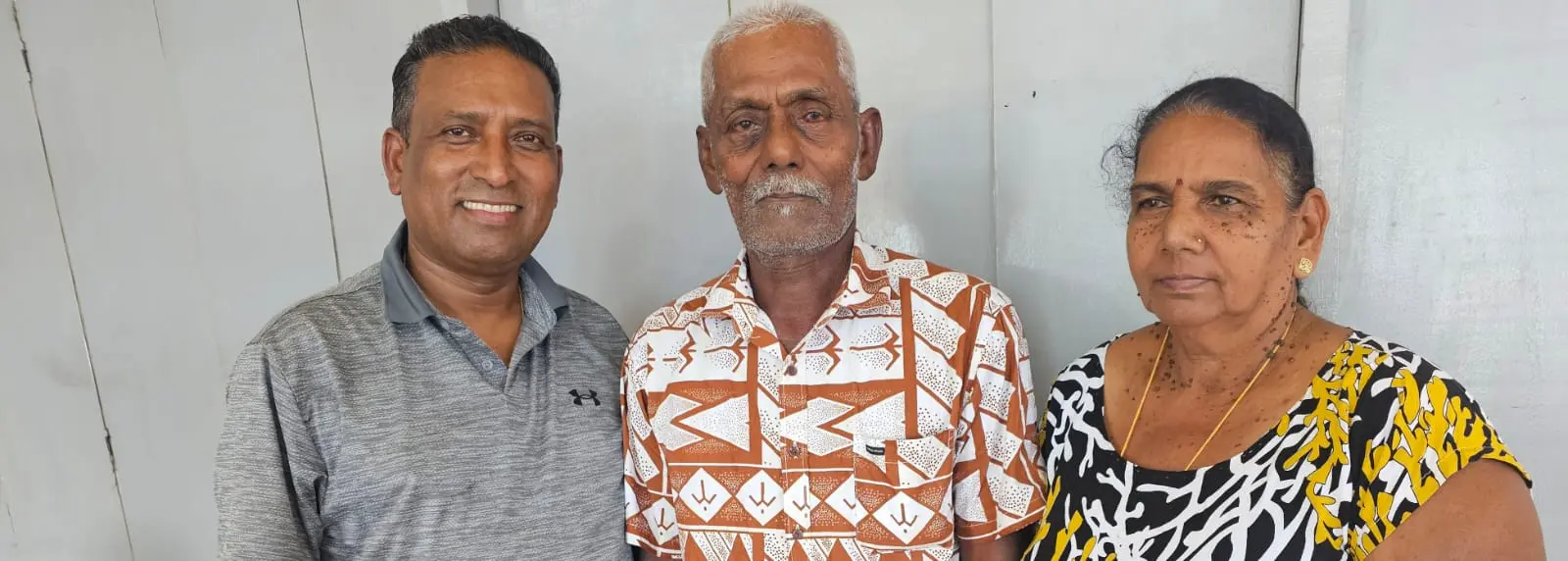
The Fiji Eye Project Incorporation executive director Mike Kumar, Narayan Mudaliar with his wife Lakshmi Mudaliar in Labasa Hospital on May 29, 2026.
Photo: Supplied
Related stories
For 10 days, a team of specialist medical professionals worked at Labasa Hospital, restoring sight and transforming lives through cataract and laser surgeries. The programme concluded last Friday.
The Fiji Eye Project Incorporation executive director Mike Kumar said the organisation first conducted free eye surgeries on 50 patients at Labasa Hospital last year. Following the programme's success, the team returned this year and increased the number of patients treated to 73.
Among them was a six-year-old child.
Mr Kumar said the achievement reflected the dedication of a highly skilled medical team led by medical director and vitreo-retinal surgeon Dr Jay Chandra.
The team also included paediatric ophthalmologist Dr Jeremy Smith, ophthalmologist Dr Tang, registrar Dr Christopher Shafiq, two anaesthetists, seven nurses, two orthoptists, a medical intern, a biomedical engineer and support staff.
“We were also privileged to welcome members of our leadership team to Labasa such as our board chair, Michael Edwards and director, Brian Jago who spent two days on-site to physically experience the mission work,” Mr Kumar said.
“Seeing the operations firsthand deeply connected our governance with the reality of our clinical impact.”
A mission that began with service
The project's roots trace back to the Sydney Hindi Uniting Church faith community in St Clair, New South Wales.
Mr Kumar said the organisation's overseas mission work began in Fiji in 2006 at Ba Hospital before moving to Lautoka Hospital, where surgeries continued until 2019.
“This early chapter of our journey was made possible through the generous 10-year sponsorship of Uniting World, an agency of the Uniting Church Australia,” Mr Kumar said.
“We remain deeply grateful for their foundational support. We are also grateful for the ongoing support of Wesley Uniting Church, Castle Hill.
“The year 2019 was a milestone of evolution for us.”
That year, the organisation officially registered as The Fiji Eye Project Inc. with the Australian Charities and Not-for-profits Commission and obtained Deductible Gift Recipient status.
Like many humanitarian initiatives, the project was forced to pause during the COVID-19 pandemic from 2019 to 2024.
However, the team remained committed to returning.
“In 2024, we proudly returned to Fiji, shifting our focus to the Northern Island to serve the community of Labasa,” Mr Kumar said.
“The profound gratitude of our patients and the visible impact of restored vision remind us exactly why we do this work.”
He said the organisation funded its own equipment, medical supplies, airfares, accommodation and meals, with this year's mission costing about $100,000.
Mr Kumar acknowledged the support received in Fiji, including Anand Latchman of Wesley Methodist Church/Westpac Bank Lautoka, Labasa Chamber of Commerce president Vinesh Dayal and his team, Pinto Industries Limited director Pinto, Minister for Multi-Ethnic Affairs Charan Jeath Singh and the Vodafone Festival of the Friendly North committee.
The organisation plans to return next year to continue the programme.
'I can see again'
For Mr Mudaliar, the surgery has been life-changing.
The father of five from Wailevu, Labasa, lost sight in one eye after it was injured by a bamboo stick and later developed cataracts in the other eye.
“My left eye was damaged by a bamboo stick and right eye had cataract; due to this I had to stop working as a sugarcane labourer and stayed home,” Mr Mudaliar said.
“When I opened my eyes, I was so happy to see my wife first and with joy I told her I can start driving taxi around to earn income for the family.”
He said he had sought help from many doctors over the years without success.
“I saw so many doctors requesting them to restore my eye sight in the past but they couldn’t,” he said.
“Life without eyes is full of darkness and pain.”
For Mr Mudaliar and dozens of others, the programme has offered more than medical treatment — it has given them the chance to see, work and live independently again.