Industrial Hemp: The Multi-Billion Dollar Industry
In 2019, Canada earned more than FJD300m from selling products made out of hemp such as fibre, oil, protein and seed.
Monday 13 December 2021 | 10:30
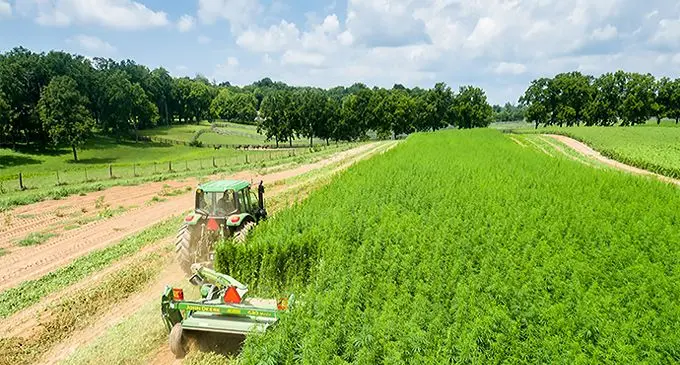
K-State Research and Extension specialists began growing and harvesting small, highly controlled plots of industrial hemp at research facilities around the state in 2019, much like the plot in this file photo from the University of Kentucky. Photo credit: Matt Barton, University of Kentucky Ag Communications
Industrial hemp is a multi-billion dollar industry world over.
On Day 2 of the 23rd Attorney-General’s Conference, industry experts and legal experts weighed in on what are the laws regarding industrial hemp around the world and what are the opportunities countries can explore.
The Law:
Related stories
Xiaohong Li, chief conference support section organized crime and illicit trafficking branch division for treaty affairs UNODC talked about laws governing industrial hemp in a few countries.
Fiji Is Party To Three Conventions:
- Single Convention on Narcotic Drugs of 1961, as amended by its 1972 Protocol (signed 21 Nov 1973)
- Convention on Psychotropic Substances of 1971 (acceded 25 March 1993)
- United Nations Convention against Illicit Traffic in Narcotic Drugs and Psychotropic Substances of 1988 (acceded 25 March 1993)
The three international drug control conventions provide an international regulatory framework applicable to drug control.
States parties to the Conventions, which nearly enjoy universal adherence, are obliged to incorporate treaty requirements into domestic law.
Ms Li reminded lawyers that as a general obligation under the international drug control conventions, States parties are required to take measures to limit the production, manufacture, export, import, distribution of, trade in, use and possession of scheduled drugs and substances exclusively to medical and scientific purposes
Types of Measures Applicable To Drug-Related Activities Include:
Legislative and administrative measures such as licences, permits, inspections, requirements for record-keeping and reporting to designated national authorities regulating licit conduct.
Administrative and criminal law measures (with sanctions proportionate to the offences), to regulate illicit conduct.
Cannabis is one of the drugs controlled under the 1961 Convention.
Article 28(2) expressly excludes the application of the 1961 Convention (and control measures mentioned earlier) to the cultivation of the cannabis plant “for industrial purposes (fibre and seed) or horticultural purposes”
This exemption appears to be in line with the understanding that the psychoactive content in some varieties of the plant cultivated for the fibre and seeds – commonly known as “hemp” - is negligible.
In implementing article 28 of the 1961 Convention, Parties have put in place domestic regulatory measures aimed at ensuring control over THC levels, as well as preventing its abuse of cannabis.
Examples Of Countries Using Cannabis For Industrial Purposes:
- In the European Union, the production of hemp eligible for certain payments to farmers is limited to varieties of hemp with a THC content not exceeding 0.2 per cent.
- Canada and the United States have set the threshold at 0.3 per cent.
- In Australia: THC content is regulated by the various federal states. For example, cultivation of plants with a THC level of greater than 0.35 per cent in Victoria, Western Australia and Tasmania, and greater than 1 per cent in New South Wales and Queensland, without authorisation, is an offence under relevant Australian state drug laws.
- The basis for these threshold amounts is not stated in the relevant instruments establishing them, but may be linked with limits of quantification of applicable analytical methodologies and cost-efficiency.
Ms Li pointed out that: “The ultimate objective of any national drug policy should be to improve peoples’ lives, notably by protecting public health through better and safe access to controlled drugs for medical purposes if cannabis for industrial purposes are well-defined and regulated, including in relation to the maximum THC allowed in cultivated plants, its cultivation and production are outside the scope of those treaties."
“The role of science in researching controlled drugs’ harm and benefits to health is fundamental. UNODC remains available, in our advisory role and technical assistance mandates, to support countries in the implementation of the international drug control treaties to which they are Parties.”
The emerging industrial hemp industry:
Industrial hemp’s use in agriculture was also discussed at the conference.
Doctor Stuart Gordon who is the senior principal research scientist at CSIRO Agriculture and Foods System Program provided a glimpse of how a country like Canada is earning money through this industry.
In 2019, Canada earned more than FJD300m from selling products made out of hemp such as fibre, oil, protein and seed.
USA is a major importer of the Canadian hemp
- Export to South Korea spiked in 2016
- Canadian hemp was exported to 33 countries in 2019
- Export to Australia ranked number 3 in 2019
Feedback: jyotip@fijisun.com.fj