Inside the Women’s Mock Parliament
“Our work involves co-designing location-specific solutions that incorporate green infrastructure, such as constructed wetlands, to enhance the entire water and sanitation cycle.
Thursday 15 August 2024 | 17:31
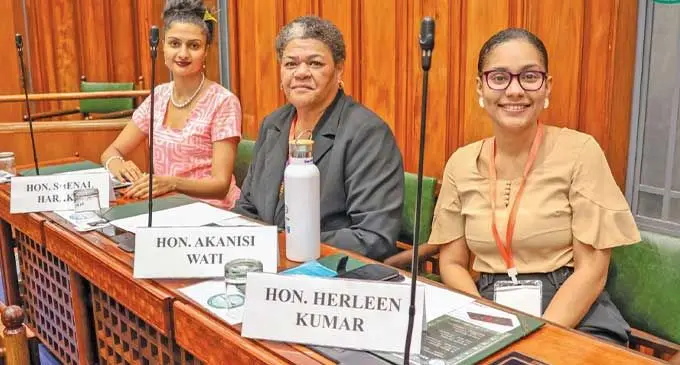
Shenal Harakh, Akanisi Wati, and Herleen Kumar during Rehearsal in the Parliamentary Chamber. Photo: Parliament of the Republic of Fiji
Though it may have been a mock parliament, the ambitions, capabilities, and concerns of the 55 mock parliamentarians were real.
Hailing from across Fiji with mock parliamentarians travelling from as far as Labasa, Koro, and Ovalau, the 2024 Women’s Mock Parliament ended with elation and optimism.
The call for more women in Parliament is not a call to simply equalise the statistics. It is a call to build a House that best serves the needs of the nation.
Related stories
Our first opportunity to meet as a cohort was during the welcome gala dinner held on Sunday, July 28.
Speeches from donor agencies set the tone and understanding of how significant the Mock Parliament was, as well as the scale of planning involved to bring it to life.
It was also here that we made our first impression of each other and the makeup of the group. An impression that would be challenged, moulded, and broken over the next few days.
Day 1 and Day 2 were filled with informational sessions to explain the road to parliament, parliamentary skills, understanding policy-making skills, and exercises to implement our new knowledge and prepare for our third and full day within the Parliament Chamber.
Whilst we were able to choose whether we’d like to be on the Government or Opposition side, the assignment of ministerial portfolios and roles reflected a rather different process bringing to light existing biases, associations, and ways of working.
Day 3 called on our time to shine. The final day of the programme consisted of a full day within the Parliament chambers where we were to speak on one motion out of the three motions regarding improving maternal healthcare funding in rural areas, environmental conservation impacting women, and increasing women’s representation in decision-making.
Even among the 55 mock parliamentarians, the issues raised reflected vastly different experiences of life in Fiji. What may seem like a universal experience, poor maternal healthcare in Fiji, was quickly broken down into specific challenges faced by different women.
Jacinta Renu of Labasa raised the plights of pregnant women around Fiji during her address to Parliament. In areas around Labasa, pregnant women are expected to walk through potholes and roads without toilet facilities on their way to town. Meanwhile, expecting mothers in maritime areas must arrange for travel to maternal health clinics via boat.
Mrs Renu’s strong-willed yet heartfelt speech captured the attention of Lenora Qereqeretabua and Sashi Kiran, who were seated in the gallery alongside Premila Kumar and Lynda Tabuya. Along with viewers of the live stream, it was only on the final day that our group heard from each of the 55 women.
It was here that we broke down our walls, and experienced the humanity behind our speeches and intentions, this was seen in the congratulatory hugs and touching conversations about shared experiences during the breaks between speaking sessions.
My biggest learning from the 2024 Women’s Mock Parliament was that we need to put in the effort to understand each other.
Regardless of our gender, race, or other differences. When we hear each other’s stories we will find that what may appear as women’s issues, are indeed national issues. What may appear as rural issues, are indeed national issues. What may appear as racial issues, are indeed national issues. All in all, every issue is a human issue.
This is why we need more women in parliament, to better serve the entirety of our nation.
I’d like to thank everyone who was involved in bringing the 2024 Women’s Mock Parliament together. It is a much-needed opportunity and platform, and I hope more such initiatives will prevail in the future.
Hear from our Mock Parliamentarians:
Shivashni Dutt
“My name is Shivashni S Dutt. I hail from Labasa, brought up in Vuci South, Nausori and I now live in Samabula, Suva. I am a barrister and solicitor, and the principal of Shivashni Lawyers.
“Fiji Women’s Mock Parliament was very informative and empowering and encouraged me as a woman to do what we can do to change the mindset of our society.
“ It was a dream come true when I was called by the office of the parliament that I was chosen two days before the Mock Parliament 2024 began. It was all God’s plan that I was chosen to be here and I am confident that I will make a difference to my country when I stand for election.
“The three days of Mock Parliament have driven me to be more confident and determined to achieve success in life. I plan to contest the upcoming municipal elections, and hopefully contest the 2026 General Election.”
Losana Derenalagi
“I am Losana Derenalagi from Nawaka Village, Nadi. Mock Parliament was quite interesting, very powerful in terms of the confidence you get after the three days.
“We have learnt a lot about the Parliament and it has boosted us women to enter Parliament and stand in the election.
“We need more women to lead not only in Parliament but in all decision-making bodies, in boards, in committees from the community right up to the national and in Parliament.
“Why do we need women? We make up 50 per cent of the population, we live in the same country and it is not right for men to solely make decisions that affect us all.
“We have to have a say in our country. A bird can’t fly with one wing, it needs both to fly well.
“Our contribution is very important for the development of our nation.”
Raniyah Muhammed
“I am from the City of Suva, where I work as an engagement and safeguards officer for RISE. RISE is a transdisciplinary research programme that operates at the intersections of health, environment, and water and sanitation.
“We are piloting a new water-sensitive approach to water and sanitation management in informal settlements across Makassar, Indonesia, and Suva, Fiji.
“Our work involves co-designing location-specific solutions that incorporate green infrastructure, such as constructed wetlands, to enhance the entire water and sanitation cycle.
“My experience during the mock Parliament was both enriching and rewarding. It provided me with deeper insights into governance and policy-making, and it was an invaluable opportunity to practice parliamentary procedures and understand the intricacies of our political system.
“Addressing the issues that women face was particularly significant for me. This experience has boosted my confidence and solidified my resolve to take the next steps towards a career in politics. Women bring a unique approach to addressing issues, often focusing on collaboration, empathy, and inclusiveness.
“These qualities are crucial for tackling complex societal challenges. The presence of women in leadership roles fosters a more equitable and inclusive democracy, which is something our country greatly needs. Their involvement ensures that diverse perspectives are considered, leading to more comprehensive and effective governance.”
Feedback: editorial@fijisun.com.fj