Kadavu Earthquake: We Felt The Ground & Houses Shake, Kadavu Islanders Tell
This morning’s (yesterday) quake was frightening. A benzene lamp hanging on the post fell. Lucky it was not lit. We use it at night. If the quake had struck at night when the lamp was lit, it would have been a different story. It would have caused a fire.
Monday 21 October 2019 | 10:45
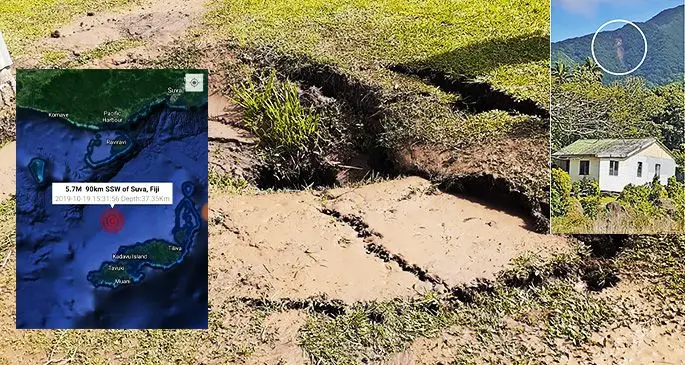
Damage to the ground in Kadavu as a result of the earthquake on October 20, 2019. Inset:A landslide (circled) can be seen on Mt Washington ridge in Kadavu.
Retired school teacher Ruca Senitavu Luvurowaqa is no stranger to earthquakes.
When the ground and her house shook at 8.30am yesterday at Tavuki Village, Kadavu, it reminded her of a similar earthquake that hit the island in the 1990s when she was teaching at Ratu Nacagilevu School.
“This morning’s (yesterday) quake was frightening. A benzene lamp hanging on the post fell. Lucky it was not lit. We use it at night. If the quake had struck at night when the lamp was lit, it would have been a different story. It would have caused a fire,” she said.
Related stories
“Plates and cutlery fell breaking into pieces. It was a scary experience even though it was not as strong as the 1990s quake. That quake caused damages to some schools and forced their closure.”
She said she was preparing breakfast when she could feel the earthquake.
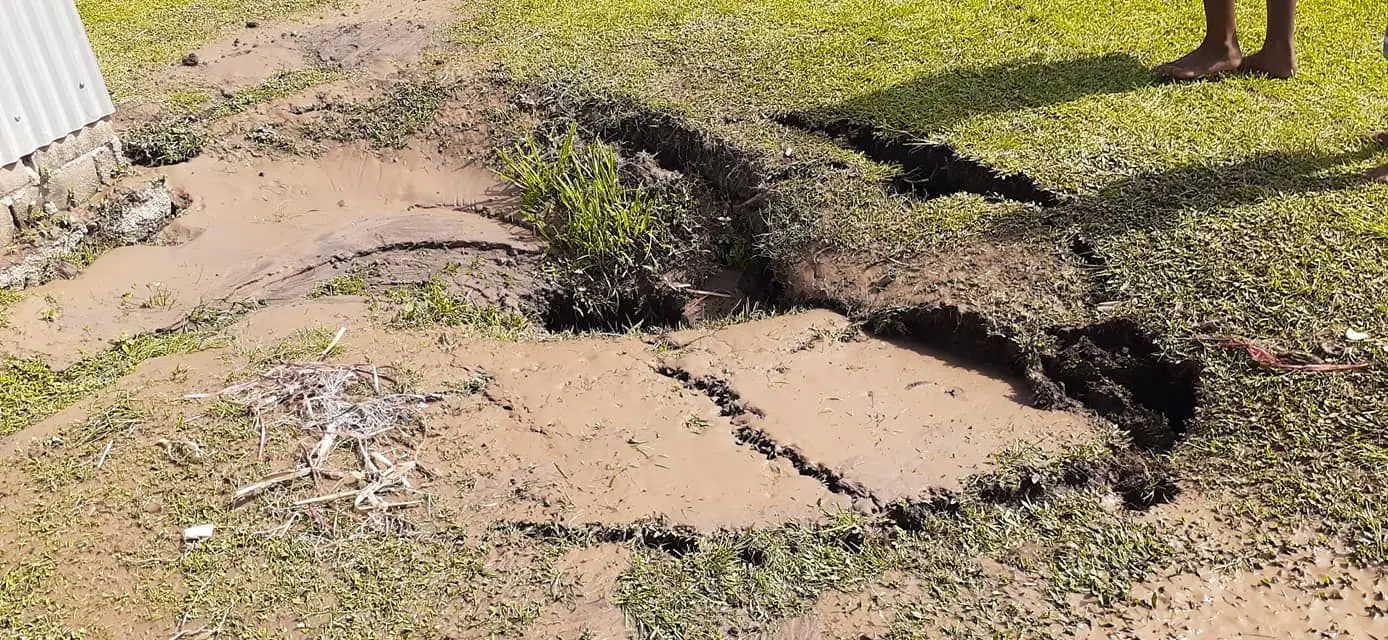
Damage to the ground in Kadavu as a result of the earthquake on October 20, 2019.
Edited by Jonathan Bryce
Feedback: maikab@fijisun.com.fj
Earthquakes in Fiji
Earthquakes occur throughout the world but certain areas are more prone to them than others. Unfortunately, Fiji is within the Pacific Ring of Fire, the zone of earthquakes and volcanoes which surrounds the Pacific Ocean.
Although there are no volcanoes in Fiji and the number of earthquakes is somewhat less than for the most active areas around the Pacific such as Japan, Alaska. Chile and nearby Tonga. Vanuatu and Papua New Guinea, the risk from earthquakes is similar to that in New Zealand, which is relatively high by world standards.
The first known historical earthquake report in Fiji describes an earthquake at Kadavu in about 1850.
It states: “A recent earthquake had been felt throughout the greater part of Feejee, but was so tremendous in Kadavu that the earth opened in several parts and destroyed a great number of people.
“In one part it shook down a large cave and buried thirty or forty women who had taken shelter for the night, having been on a fishing excursion.”
Details of other severe earthquakes, such as those which were reported in 1869 (upper Rewa River), 1884 (Macuata), 1902 (Yasawas). 1919 (Rabi), 1932 (Rabi and Koro). 1953 (Suva). 1979 (Taveuni) and 1998 (Kadavu) are given in the Table and their locations are shown in the earthquake map overleaf.
The Zones of Earthquake Activity Earthquakes occur in several zones which are outlined in the map inset. Offshore activity occurs to the northeast and east of Vanua Levu and Taveuni, north of the Yasawas and Vanua Levu, to the west of Viti Levu and around Kadavu. Southeastern Viti Levu shows activity and another belt of seismicity which is not clear definable possibly extends from near southwestern Vanua Levu through Koro than arcs around to the southwest to south of Kadavu.
The magnitude of the largest earthquake known to have occurred in each zone is given in the table above.
Source: Ministry of Land and Mineral Resources
Feedback: nemani.delaibatiki@fijisun.com.fj
NO TSUNAMI THREAT.
A moderate earthquake of 5.3mb with a shallow depth of 10km source location occurred 26 km NNW from Vunisea, Kadavu this morning at 08:31:57 AM, local time. However, it does not pose any immediate tsunami threat to the region.
THIS IS A FELT EVENT. pic.twitter.com/pEawEoBaBd
— Fiji National Disaster Management Office (@FijiNDMO) October 19, 2019