Prasad open to Cabinet size review
Professor Prasad said Fiji's economic challenges should be viewed in the context of external shocks rather than solely domestic policies.
Wednesday 10 June 2026 | 02:00

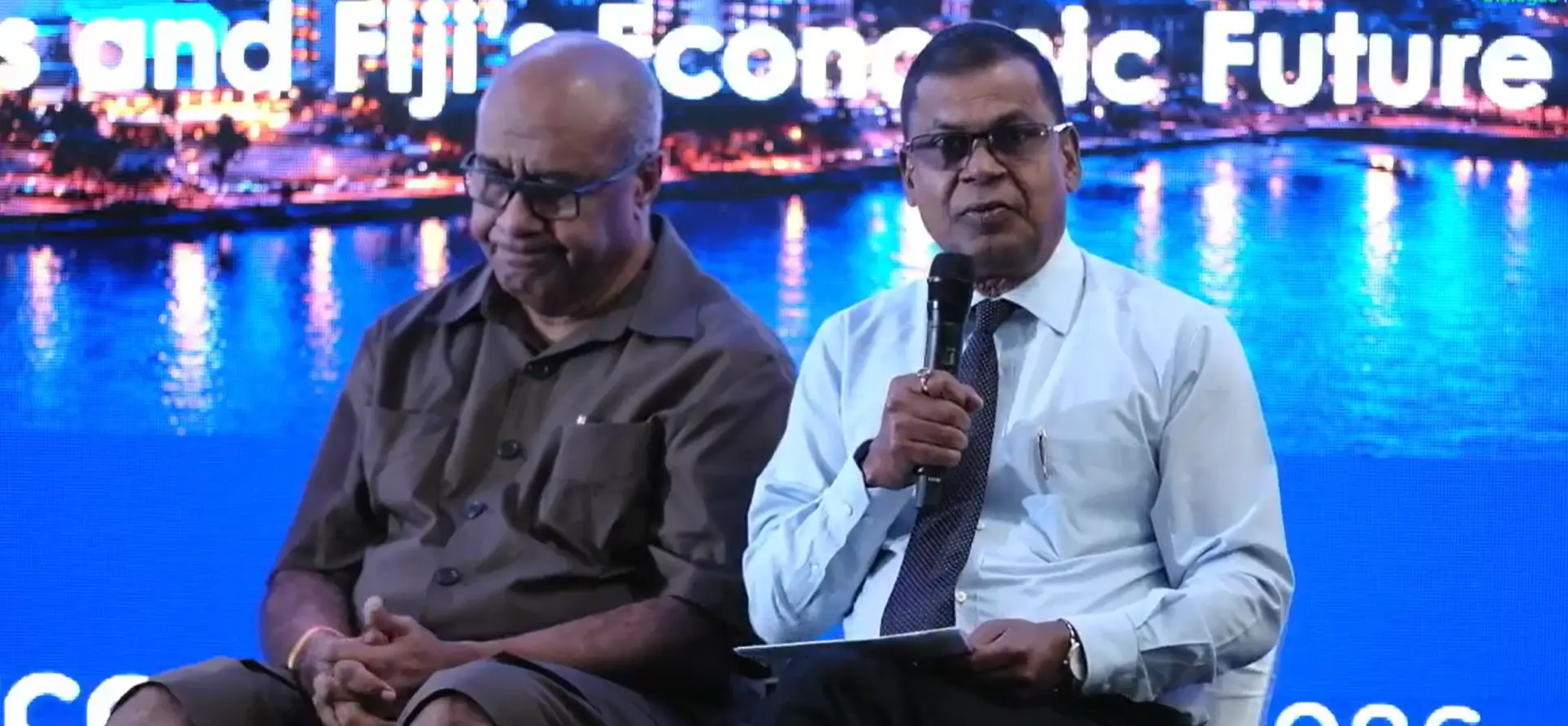
Former Finance Minister Biman Prasad speaking at the Dialogue Fiji State of the Economy dialogue at the Grand Pacific Hotel in Suva today.
Dialouge Fiji
Former Minister for Finance Professor Biman Prasad says it could be a good time to relook the size of Cabinet and the civil service as Fiji grapples with the economic fallout from a global fuel crisis.
Speaking at the Dialogue Fiji State of the Economy dialogue at the Grand Pacific Hotel in Suva today, Professor Prasad acknowledged that Government could have managed the size of Government better.
“I agree that we could have managed our size of government, size of the civil service better than what we probably have done,” he said.
“Maybe, you know, this is the time to relook at all that.”
Professor Prasad said Fiji's economic challenges should be viewed in the context of external shocks rather than solely domestic policies.
“This is a crisis that has not been created by government,” he said.
“Of course, there was Israel, Palestinian War. There was some impact that we were able to see and predict but nobody predicted this American, US Iran War, and that is something that has put everything off the rail.”
He defended the Coalition Government’s economic management over the past three years, saying it inherited a high debt-to-GDP ratio following the COVID-19 pandemic.
“We inherited a debt to GDP ratio, and there are good reasons why that went up during COVID,” he said.
“You know, I'm not, you know, discounting debt.”
Professor Prasad said the Government had taken “decisive revenue policy decisions” to improve revenue collection, including simplifying the Value Added Tax (VAT) system.
“So we had three rates of VAT, 0, 9, and 15,” he said.
“And we found that there was a lot of revenue leakage close to $400 million to $500 million.”
He said the rationalisation of VAT helped strengthen government revenue, with Fiji recording more than three per cent economic growth for three consecutive years up to 2025.
Professor Prasad also pointed to measures in the 2024-2025 National Budget, including minimum wage increases and expanded social support programmes, which he said helped households cope with rising costs.
“So when we got hit by this crisis, people had a space, a level of space, which allows them to take this truth,” he said.
However, he acknowledged that the current crisis was creating affordability and livelihood challenges for families.
“The important thing about this crisis is, it's a very strong, short term shock,” he said.
“The shock is about affordability. It's about livelihoods.”
Professor Prasad said the key question for policymakers was how the burden of the crisis could be shared more equitably through the next national budget.
“What can we do in the next budget is to look at how the burden of this crisis can be shared,” he said.
He added that Fiji’s debt-to-GDP ratio had fallen during the Coalition Government’s term, reaching 79 per cent in July 2025, although he expected it to rise again because of current economic pressures.
“The debt to GDP ratio was brought down in the last three years,” he said.
“It obviously will go up this year. That's understandable.”
Explore more on these topics








Advertisement
Advertise with Fiji Sun