Opinion: Use AI or be replaced by people who use AI
For students and young professionals, this shift presents both a challenge and an opportunity. The challenge is that traditional knowledge alone may no longer be sufficient.
Sunday 07 June 2026 | 16:00
Updated 10 June 2026 | 12:16 FJT

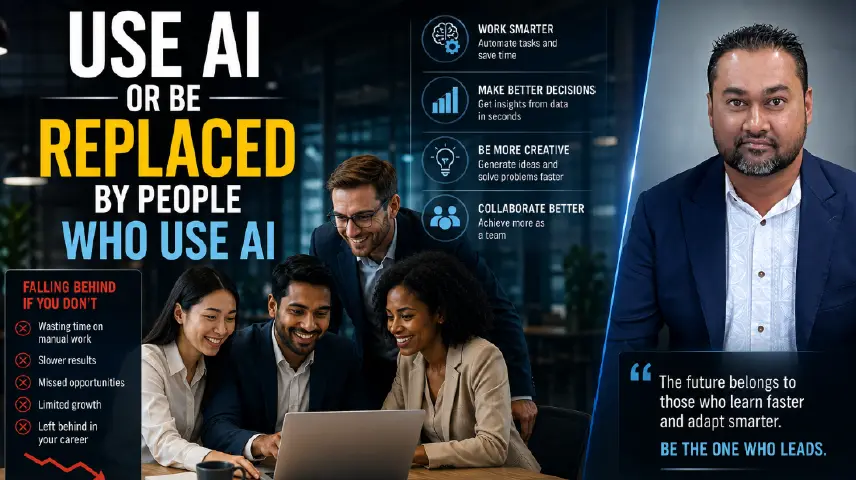
Artificial Intelligence (AI) is no longer a futuristic concept confined to science fiction movies.
It is here, embedded in our smartphones, workplaces, classrooms, hospitals, banks, and even our social media feeds. Whether we realise it or not, AI is rapidly reshaping how we live and work.
The phrase “Use AI or be replaced by AI” may sound harsh, but it reflects a growing reality in today’s digital economy. The message is not necessarily that robots will take over every job. Rather, it is that individuals who effectively use AI will increasingly outperform those who do not.
Related stories
History has shown that technological revolutions reward those who adapt. During the Industrial Revolution, machines transformed manufacturing.
The arrival of computers revolutionised offices. The internet changed how businesses operate and how people communicate. In each case, workers who embraced new technologies thrived, while those who resisted struggled to remain competitive.
AI represents the next major transformation. Across the world, organizations are using AI to automate repetitive tasks, analyse massive amounts of data, improve customer service, and increase productivity. A marketing professional can use AI to generate content ideas within seconds. A software developer can use AI-powered coding assistants to write and debug programs faster. Teachers can create lesson plans and learning materials more efficiently. Medical professionals can use AI tools to assist in diagnostics and patient care.
The result is clear: workers equipped with AI tools are becoming significantly more productive than those relying solely on traditional methods. This does not mean that AI will eliminate the need for human workers.
In fact, many jobs still require creativity, critical thinking, emotional intelligence, leadership, and ethical judgment qualities that machines cannot fully replicate. However, AI is changing what employers expect from their workforce.
Increasingly, companies are looking for employees who can work alongside AI. The ability to effectively use AI tools is becoming a valuable professional skill, much like computer literacy became essential in previous decades.
For students and young professionals, this shift presents both a challenge and an opportunity. The challenge is that traditional knowledge alone may no longer be sufficient.
The opportunity is that AI can act as a powerful assistant, helping individuals learn faster, solve problems more effectively, and achieve more with less effort.
Educational institutions also have a responsibility to prepare students for this new reality. Universities and schools must move beyond simply teaching about AI. They must teach students how to use AI responsibly, ethically, and productively.
Digital literacy in the AI era should include understanding AI capabilities, recognising its limitations, verifying AI generated information, and applying critical thinking.
For Fiji and other developing nations, AI presents a unique opportunity. Limited resources and geographical challenges have often restricted growth and innovation.
AI can help bridge these gaps by improving access to education, healthcare, agriculture, tourism, and government services.
Small businesses can leverage AI powered tools to compete in global markets, while entrepreneurs can use AI to launch innovative products and services at a fraction of traditional costs.
The most successful individuals and organisations will not be those who fear AI, nor those who blindly trust it. They will be those who learn how to harness its strengths while understanding its limitations.
The future workplace is unlikely to be humans versus AI. Instead, it will be humans with AI versus humans without AI.
The lesson is simple. AI is becoming an essential tool of modern life, much like computers and the internet before it. Those who learn to use it effectively will unlock new opportunities, increase their productivity, and remain competitive in a rapidly changing world.
In the years ahead, the question may not be whether AI will replace people. The real question will be whether people are willing to adapt and work alongside AI.
The choice is ours: use AI, or risk being replaced by those who do.
*Anal Kumar is a Senior Computing Lecturer, and Head of the Department of Computing Science and Information Systems (CSIS) at Fiji National University. His work focuses on Digital Marketplaces and Emerging technologies. The views expressed in this article are solely those of the author and not the Fiji Sun and/or it’s employees.