RFMF Tells Of Mutiny: 21 Years On
It was the height of chaos in a country which prided itself in its hospitality, friendliness, and the way the world should be!
Sunday 31 October 2021 | 11:52
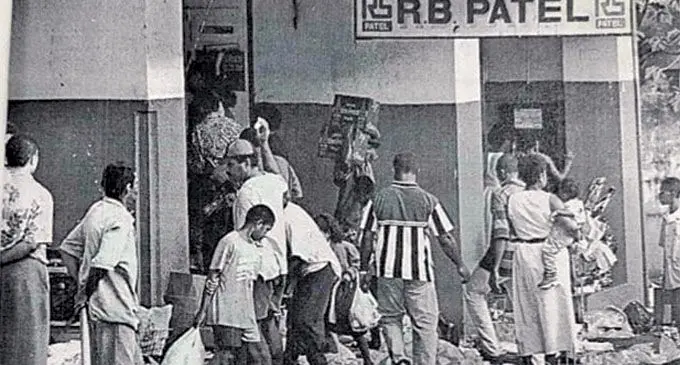
Shops in Suva were looted and torched by citizens during the coup by George Speight and his group on May 19, 2000.
A day that will go down in the history of the Republic of Fiji Military Forces as its darkest hour and to some extent its most enlightening too in terms of the undercurrent sweeping through a divided military that needed to a re-assure itself of its duty to the nation and the people of Fiji.
While there will be stories told of the heroism of some in the face of adversity and the cowardice of a few in the moments of chaos, we will share some insights of how the mutiny of November 2, 2000 was in no way an isolated incident nor was it a sudden or quickly hatched plan in a matter of minutes and hours.
The plan to takeover Queen Elizabeth Barracks, its armories’, its Operational cell along with the killing or incapacitation of the Commander RFMF was deliberate and methodical in its planning. Thankfully, it lacked “precision” and “accuracy”.
Related stories
To talk about the mutiny of November 2, 2000, we must look at the events leading up to it. There will be differences in opinion and story depending on who you speak with, it doesn’t take away the fact that the mutiny happened.
And it was a result of the prevailing political situation in the country at the time.
Attempting to relook at the incident from a purely military perspective can be daunting.
There will be grey areas where the lines become blurred due to the intertwining of events and those involved.
Nonetheless, the story must be told, and the events re-lived on paper to remind us of how a few very selfish, ego- centric and evil men almost succeeded in bringing our nation to its knees.
THE CONSTITUTIONS
After the two coups by Sitiveni Rabuka in 1987, the constitution in place from 1990 was seen as protecting the interests of the indigenous Fijians (iTaukei), and to ensure a consistency in the practice of “protection”, Fijian leaders were also to be governing.
While the changes in the 1997 Constitution were brought about by the recognition of the iTaukei leaders to have some form of multiracial governance system set in place to allow for acceptance and re-engagement in the international diplomatic arena and to ensure economic recovery, there remained a segment of the indigenous Fijian society that saw the changes in the 1997 Constitution as a betrayal of their belief in “iTaukei supremacy”.
The elections of May 1999 under the 1997 Constitution gave birth to Fiji’s first Indo-Fijian Prime Minister, Mahendra Chaudhry.
His Fiji Labour Party (FLP) won decisively by winning 37 of the 71 seats. Whatever reasons given for the demise of Rabuka’s Soqosoqo Vakavulewa ni Taukei (SVT) Party in the 1999 elections, one thing is clear, the iTaukei voters had been split along racial lines and by seeing through the evolution of Sitiveni Rabuka into a “multiracial politician”.
Perhaps too much had been “given up” from the 1990 Constitution to allow for the 1997 “multiracial” Constitution.
The takeover of the Chaudhry Government by George Speight and members of the Counter Revolutionary Warfare (CRW) squadron on May 19, 2000, sparked a lot of interest within the RFMF establishment.
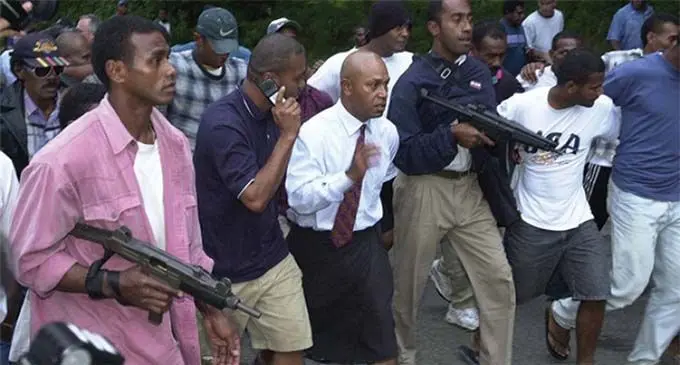
May 19, 2000, coup leader George Speight (with neck tie) with some members of the rebel armed forces followed by supporters and media personnel, Tukini Cama (on the phone), during the events of the takeover of the Mahendra Chaudhry Government.
Following the clearance of Kalabu and the detainment of George Speight and his group on Nukulau, the RFMF turned to the North and recaptured Sukanaivalu Barracks in Labasa and moved down to Savusavu for more security and stability operations.
After Vanua Levu, the RFMF deployed troops to Naitasiri to retake the Monasavu Dam. Naitasiri had openly declared their support for the takeover through Ratu Inoke Takiveikata, the Turaga na Qaranivalu.
With the military moving from one operation to another, in an attempt to ensure that there was no widespread consistent armed insurgency, there were already attempts at QEB to have members of the CRW squadron rehabilitated and reintegrated into the military.
While the members of the military who remained loyal to the RFMF Commander went about their daily duties, plans were also being hatched albeit in the form of expression of disappointment within a group to plan the mutiny.
Meetings held at Ragg Avenue in Suva and later in Nausori echoed sentiments of a dislike in the way the military had handled the Kalabu, Sukanaivalu, Monasavu and other incidents around Fiji.
The iron fist that had descended itself in the form of the military teams that crushed any isolated incidents around the country were perhaps an outpouring of the frustration of the soldiers who had been ridiculed, and many a time, verbally abused by the supporters of George Speight during the 56 days of captivity in Parliament.
The meetings confirmed the need for a change of leadership in the RFMF.