State Appeals Bainimarama, Qiliho Acquittals on 8 Grounds
Bainimarama was acquitted of one count of attempt to pervert the course of justice while Qiliho was acquitted of one count of abuse of office.
Friday 01 March 2024 | 11:00

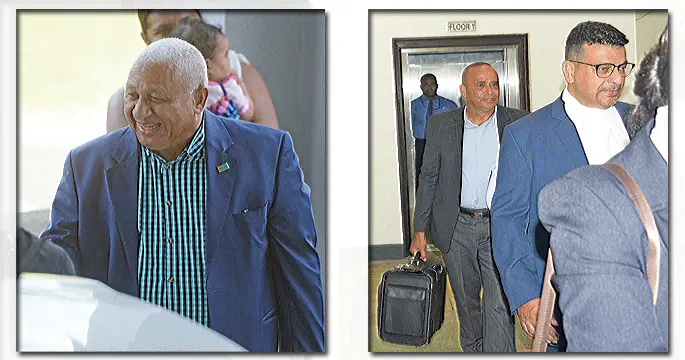
Former Prime Minister Voreqe Bainimarama & Suspended Police Commissioner Sitiveni Qiliho outside the High Court in Suva on February 29, 2024. Photo: Ronald Kumar
The State prosecution argued in court yesterday that the acquittals of former Prime Minister Voreqe Bainimarama and suspended Police Commissioner Sitiveni Qiliho breached the Browne V Dunn rule.
State Prosecutor Nancy Tikoisuva was presenting the State’s case before Acting Chief Justice Salesi Temo at the High Court in Suva
yesterday.
Related stories
Bainimarama was acquitted of one count of attempt to pervert the course of justice while Qiliho was acquitted of one count of abuse of office.
Magistrate Seini Puamau reached this verdict on October 12, 2023.
Ms Tikoisuva told the court Magistrate Puamau had made up her own assumptions without evidence while acquitting the duo.
She said none of the matters raised in the defence were put to Police and prosecution witnesses to solicit their response during the trial.
Instead, Magistrate Puamau challenged the prosecution witnesses using the evidence of the respondents, Ms Tikoisuva argued.
Ground 1:
The learned magistrate erred in law and in fact in failing to consider and apply the principles of law laid down in the case of Browne V Dunn (1893) 6.R.67,H.L when the first respondent was giving evidence under oath in his defence.
Ground 2:
The learned Magistrate erred in law and in fact in failing to consider and apply the principles of law laid down in the case of Browne v Dunn (1893) 6.R.67, H.L when the second respondent was giving evidence under oath, in his defence.
Ground 3:
That the learned Magistrate erred in law and in fact when she failed to indicate to the State that it was available to the State to recall any of its Prosecution witnesses, to challenge the new defenses and evidence raised by both the first and the second defendant, thereby resulting in an
unfair trial.
Ground 4:
That the learned Magistrate erred in law and in fact in arriving at a finding that a Prosecution witness 19, Rusiate Tudravu “clearly came to court with an axe to grind following his dismissal from the Fiji Police Force due to an unrelated event” when such an imputation was not put to Rusiate Tudravu during cross examination and there was no evidence to support such a finding.
Ground 5:
That the learned Magistrate erred in law and in fact in arriving at the finding that what witnesses SSP Serupepeli Neiko and A/ASP Reshmi Dass wrote in their police notebooks regarding the conversation they had with the second respondents was “what they understood to be his intent and this view was, was unfortunately colored and potentially tainted by the subsequent conversations they had with each other, another and possibly others and it was not a verbatim recording” when such imputation was not put to either of the witnesses ion cross examination and there was no evidence to support such a finding.
Ground 6:
That the learned Magistrate erred in law and in fact in arriving at her findings in paragraph 143 of her judgement, in respect of the first respondent when such findings were based on an erroneous assessment of the elements of the offense, the evidence called by the State and the evidence of the first respondent which was in blatant breach of the Browne v Dunn rule.
Ground 7:
That the learned Magistrate erred in law and in arriving at her findings in paragraph 172 of her judgement, in respect of the second respondent when such findings were based on an erroneous assessment of the elements of the offence, the evidence called by the State and the evidence of the second respondent which was in blatant breach of the Browne v Dunn rule.
Ground 8:
That the learned Magistrate erred in law and in fact in failing to place proper weight on the entire evidence of the State but instead erroneously placed more weight on the recent concocted evidence of the first and second respondent, thereby resulting in her returning erroneous orders of acquittal on both respondents.
In response to Ground 2, Justice Temo told the court that this was on the onus of the State.
He said how they fought their battle in court depended on the strategy they chose.
It was something that the previous Acting Director of Public Prosecution (the late) David Toganivalu failed to execute.
Defence argument Meanwhile, defence lawyer for both respondents, Devanesh Sharma, questioned the State prosecution about the legitimacy of the breach.
Mr Sharma said the court had sufficient material before to make a decision and there was nothing unreasonable or perverse about
the court’s decision.
Mr Sharma said the DPP could have recalled any witness or brought in new evidence to refute anything the defence had raised but Mr Toganivalu chose not to do so and somehow the court was to be blamed for this.
Mr Sharma argued the Criminal Investigation Department (CID) did nothing from July 2020 and suddenly from January 2023 they looked for something to charge the respondents.
However, for the main witness who gave the statements in 2023, they overlooked the fact that independent as the CID docket minutes and the NSC meeting transcript’s contradicted what the witnesses were saying.
Justice Temo adjourned the matter for judgement to March 14 at 10.30am.
Feedback: Beranadeta@fijisun.comm.fj