Supervisor Of Elections Sets Record Straight
The Fijian Elections Office is concerned with the grossly incorrect, inflammatory headline in the Fiji Times titled “Power to Fine”’
Tuesday 23 March 2021 | 13:22
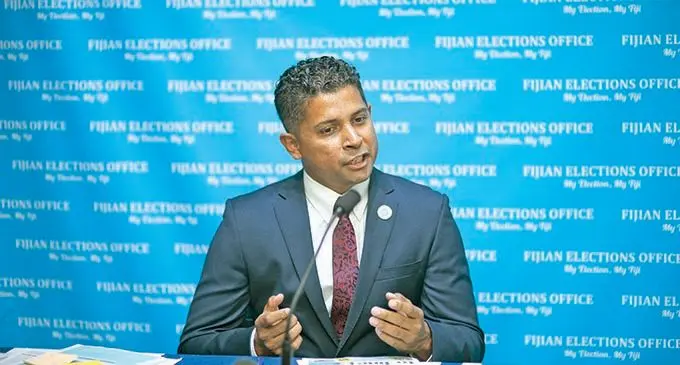
Supervisor of Elections office Mohammed Saneem on March 22, 2021. Photo: Leon Lord
The Supervisor of Elections Mohammed Saneem has revealed alleged errors in yesterday’s Fiji Times articles on proposed amendments to the Electoral Bill.
The Fiji Times newspaper issue, published on Monday, March 22, had extensive coverage on the amendments proposed to the Electoral Bill. However, Mr Saneem highlighted the many alleged errors and false information in the articles, prominently published on pages 1 and 3.
What was reported:
Related stories
Mr Saneem yesterday said: “The Fijian Elections Office is concerned with the grossly incorrect, inflammatory headline in the Fiji Times today (yesterday) titled ‘Power to Fine’ by Anish Chand.”
The article ran in the front page of the Fiji Times newspaper yesterday.
In the first paragraph, The Fiji Times wrote: “Under the proposed Bill Number 50 of 2020, the Supervisor of Elections [“SoE”] and the Electoral Commission [“EC”] have powers to fine and jail persons publishing materials undermining public confidence on his duty and function.”
This report is not correct.
The law very clearly states:
Proposed Electoral (Amendment) Bill 2020
“Section 144A (4) – Any person or political party that contravenes this section commits an offence and is liable on conviction to a fine not exceeding $50,000 or imprisonment for a term not exceeding five years or both.”
Mr Saneem said: “It has been suggested in the above mentioned article that section 144A (4) gives power to the SoE and the EC to fine and jail persons publishing materials that undermine public confidence on duty and function of both offices. This is grossly incorrect!”
“It must be noted that the provision must be read in its entirety to be able to grasp the true interpretation of the same. This proposed provision makes it an offence for a person or political party to publish information in or outside of Fiji and is accessible in Fiji knowing or having reasons to believe that the information is false and could likely influence the outcome of an election or diminish public confidence in the performance of any duty or function of the SoE and EC.
“In such situation, the SoE could rectify the issue by directing the person, including a service provider or political party to remove or correct the statement or information that was published. The person directed must action with immediate effect.
“If the person or political party does not agree with the SoE’s decision they could appeal to the EC who would review the decision of the SoE within 24 hours.
“Now, section 144A (4) makes it an offence for a person or political party to be publishing information that is false. If the SoE has reasonable belief that the information is false and could diminish his function as well as the function of the EC, the SoE could either rectify the issue right there and then or under section 18 of the Electoral Act, 2014 lodge a complaint to FICAC who would conduct its own investigation into the matter.”
Electoral Act, 2014
“Section 18 – If the EC or SoE becomes aware at any time of the probable commission of an election related criminal offence including criminal offence prescribed in this Act, it must immediately report the matter to the Fiji Independent Commission Against Corruption [“FICAC”] and all election officials must fully co-operate in the investigation of any election related offence.”
If the person or political party is charged, the Court would rely on section 144A (4) to determine the suitable penalty for the accused.
The explanatory note of this provision clearly indicates that section 144A (4) is there to allow the “Court from awarding penalties best suited to the circumstances of the offending”.
This does show that section 144A (4) is meant for the Court and does not provide powers to the SoE or EC as suggested.
The Fiji Times, in the same article, stated: “Those found guilty of this offence could be fined $50,000 or serve a jail term of five years or serve both penalties under the proposed Bill.”
Mr Saneem showed journalists at a press conference yesterday what the Section of the proposed Bill states.
The section viewed by Fiji Sun journalists clearly stated that the Court and not the Supervisor of Election, nor the Electoral Commission, has any “power to fine”.
On page 3 of the newspaper, the Fiji Times published the photograph of a lady they identified as the Wailotua polling centre’s former presiding officer Biu Solia. They also ran an article written by Fiji Times reporter Luke Rawalai in which it was stated: “Wailotua polling centre former presiding officer, Biu Solia has questioned the transparency of electoral procedures because of inconsistencies in vote count numbers during the last elections.”
The Fiji Times further reported: “As a presiding officer in the past two elections, Ms Solia said she was well versed with vote-counting procedures and that she had followed these procedures. Ms Solia told the committee she was shocked at the inconsistency in the vote counts, casting doubt on electoral procedures.”
Based on evidence provided by Mr Saneem, the presiding officer at Wailotua was a man, whose identification details were shared with media.
Furthermore, he showed the presiding officer’s documentation from the elections count night which tallied with the information available on the Fijian Elections Office (FEO) app.
There is also no record of anyone called Biu Solia being employed by the Fijian Elections Office, or anyone by that name undergoing any training with the FEO.
Third article:
Another claim was made in the lead article on page 3, which was also written by reporter Luke Rawalai. In this article, he claimed that villagers in Wailotua could not vote because of flooding.
Mr Saneem shared the Google Earth image of where the village is, where the polling stations were and outlined how the claim of flooding did not hold any water.
Mr Saneem said: “Here are the facts”:
“Wailotua District School Polling Station had 211 voters on the day. From our verification of the Voter List we established that 207 Villagers attended to vote out of 276 registered voters at the venue. The other four votes were by the election officials. We also identified that voters who lived in Wailotoa Village 1 & 2 and Malabi which is situated near the school were registered to vote at this venue. Nobody has to cross a river to get to the Polling Station,” he said.
“The Presiding Officer was Mr. Waisiki Tamani. There is no record of any person by the name of Biu Solia to have undertaken any role as an election official at the Wailotua Polling Station. In fact, we have searched for her in our database and from the records we can say that no person by that name ever worked for the FEO in 2018. She was not an applicant for any election official role and therefore, it is questionable as to her claim to have thorough knowledge of the counting process.
“I also would like to present you with the results sheet for that Polling Station. In 2018, the FEO verification team inspected the Protocol of Results and had to rectify the number of votes for candidate 518 – Lynda Tabuya as the PO Record Book had 5 votes for that person and it was not reflected in the Protocol of Results. The original sheet together with the tracking form is available for the media to inspect.
“The FEO App explicitly represents the data as we obtained from the field. Here are the verified printouts for your perusal. I feel that the Standing Committee was given false information at this Consultation Session.
“I would like to point out that the information published in the national daily newspaper is incorrect and the newspaper failed to carry out any verification or clarification on such information. It appears that the newspaper added inflammatory headlines to such poorly researched stories that are not only obviously incorrect in terms of the fact but also present a poor statement of the Electoral Amendment Bills.”
Fourth article:
The fourth article in the Fiji Times, written by reporter Anish Chand and published on page 3, also had wrong information, according to Mr Saneem.
Mr Saneem revealed: “The reporter, Anish Chand, has made enquiries about other provisions of the law from the FEO, yet he failed in his responsibility as a journalist to seek clarification from the FEO on the law, if he was unsure.
“The Fiji Times should take great care if it wishes its reporters to take up the role to explain provisions in the law or give opinions on the front page in light of today’s experience. It might also be important to consider the qualifications and expertise of individuals in the respective areas as well.
“The FEO will continue to correct the Fiji Times as we did on many occasions in 2018. The FEO is always available to provide facts and information to all media organisations and we urge them to use this resource.”
Fiji Times’ responses
The Fiji Times editor-in-chief Fred Wesley responded to this in an email. He wrote: “We accept that there was an error in our reporting on the Electoral Amendment Bill where we suggested that the Supervisor of Elections had the power to jail and fine persons undermining public confidence in FEO’s functions. The power to jail and fine is in the Court. The error arose during our editing process and will be corrected.
“With respect to the Wailotua polling centre, allegations by Ms Biu Solia, The Fiji Times is reporting on submissions made to the Standing Committee on Justice, Law and Human Rights. It reports proceedings of the Committee as they occur. If the Supervisor of Elections wishes to respond to those reports, he is of course free to do so – as he did today (yesterday).”
Feedback: wati.talebula@fijisun.com.fj