UK: Pacific Experience On Climate 'Harrowing'
The UK had made a $10billion commitment as a crucial part of its COP presidency and pre-presidency.
Thursday 04 November 2021 | 15:49
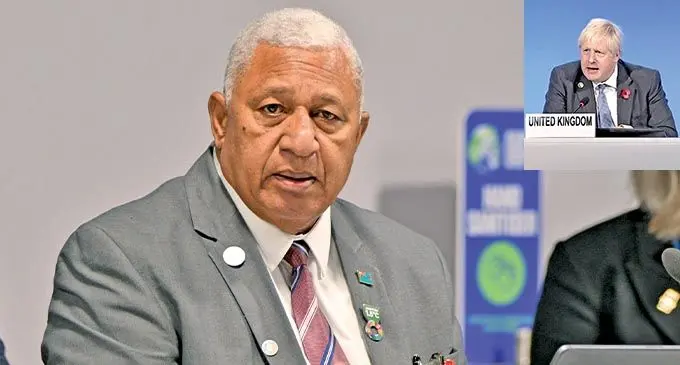
Prime Minister Voreqe Bainimarama at the COP26 in Glasgow, Scotland, on November 3, 2021, during the launch of the ‘Infrastructure for Resilient Island States’ (IRIS). Photo: Office of the Prime Minister Insert: British Prime Minister Boris Johnson.
UK Prime Minister Boris Johnson has described the lived realities and experiences of people living in small island states as ‘harrowing.’
He said conversations with his Fijian counterpart “Frank” and others on the frontline of the climate crisis showed the Pacific Islands did not cause the crisis and were undeserving sufferers from it.
Mr Johnson was speaking during the launch of the ‘Infrastructure for Resilient Island States’ (IRIS) at the Scottish Events Campus yesterday.
Related stories
IRIS was jointly launched by Mr Johnson and the Prime Ministers of India, Australia, Fiji, Jamaica and Mauritius.
On several occasions during his introduction, the UK Prime Minister referred to Prime Minister Voreqe “Frank” Bainimarama on a first name basis as “Frank”.
It underlined the ties that have grown between the two leaders.
It it also understood that Mr Johnson had even personally telephoned Mr Bainimarama in the lead up to the annual climate summit, COP26.
Mr Johnson’s simple yet clear interpretation of the dilemma faced by small island states was evident.
“It’s incredibly cruel that these vulnerable small island states are right in the frontline of loss and damage and they have done virtually nothing to cause the problem.”
Mr Johnson urged those countries that have benefitted from pumping carbon dioxide to join this campaign and clear it up.
The UK had made a $10billion commitment as a crucial part of its COP presidency and pre-presidency.
Pacific cyclone season
Mr Bainimarama, in his address, pointed to the cyclone season that started on Monday November 1, as Fiji and the Pacific braced for the unknown.
He described the period as one defined by record-smashing super-storms that can erase years of infrastructure progress in a matter of hours.
“The world is warming, the impacts are terrifying, and the standards we build must be defined by and readied for those intensifying risks.
“It takes resources to build resilience. But we either pay to adapt now, or pay a much higher price in the aftermath of climate-driven devastation.”
By becoming the first developing state to enact a comprehensive Climate Change Act, Fiji will be required to adapt our building codes and standards to the climate reality and be inclusive of our green priorities, Mr Bainimarama said.
To his Indian counterpart, Mr Bainimarama said the launch of the ‘Infrastructure for Resilient Island States’ is a promising start.
“Prime Minister Modi, thank you for your leadership. We trust this initiative will reach well beyond technical assistance and capacity building to unlock trillions in private sector capital.
“It can do that by de-risking critical investments now that will build resilience for those on the front line of the climate crisis.
“Fiji’s Relocation and Displaced Peoples Trust Fund, which establishes a proven process to move at-risk communities and their infrastructure, is one example of where those funds can make an impact.”
Feedback: rosi.doviverata@fijisun.com.fj