Vatulele islanders turn sea knowledge into lifesaving skills
Josaia Rabuno says the training has changed how coastal communities respond to emergencies at se
Friday 10 July 2026 | 14:00
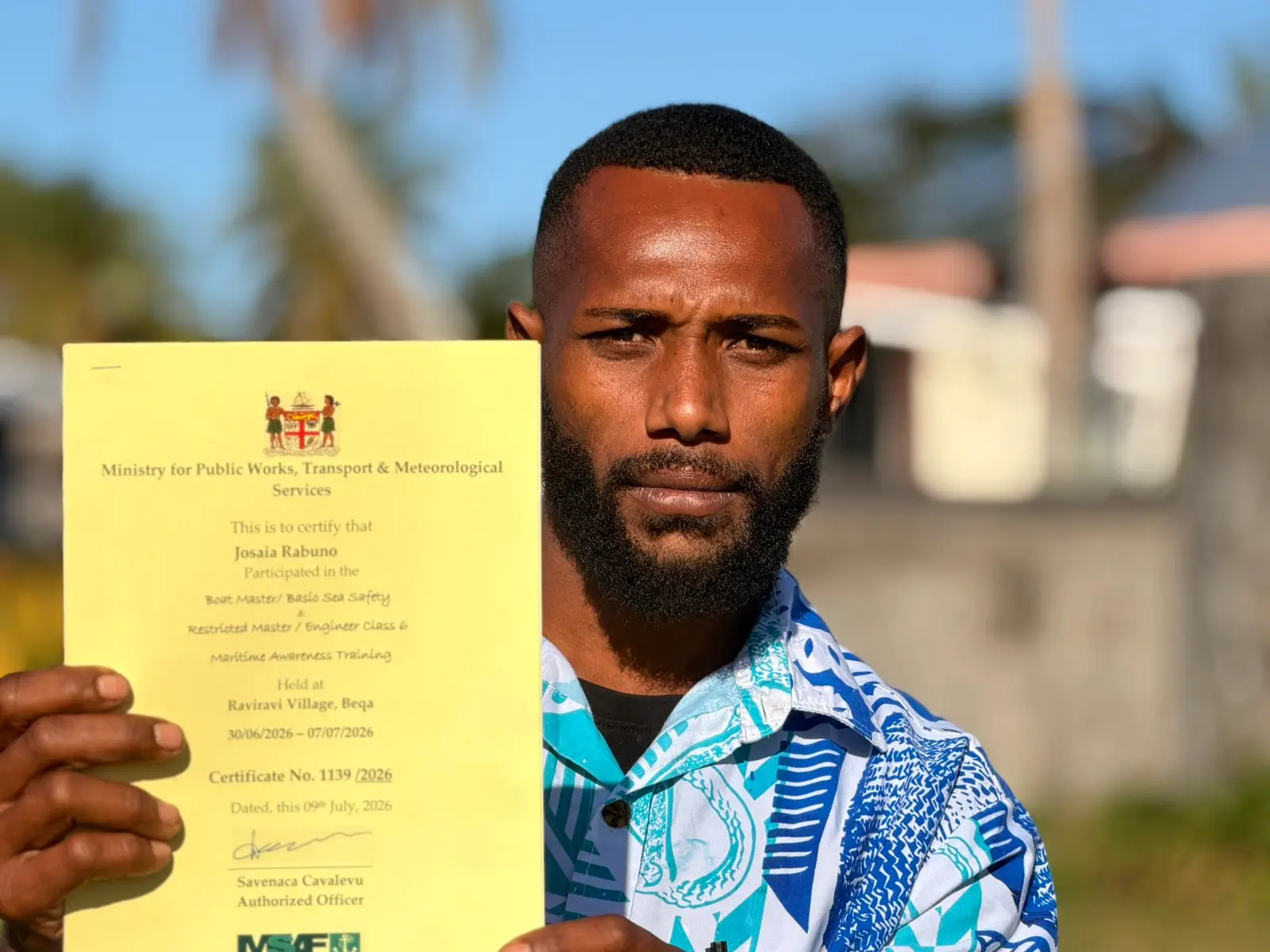
Josaia Rabuno with his certificate at Ekubu Village on Vatulele Island.
Photo: Talei Matairakula
For generations, the people of Vatulele Island, Nadroga-Navosa province have relied on the sea for transport and survival.
They learnt to steer boats from childhood, guided by experience and tradition. Now, many are combining that traditional knowledge with formal maritime training that could save lives and create new livelihood opportunities.
Among them is 29-year-old Josaia Rabuno, who recently completed Boat Master, Basic Sea Safety and Restricted Master/Engineer Class 6 training on Vatulele.
Related stories
For Mr Rabuno, the training was about far more than earning certificates — it was about improving safety, building confidence and creating opportunities for coastal communities.
"This training is immensely beneficial for those of us living in villages and coastal areas, surrounded by the vast ocean," he said.
"It was especially good because it was held here on the island and delivered in a way that was easy for us to understand."
Like many islanders, Mr Rabuno grew up on the water, learning to operate boats from a young age. However, he said practical experience alone did not prepare them for emergencies at sea.
"We grew up navigating these waters and learning to operate boats from a very young age. However, we were never taught how to respond to emergencies at sea," he said.
"When we encounter an emergency, we are often overwhelmed, but this training equipped us with the skills and knowledge to respond effectively."
One lesson that stood out for participants was learning that a capsized boat could still be used as a flotation device — a simple but potentially life-saving technique that could help reduce casualties during maritime accidents.
Participants also learnt how to identify suspicious or unfamiliar parcels found floating at sea and the correct reporting procedures, strengthening community awareness and maritime security.
Beyond improving safety, Mr Rabuno believes the qualification could create new economic opportunities for his family and others on the island.
"This qualification can also provide another source of income for us, in addition to making masi," he said.