Villagers Adapting To Changing Weather
Though the village has a seawall built from rocks, it has gradually deteriorated from the impacts of huge waves.
Monday 14 February 2022 | 12:33
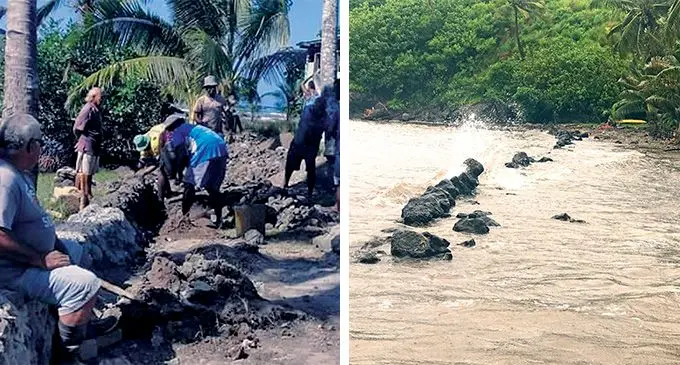
Men from Natawa Village using whatever resources is available (right) and the current seawall hit by waves during high tide.
Mothers on the island of Waya in the Yasawa group are finding ways to adapt to changing weather patterns.
They are not waiting for Government or stakeholder intervention. Instead, simple common sense is key to ensure that their daily needs are met and both food and water are safe to consume.
65-year-old Ilisapeci Ceva is a witness to the changing weather conditions. She’s lived on Natawa Village most of her life.
Related stories
Natawa is one of four villages on Waya Island. It’s about an hour boat ride from the Lautoka wharf.
Like most coastal and island communities around Fiji, Natawa Village is susceptible to sea level rise and coastal inundation.
Villagers are uncertain about the future and are often caught by surprise by extreme weather conditions.
“We would sit by the beach, throw our fishing baits out to sea and we still caught a lot of fish to have for dinner.
“But now, the elders in the village have noticed the change in weather patterns and it affects our ocean and its marine life,” Ms Ceva said.
In April 2021, a climate change impact Fiji assessment was published by the Fiji Red Cross and Technical Advisors at the International Federation of Red Cross Asia Pacific Regional Office.
The assessment said climate change primarily affected Fiji through sea-level rise, coastal erosion, tidal inundation, intensification of storm surge activity, and more extreme rainfall events.
Ms Ceva said these changes allowed villagers to be smart and have an adaptive mindset.
“We are mothers and we have a nurturing spirit to do whatever we can to support the wellbeing of our children and entire family and because of that we have to start educating those around us not to take these changes in weather patterns lightly,” she said.
“I believe one of the impacts is the sighting of sea-worms (balolo) in March last year. It’s quite unusual because it usually surfaces later in the year.”
Villagers have also opted to boil drinking water rather than drinking straight from the village water source.
They also depend on agriculture and fisheries to sustain their livelihoods.
Seawall
Village headman Sisa Neibale said high tides brought seawater right into the village grounds. Soil erosion is now a problem as a result.
Though the village has a seawall built from rocks, it has gradually deteriorated from the impacts of huge waves.
“Before we had coconut trees lined by the seawall, but due to the rise in sea level the shoreline has moved into the village,” Mr Neibale said.
With a population of 170 people, the future and locality of the island is at stake.
“We found that the seawalls have not been successful in achieving their primary aim of safeguarding communities against coastal pressures and have instead resulted in unanticipated negative outcomes for our land and livelihood.”
Waya island consists of four villages – Nalauwaki, Natawa, Waya Levu and Yalobi.
Of these four villages, Natawa Village seems to be facing the direct hit of climate change.
Villagers believe building a more effective seawall will at least give them a sense of hope for the future.
Mr Neibale said they haven’t had any luck after reaching out to Government and non-governmental organisations.
“However, that does not mean we will stay idle. We have a committee that looks into village projects and we have been very active when it comes to maintaining the seawall the best we can,” Mr Neibale said.
He added that the long-term goal includes more local and technical input in the planning, implementation, and maintenance processes of climate change projects for the village.
Feedback: kelera.sovasiga@fijisun.com.fj