We Can Stem Rising Tide Of Urban Drift By Levelling Playing Field: PM
“As we look ahead to the UN Secretary-General’s Climate Action Summit in September, today’s Ministerial gathering represents a critical opportunity to spur a global re-imagining of how our cities and infrastructure networks can power sustainable development.
Wednesday 29 May 2019 | 12:23
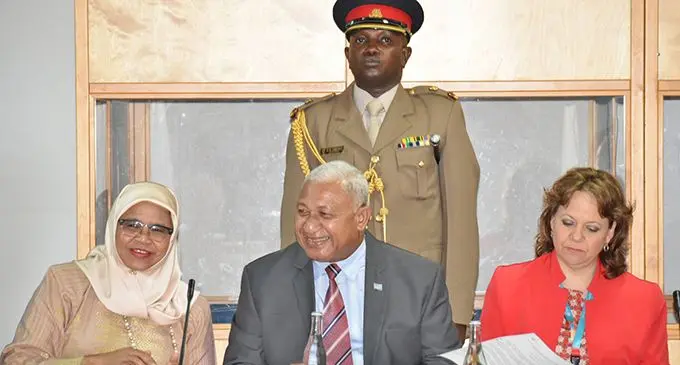
Prime Minister Voreqe Bainimarama says an unprecedented rise in rural-to-urban drift is being fuelled by the search for new opportunity and the certainty of reliable services and infrastructure.
He made the remark when he opened a roundtable on Infrastructure, Cities and Local Action (ICLA) at this first-ever UN-Habitat Assembly in Nairobi, Kenya.
“As we look ahead to the UN Secretary-General’s Climate Action Summit in September, today’s Ministerial gathering represents a critical opportunity to spur a global re-imagining of how our cities and infrastructure networks can power sustainable development.
Related stories
He said as governments, they could certainly stem that rising tide of urban drift by levelling the playing field across rural and urban regions.
“But we still must confront the reality that the populations of our urban areas will continue to massively expand, he said.
“We must ask ourselves: How can our cities adapt? How can we ensure growing urban populations have access to clean water, other essential services and decent, affordable housing? How we deal with the resulting increases in waste and pollution?
“How do we protect our environment from the strains of urbanisation? And – the question of paramount importance: How do we guarantee our cities develop in a sustainable manner?”
He said the answers to these questions were made far more urgent and complex by the scale and ferocity of climate-related impacts, which both accelerated the rate of urban drift and exacerbated the costs on our economies.
Mr Bainimarama said prolonged droughts, rising soil salinity levels, and severe weather events were forcing rural populations to seek the relative safety and economic security of urban environments.
But, he said, the impacts weren’t limited to rural regions.
He said many cities themselves faced deep vulnerabilities to rising seas, worsening floods and other devastating climate impacts.
Cities were at a crossroads; they must either evolve into models of resilience or crumble into continuous sources of climate crises.
“In Fiji, we’re thinking seriously about how our cities, towns and rural communities must adapt in the face of a changing climate
“We’ve already embarked on an urban planning initiative with the Singaporean Government that is placing low-emissions and climate-resilient strategies at the heart of our urban development agenda.
“We’ve undertaken a comprehensive climate vulnerability assessment across our economy that considers the potential climate impacts over the coming decades. That assessment has placed a US 4.5-billion-Dollar value on the resources, technology and expertise we need to adapt the Fijian economy over a 10-year period. That’s nearly the value of our entire GDP.
“Whether it’s the Pacific, Asia, Europe or here in Africa – the costs of adaptation are similarly staggering. But we know the costs of inaction are far greater.
“Many vulnerable economies are only one severe weather event away from complete decimation.
“We need new financing mechanisms and new technologies to mitigate that risk, but we also need a new recognition of the opportunities in the adaptation space. No nation, and no economy, will be spared from worsening climate impacts. Those leading the way in funding and implementing adaptation solutions will reap the benefits of that body of knowledge and experiences in the decades to come.”
“But our efforts to build resilience must be matched with decisive cuts in global carbon emissions. Otherwise, climate impacts will intensify to a scale beyond any nation’s ability to manage.
“Fiji and the Marshall Islands were the first two nations to commit to raising the ambition of our NDCs by 2020 and reaching net zero emissions by mid-century. That is a commitment every nation on Earth – particularly every major economy – must emulate.
“Presently, our collective global commitments fall badly short of where they need to be, placing our planet on track for three degrees Celsius of warming above pre-industrial levels. That is a nightmare scenario that we cannot allow to unfold.
“Urban areas account for nearly 70 per cent of global greenhouse gas emissions – that is where the most decisive cuts can and must be made.
“And I’ve been inspired by the many cities that are already stepping up their own commitments; turning urban environments – long the most significant sources of harmful emissions – into greener, more inclusive, and more resilient local economies.
“Organisations like C40 Cities and R20, led by my friend and fellow climate champion, Arnold Schwarzenegger, are rallying sub-national governments to deliver sustainable infrastructure and lead the movement toward de-carbonisation. We need that same level of commitment shared throughout all levels of society; from ordinary citizens, to business leaders, to world leadership.
“The sustainability of cities, towns and communities of the future will be determined by the strength of those commitments today. Let the weight of the enormous responsibility inspire us with conviction throughout our discussions, both at this Assembly and beyond.”
Edited by Caroline Ratucadra
Feedback: maikab@fijisun.com.fj