Words to Empower the Public
"But I am specially trained to serve them in a manner that an ordinary citizen would find challenging without legal expertise."
Thursday 11 April 2024 | 23:15
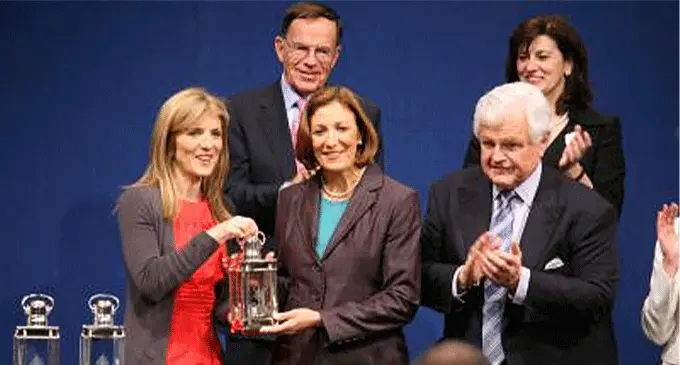
Justice Brunner receiving the John F Kennedy Profile in Courage Award in 2008 for her service as Ohio's first female Secretary of State from 2007 to 2011
Using words as a tool to empower the public was the key message from Justice Jennifer Brunner of the Ohio Supreme Court.
She spoke to 20 journalists from around the world who participated in the Foreign Press Center’s “Democracy is More than Election Day” reporting tour in the United States of America last month at Ohio.
Justice Brunner, the 162nd Justice of the Ohio Supreme Court, was elected on November 3, 2020, and her term expires on January 1, 2027.
Related stories
She received the John F. Kennedy Profile in Courage Award in 2008 for her service as Ohio's first female Secretary of State from 2007 to 2011.
Ohio is one of the 50 States of America.
The Ohio Supreme Court is established by the state Constitution. The chief justice and six justices are elected to six-year terms.
Two justices are chosen at the General Election in even-numbered years, and in the year when the chief justice is on the ballot, voters elect three members of the Court.
Justice Brunner said it was important to act, not based on political leanings, but on a genuine care for the State and its people.
"Some judges don't primarily see themselves as public servants, they see themselves solely as judges. I discovered this at a national conference of judges.
However, since I am elected by the people, I believe my foremost duty is to serve," Justice Brunner remarked.
"But I am specially trained to serve them in a manner that an ordinary citizen would find challenging without legal expertise."
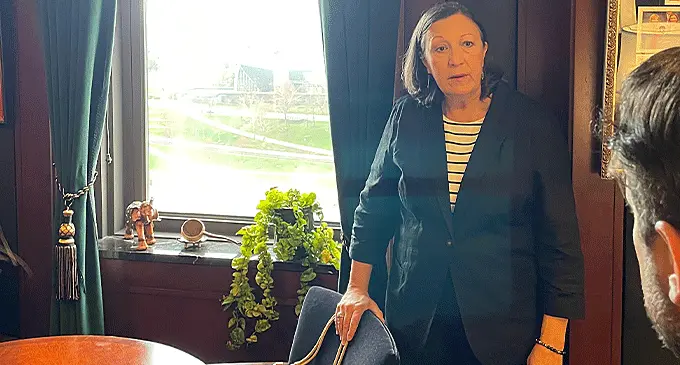
She spoke to 20 journalists from around the world who participated in the Foreign Press Center’s “Democracy is More than Election Day” reporting tour in the United States of America last month at Ohio.
She highlighted that judges have constraints on their free speech and should avoid making promises about their actions in office, except to uphold integrity.
"We're not allowed to say, for instance, how we would rule on specific cases.
There is a separate process for supporting such views during a campaign," Justice Brunner explained.
She acknowledged concerns about the state of democracy, particularly regarding the current election, urging Americans to look beyond surface appearances and labels to choose the candidate they believe will best serve their interests.
It is important to note that in Fiji, judges of the Supreme Court, Justices of Appeal (including the President of the Court of Appeal), and puisne judges of the High Court are appointed by the President on the recommendation of the Judicial Service Commission.
The 20 journalists present were from Albania, Austria, Bolivia, Germany, Ghana, Indonesia, Mexico, Moldova, Mozambique, North Macedonia, Peru, Qatar, Russia, Serbia, Sierra Leone, South Africa, Suriname, Uzbekistan, Venezuela, and Fiji.
Feedback: wati.talebula@fijisun.com.fj