Legislated National Minimum Wage in Fiji: Why businesses should not be treated as welfare institutions
Wednesday 13 May 2026 | 12:00

Economists warn sharp increase could trigger inflation, job losses and weaken competitiveness
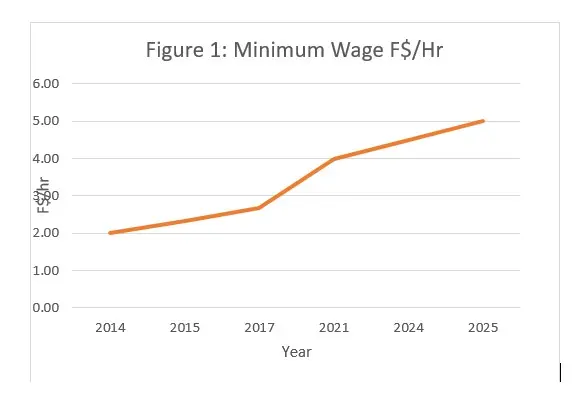
Fiji introduced its first National Minimum Wage (NMW) in 2014 at $2.00 per hour with the intention of providing a wage floor for workers in both the formal and informal sectors.
Since then, the minimum wage has increased steadily and substantially.
By April 2025, the rate had reached $5.00 per hour (see Figure 1), representing a 150% increase over an eleven-year period (an average of 13.63% per year).
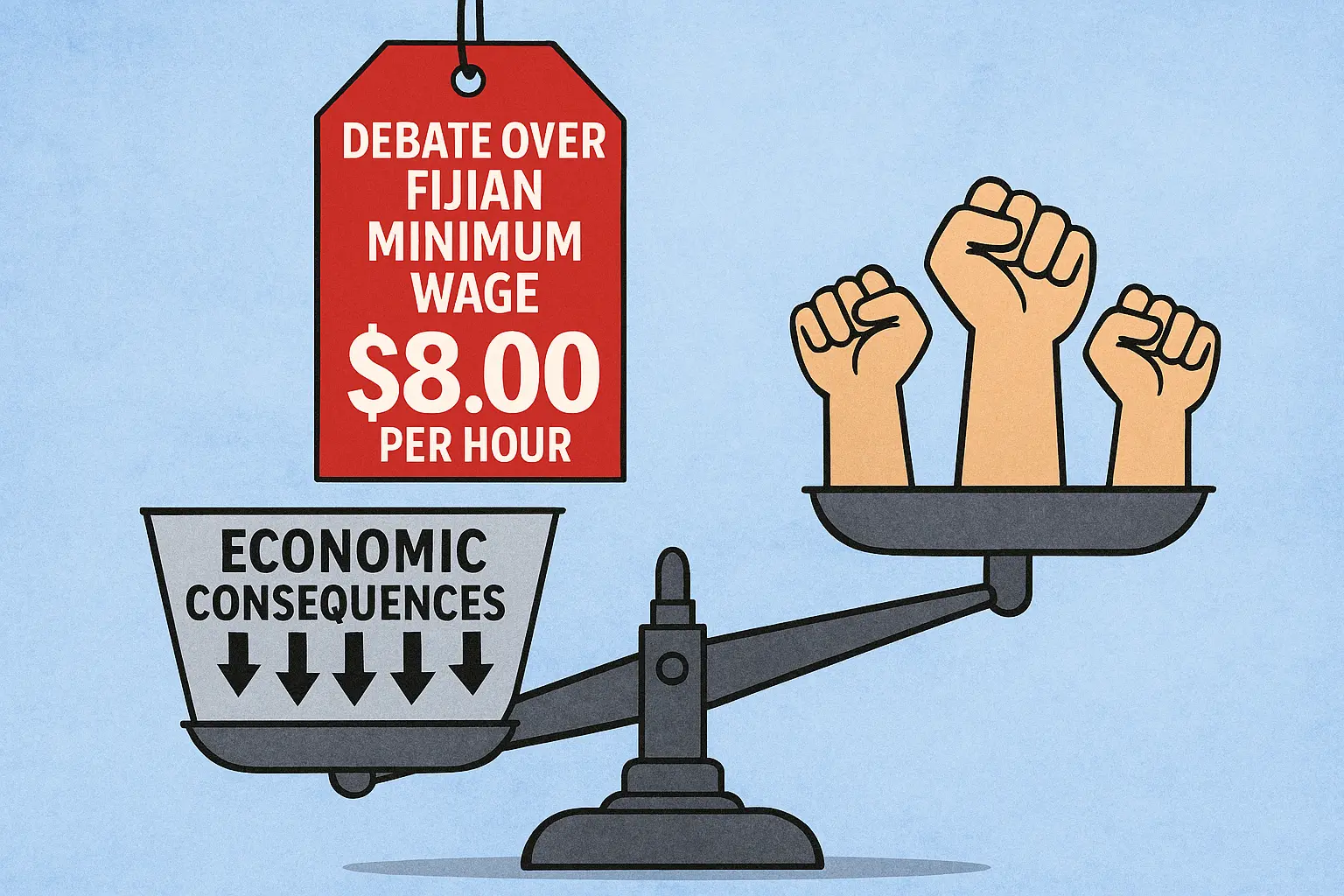
The recent proposal by trade unions to increase the NMW further to $8.00 per hour has triggered significant national debate. While the objective of improving workers’ welfare is understandable and commendable, public policy must always distinguish between good intentions and good economics.
The central question is not whether workers deserve higher incomes; they certainly do, but whether a sharp legislated wage increase is the correct mechanism for achieving sustainable improvements in living standards.
A sudden increase to $8 per hour risks imposing severe economic costs on Fiji’s fragile and highly exposed economy. It could undermine employment growth, weaken export competitiveness, fuel inflationary pressures, discourage investment, and ultimately harm the very households it seeks to protect.
Minimum wage as a market intervention
The labour market, like all markets, operates through supply and demand. Wages generally reflect productivity, skill levels, labour availability, and business profitability. A national minimum wage is therefore a direct government intervention that imposes an artificial price floor above the market-clearing wage.
In some circumstances, such intervention may be justified, particularly where labour markets are characterised by exploitation, monopsony power, or chronic unemployment among low-skilled workers.
However, interventions of this nature must be carefully calibrated, especially in small developing economies like Fiji, where markets are narrow, businesses are fragile, and external competitiveness is critical.
When wages are raised significantly above productivity levels, employers inevitably respond. They may reduce hiring, cut working hours, delay expansion plans, automate tasks, or increase prices to consumers. In extreme cases, businesses may close altogether.
Unlike large industrial economies with massive domestic markets and diversified production structures, Fiji operates within tight economic constraints. A policy error in labour pricing can therefore generate disproportionately large consequences.
Fiji’s economic structure requires caution
Fiji is a small island developing state with a limited domestic market, high import dependence, significant transport costs, and vulnerability to external shocks.
Tourism, agriculture, garments, call centres, retail, construction, and small service enterprises remain highly labour-intensive sectors. Many of these industries compete internationally.
Tourism competes with destinations such as Bali, Thailand, and Vietnam. Garment manufacturing competes with Asian producers. Agricultural exports compete with producers from larger and more efficient economies.
One of Fiji’s comparative advantages has historically been its relatively affordable labour force combined with political stability and English-speaking workers. Investors considering Fiji frequently evaluate labour costs when deciding where to establish operations. A sharp increase in the NMW to $8 per hour would substantially erode this advantage.
Labour costs are not isolated costs; they flow through the entire production system. Higher wages increase transportation costs, retail costs, hospitality costs, food prices, construction costs, and manufacturing costs.
Businesses then pass these higher costs onto consumers through increased prices. This creates the classic wage-price spiral: wages rise, prices rise, workers demand even higher wages, and inflation accelerates further.
For a country already grappling with high living costs, import inflation, and pressure on household budgets, such a spiral could become economically destabilising.
The inflationary consequences
Supporters of higher minimum wages often argue that workers need higher incomes because the cost of living has risen sharply. While this concern is valid, artificially raising wages can ironically worsen the very problem policymakers seek to solve. If businesses are forced to absorb significantly higher labour costs, they will pass those costs onto consumers wherever possible. Restaurants will increase menu prices.
Supermarkets will raise retail prices. Taxi operators will charge more (or request government raise the legislated fare). Hotels will raise room rates (thus further eroding our competitiveness).
Farmers will increase produce prices (thus pushing more people to consume less fresh produce and more cheap canned products), and construction costs will rise.
The result is economy-wide inflation. Rising business costs also weaken export competitiveness, reducing foreign exchange earnings over time. Ultimately, nominal wage gains (acquired from a rise in NMW) may disappear through rising prices, falling household income from falling export income, leaving workers no better off in real terms.
Impact on employment and small businesses
The greatest burden of a large minimum wage increase will fall on small and medium enterprises (SMEs), which form the backbone of Fiji’s economy.
Large corporations may be able to absorb temporary wage shocks through scale efficiencies or capital reserves. Small businesses cannot. Family-owned shops, restaurants, transport operators, farms, and small tourism operators operate on very narrow profit margins.
A legislated jump to $8 per hour may force many employers to reduce staff numbers; shorten employee hours; replace workers with machinery; increase casualisation of labour; postpone expansion; or shut down operations entirely.
Ironically, minimum wage laws intended to protect vulnerable workers can end up excluding low-skilled workers from employment altogether. Employers do not hire workers out of charity.
They hire workers when the worker’s productivity exceeds the total cost of employment. If labour costs rise beyond productivity levels, employers reduce labour demand.
Young workers, school leavers, and low-skilled individuals are usually the first casualties of excessive minimum wage increases because employers become reluctant to hire inexperienced staff.
Does Fiji even meet the traditional conditions for a high minimum wage?
Historically, strong minimum wage interventions are most justified when there is a large surplus of labour and widespread worker exploitation arising from excessive unemployment.
But Fiji’s labour market today presents a very different picture. Many sectors are actually facing labour shortages. Businesses across tourism, construction, agriculture, and services have repeatedly reported difficulty finding workers.
Fiji has increasingly relied on importing labour from countries such as Bangladesh to fill gaps in the labour market.
This reality fundamentally changes the economic argument. If employers are already struggling to find workers, then market forces themselves will gradually push wages upward.
Labour shortages naturally increase worker bargaining power. Businesses competing for scarce workers will voluntarily raise wages to attract and retain employees.
Under such conditions, an NMW becomes irrelevant. Furthermore, those skilled workers who enter the market and fetch a higher wage rate, for them, the NMW is also irrelevant.
Lastly, if we are turn to low-wage countries to import labour for our production process, then by imposing such a higher minimum wage, we lose out on utilising the low-cost labour in the domestic economy.
Poverty reduction is primarily a Government responsibility
One of the most misunderstood aspects of the minimum wage debate is the assumption that businesses should solve national poverty problems through wage mandates. Businesses are not welfare institutions.
Their primary function is to produce goods and services efficiently, generate profits, create employment, and contribute to economic activity.
Poverty alleviation is fundamentally the responsibility of the government through targeted social policy. If households are living below the poverty line, policymakers must diagnose the underlying causes carefully.
Is unemployment the main issue? Are workers under-skilled? Are there too many dependents per household? Is productivity low? Are education outcomes weak? Is transport or housing unaffordable?
Each problem requires a different policy response. Simply forcing employers to pay substantially higher wages does not address the structural causes of poverty. In fact, it may worsen them by reducing employment opportunities (in the short run) and slowing economic growth.
A more sustainable approach would involve targeted income support for vulnerable households, skills upgrading programs, vocational training, productivity enhancement initiatives, transport assistance, tax relief for low-income earners, and active labour market placement programs…some of which are already being undertaken by the government.
If workers become more productive through training and skill development, market wages will rise naturally and sustainably without distorting labour markets.
Protecting workers does not necessarily require excessively high minimum wage mandates. There are several more effective interventions available to government that can improve worker welfare while preserving economic competitiveness and employment growth. One of the most important responsibilities of government is to ensure strict enforcement of existing labour laws and employment standards.
In many cases, worker hardship does not arise solely from low wages, but from weak compliance and poor enforcement practices.
First, the government must ensure that there is no wage theft (as alluded to by unions recently). Employees must be paid fully and on time for the hours they have worked. Employers who underpay workers, withhold wages, delay payments, or manipulate work records must face strong legal penalties.
Effective labour inspections and enforcement mechanisms are therefore critical. Second, the government must ensure that employers are making correct superannuation contributions.
Workers rely on pension savings for long-term financial security and retirement dignity. Failure by employers to contribute the required Fiji National Provident Fund (FNPF) deductions effectively deprives workers of future income and social protection.
Strengthening compliance systems and auditing employer contributions should therefore become a national priority.
Third, the government must ensure that employees receive all legally entitled benefits, such as annual leave, public holiday pay, sick leave entitlements, overtime payments, and maternity-related protections.
Many workers, particularly in smaller enterprises and informal sectors, often fail to receive these lawful entitlements despite existing regulations. Fourth, worker welfare must also extend beyond wages alone.
Employees must be treated with dignity, fairness, and respect in the workplace.
Safe working conditions, protection from harassment and intimidation, reasonable working hours, grievance mechanisms, and professional treatment are essential elements of a healthy labour market.
Economic development should never come at the expense of basic human dignity. These interventions are far more targeted and economically sustainable than imposing sudden and excessive increases in the national minimum wage.
They strengthen worker protection without severely distorting labour market conditions or undermining business competitiveness.
Ultimately, the long-term solution to improving living standards lies not merely in legislating higher wages, but in building a stronger, more productive, and more competitive economy that can sustainably support higher incomes for all Fijians.
Concluding remarks
Long-term wage growth cannot be separated from productivity growth. Countries that sustain high wages, such as Australia, New Zealand, Singapore, or developed European economies, do so because worker productivity is high. Businesses can afford to pay higher wages because workers generate higher output and greater value. Fiji cannot legislate itself into prosperity through wages alone.
If productivity remains stagnant while wages rise sharply, businesses lose competitiveness, investment slows, and economic growth weakens.
The real challenge for Fiji is therefore not simply “how do we raise wages?”, but rather: “How do we raise productivity, skills, efficiency, and economic output so that higher wages become economically sustainable?”
That requires investments in education and technical training; infrastructure; digital transformation; agricultural modernization; business innovation; logistics and supply chains; and export diversification.
None of this suggests that workers should remain underpaid or that wage increases should never occur. Real wages should improve over time as the economy grows and productivity rises.
However, wage policy must be gradual, evidence-based, and aligned with economic fundamentals. A sudden increase to $8 per hour risks becoming economically disruptive rather than socially progressive.
An internationally accepted methodology of computing the NMW is to peg it at 60 to 66% of the national median wage. Using this methodology, our current NMW is very reasonable.
Fiji’s development strategy should therefore focus on creating a high-productivity economy capable of naturally supporting higher wages, rather than artificially imposing wage levels that the economy may not yet be able to sustain. We must, at all times, balance compassion with economic realism.
(Dr. Reddy is a Senior Fellow at the Graduate School of Business at the University of the South Pacific. The views expressed in this article are his and do not represent those of his employer.)