Is A War Brewing On The Roof Of The World?
Historically, the weather has had a surprising influence on the actions of armies, and the victor of battles. Harsh winters can decimate unprepared armies, and storms can start or end wars
Saturday 01 August 2020 | 09:49
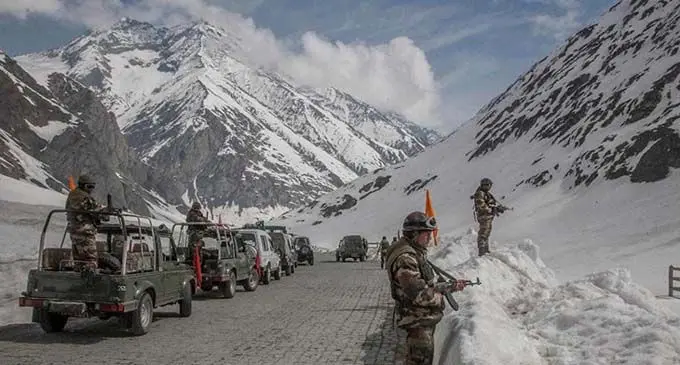
Though India and China remain engaged in talks over the border standoff, there is speculation in Ladakh that Pakistan and China are preparing for a two-front war against India during the coming winter.
Can ‘General Frost’ play a role?
The first time the name ‘General Frost’ appeared was in 1812 in a British satirical cartoon dedicated to Napoleon’s catastrophic Russian campaign. The cheering British wrote: ‘General Frost shaving little Boney.’ The severe frost took a dreadful toll on the ill-prepared Grande Armée on its way out of Russia. Only a few tens of thousands of soldiers out of 600,000 returned home, and winter played a not inconsiderable role in this.
Related stories
‘General Frost” played a crucial role again during World War-II. Adolf Hitler launched ‘Operation Barbarossa’ and attacked Soviet Russia with three and a half million German troops, 3400 tanks and 2700 aircraft. It was the largest invasion force to date. Adolf Hitler was confident of swift victory, asserting to his generals, “We have only to kick in the door and the whole rotten thing will come down.” At first it seemed that, yet again, Hitler’s prediction would come true. As such, the Nazi soldiers went into battle wearing only summer-weight uniforms. As winter approached, conditions for the lightly clad German troops at the front became appalling. Weapons malfunctioned. Vehicles wouldn’t start. Frostbite cases soared. Troops froze to death. Despite reaching close to Moscow, Germans had to retreat with heavy losses.
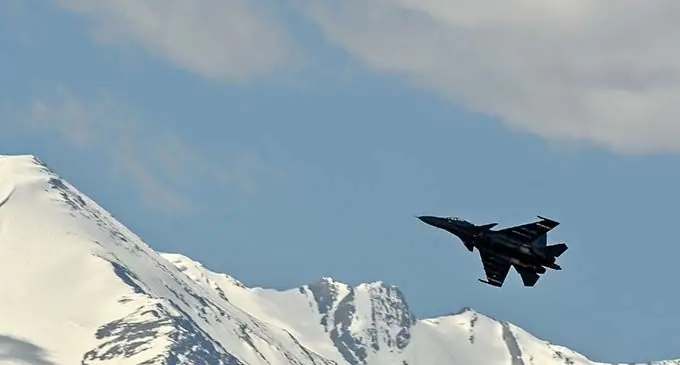
An Indian fighter jet soaring high above Ladakh.
Indian army gearing up for long haul
The Indian side has reportedly doubled its call for rations, which include winter clothing, shelter, tents, fuel and other tools required to face the harsh temperatures in the Himalayan region.
With the PLA deploying close to 50,000 troops in Aksai Chin, the Indian Army deployed the same number of troops and inducted T-90 and T-72 tanks. The armoured personnel carriers, M-777 155mm howitzers and 130 mm guns had already been deployed to the faceoff areas.
Western defence analysts feel that the Indian Air Force (IAF) has an advantage in Ladakh because most of the air fields are located in low altitude areas which allow their fighters to take off loaded with optimum fuel and weapons.
The IAF is operating large numbers of fourth generation fighters including Su-30MKi and MiG-29 which has the capability to fly at night in the high-altitude area. Recently inducted Apache attack helicopters are carrying out round-the-clock flying over Eastern Ladakh. The IAF has also pressed into service a fleet of heavy-lift Chinook helicopters, C-17 Globemaster transport aircraft as well as C-130J Super Hercules to transporting heavy military equipment and weaponry to several forward bases in the region.
With the induction of Rafale fighter jets on July 29th with Su-30 MKi, “IAF has both the capacity and capability to bring the fight to Han China, way beyond Tibet and Xinjiang” said a senior IAF officer.
Caution India
The PLA has the option to use its silent cyber capabilities to target India. Its space capabilities too are impressive. While it is unlikely to use its Direct Ascent Anti-Satellite (DS-ASAT) kinetic capability involving the use of ballistic rockets, nothing prevents it from using its co-orbital ASAT weapons to target India’s GSAT series satellites. The PLA has specialised units training on DS-ASAT and co-orbital ASAT weapons. The PLA has powerful electronic warfare (EW) jammers capable of blinding satellites.
China does not want war with India in the near future for two strategic reasons. One, its principal adversary — the United States — needs to be tamed first in the western Pacific theatre through ASEAN as the pivot.
The other reason is that it would demolish China’s peaceful rise format through the BRI. This would have an adverse effect on its Asia-Pacific strategy, its ‘Two Centennial Goals’ (2021 and 2049) and the Chinese Dream. China and India will eventually find a face-saving mutual compromise to end the Ladakh standoff, as neither wants a war. However, the unsettled border will continue to destabilise, fester, and brew more clashes down the road into the future.
Feedback: rosi.doviverata@fijisun.com.fj