Why did every country visit the city of Kigali in 2016?
Sounds like a huge relief until it’s made aware that HFCs can be held responsible for global warming.
Friday 02 February 2024 | 11:44
It’s quite the same reason why all governments of 197 countries went to Montreal, Canada in 1987 – to save the ozone layer (and beyond).
Why did the ozone layer need saving?
Apocalypse anxiety, in short.
Related stories
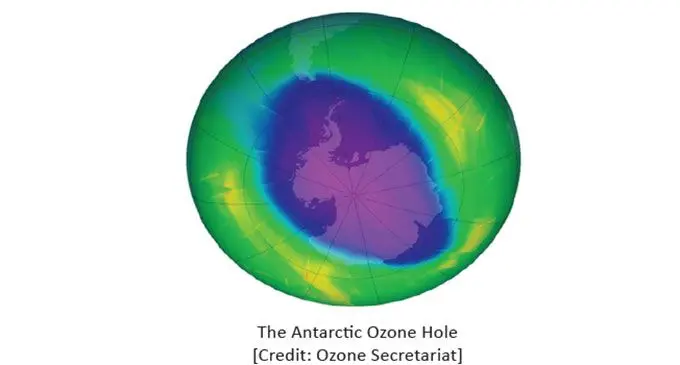
While the 80s is remembered for the Spielberg era, MTV’s debut, Madonna, and big hair, the fear of “the end of the world” emerged when a group of scientists discovered the Ozone Hole. By nature, the ozone layer softens the sun’s UVB ray before it reaches us, making the fatal level of radiation intensity appropriate for lives.
The fear was fairly justified because the worst-case scenario was that if the ozone layer had continued to thin, we would have all burned to death (with no exception to plants and animals). If not (that serious), skin cancer, eye cataract, and poor immune system were not so far off the mass reality.
The first global mission: Montreal Protocol
The urgent environmental fiasco of the ozone layer was investigated, and it was concluded that the main cause of Ozone Hole had a name… It’s chlorofluorocarbons, aka CFCs. CFCs are the chemicals used for aerosols (think hair spray) and to power up our cooling equipment such as fridges, but they did also deplete our protective ozone layer.
It became a clear and collective mission for all countries to start banning the production and use of CFCs in order to restore the ozone layer. Under this global mission, countries met in Montreal, agreed, ratified, and have ever since been guided by the international landmark treaty signed by all countries known as the Montreal Protocol.
To date, 99% of ozone-depleting substances have been phased out!
If CFCs are gone, why did the countries have to meet again in Kigali, Rwanda?
Question should be: when CFCs were phased out, what substances were used instead?
Hydrofluorocarbon (HFCs) were introduced in substitution of CFCs and Hydrochlorofluorocarbons (HCFCs) because they do not deplete the ozone layer and have remained widely used.
Sounds like a huge relief until it’s made aware that HFCs can be held responsible for global warming.
The New York Times put it so perfectly that HFCs function “as a sort of supercharged greenhouse gas, with 1,000 times the heat-trapping potency of carbon dioxide.”
No, solving one problem in contribution to another is not so ideal, especially when it involves livelihood-threatening issues of climate change. In response, countries met again in the city of Kigali in 2016 to figure out and decide what’s next.