Child Beggars: A Social Problem
The Ministry of Women, Children and Poverty Alleviation’s Department of Social Welfare Profiling Established that these children are from nearby informal settlements
Saturday 29 August 2020 | 13:12

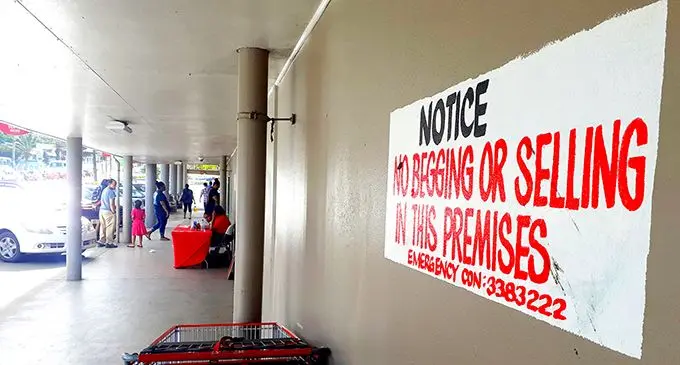
Cost U Less in Suva has put up security and sign to stop people begging and peddling on their premises. Photo: Ronald Kumar
It is a problem which seems to be escalating as school aged children are seen begging in locations around shopping centres and malls in the Suva Nausori corridor and Lami.
The children whose ages average between eight and 17-years-old mostly hang around in groups, but there are some who are found to be on their own from the evenings to late night.
It has also been established that in all cases the children are from informal settlements. A profiling of these children and their families was done by the Ministry of Women, Children and Poverty Alleviation’s Department of Social Welfare.
Related stories
Director Rupeni Fatiaki said in some cases the parents of the children know where they are and what they are doing.
According to the profiling report, the locations of the informal settlements determine where the children would be.
Informal Settlements
At the Sports City, Damodar City and Cost U Less area, the children are from Wailea and Muanivatu Settlements. Those at the Habour Point Plaza are from the nearby Lami informal settlements.
Children from the Caubati and Laucala Beach settlements are found at Centrepoint, Vivrass Plaza and the Lee’s Meet and Mingle.
“It is a complex issue. There are cases where children are begging, then there are cases where the children are selling items but also beg by asking for loose change,” Mr Fatiaki said.
“We have also found that in some cases we are dealing with absent parents. The parents are not at home, they may be drinking grog or doing something elsewhere and not looking after their children.”
When the Department of Social Welfare contacted the parents of the children found begging and asking for loose change in these locations; warnings are issued. The children stop the act for a certain time and then show up again.
Mr Fatiaki said the issue is very complex because sometimes the children are from broken homes, living with relatives and sometimes with a single parent.
He added the Department was working with the Ministry of Labour to see if parents and guardians could be held legally accountable.
Public encounters
Atnish Chand, 39, pulled over in Nabua opposite the Nabua Police Station.
He had just come out of his car and headed to the ATM when a young girl approached him.
It was around 8pm and it was outside a liquor shop.
He said the girl looked around 13 to 15 years of age.
“She said, uncle help, some loose coins. I gave her loose coins I had in my pocket $2 or $3. My biggest worry was how could a child be allowed out at night,” he said.
Viliame Naqelevuki, 48, noticed a boy sitting around the Hot Bread Kitchen in Centrepoint, Nasinu. This was morning.
He later returned in the evening and found the same boy, begging.
“I was quite stern and asked him what he was doing. He gestured that he was hungry. I told him that if he had been here since morning, I am sure that you collected more than $20 by now,” he said.
“I did not give him any money.”
Karalaini Maramanibure, 54, after buying bread at the Habour Point Plaza was approached by an eight-year-old girl selling roti parcels on a wet and cold night last month at the car park.
“The girl was wet and she seemed to have been in the rain, she had no shoes selling roti for $1 a parcel,” Ms Maramanibure said.
“She said her mum had send her to sell the roti parcels. This was close to 8pm Friday.
“The roti parcels were also cold but we bought three and gave her $5.
“How can a mother send her daughter out alone at that time with all these social decay hovering around us?”
Esther Lal, 29, said now she refused to give money to the children.
“When we give them money, it only encourages them to beg. I hope the authorities can do something about this and I urge other members of the public to stop giving money to these children,” she said.
Ms Lal said it was a nuisance as the children were almost demanding.
Cost U Less Supermarket in Laucala Bay has large written signs on their walls saying begging is not allowed. The supermarket even has security officers who are keeping the children off the customers.
A similar strategy has been adopted by the two shopping malls next door, but the children find a way to evade the watchful eyes of the security guards and approach people for money.
Inclusive approach
Director Social Welfare Rupeni Fatiaki said poverty was not always the reason behind the children’s behaviour.
He said the profiling also found that some of the children used the money for cigarettes, drugs, data and for their pleasure. He said it was hardly to help the family.
Mr Fatiaki said community leaders and faith based organisations need to get involved. He said it was not only the children that needed to be talked to but parents and guardians as well.
A visit to any of the locations mentioned above would ensure a sure encounter with these children.
Feedback: shalveen.chand@fijisun.com.fj