Shine A Light: Fiji's Ground Zero Prepares For Worse
Over the past few weeks, emergency department registered nurse Joshua Lewenilovo has had to deal with nine deaths while working his shift. He expects this number to increase over the next few weeks.
Sunday 08 August 2021 | 15:46
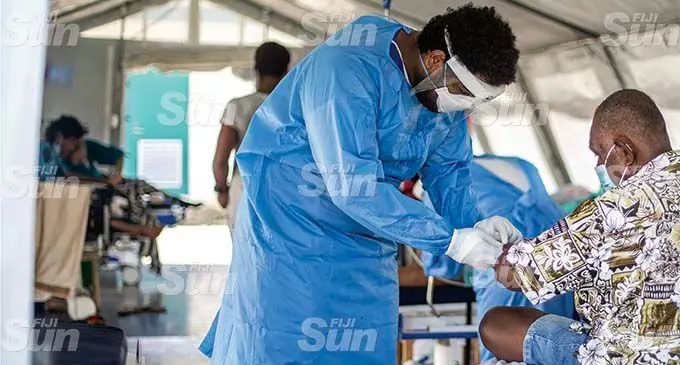
Emergency Department nurse Joshua Lewenilovo, on July 22, 2021, attends to one of the many COVID-19 patients accommodated in one of the tents that were set up outside the Colonial War Memorial Hospital. Photo: Leon Lord
The Ministry of Health and Medical Services had strategically planned to safeguard Fiji’s main hospital from the second wave of COVID-19 outbreak in April.
But today, the hospital’s emergency department is one of the hot spots for COVID-19 in Fiji.
Given the rise in the number of daily COVID cases and deaths, it is evident the situation is going to get worse, before it gets better.
Related stories
Over the past few weeks, emergency department registered nurse Joshua Lewenilovo has had to deal with nine deaths while working his shift. He expects this number to increase over the next few weeks.
Some of the deceased arrived at the emergency door lifeless. Others died while admitted at the hospital.
Mr Lewenilovo is concerned that anti-vaxxers place the vulnerable at risk of succumbing to the deadly Delta variant.
For the months of June and July alone, not only has there been a spike in COVID cases, but also an increase in the number of COVID deaths.
As of 18 July, the John Hopkins University released data placing Fiji at the top of the chart as the country recording the most number of daily cases, with 1130 cases per million people.
On Wednesday, Permanent Secretary for Health Dr James Fong announced the country recorded 21 deaths, the highest so far, for the period of 14 July to 21 July.
Most of the deceased were the vulnerable population from the Lami, Suva and Nausori areas. They were either unvaccinated or had only received one dose of the AstraZeneca vaccine.
As the crisis escalates, the CWM Hospital has had to switch to a mitigation phase. A strategic move to protect the country’s already overwhelmed health resources.
CWM FIELD HOSPITAL
Shine a Light was given access to the emergency department after consecutive in-depth coverage of lives claimed by this invisible virus.
Four makeshift tents were erected outside. They were put up about three weeks ago. This was part of the ministry’s contingency plan to cater for the influx of patients.
Inside are COVID positive patients. Most belong to the vulnerable group in our society burdened with pre-existing medical conditions. There was not a single young person on any of the beds. Majority of these elderly patients were on oxygen and medication.
Family members were not allowed inside the tent. They’d have to wear full personal protective equipment to enter the tents. All interactions were done via the healthcare workers at the entrance of the Emergency Department. This is how relatives are updated on the condition of their loved one.
Patients were later transferred to the COVID wards inside the hospital if their swab result came out positive. Getting swabbed was mandatory.
Once the result was released, patients are sorted into COVID and non-COVID patients.
The four tents can accommodate 21 patients. There are an additional 20 beds inside the Emergency Department for COVID positive patients. The sight inside the Emergency Department was both eerie and heartbreaking. Patients were on oxygen and monitors, some stable and some seriously ill.
Half of the west wing of the old hospital caters for COVID patients.
Bed spaces have also been provided in the Acute Medical, Acute Surgical wards, the two COVID intensive care units and the Critical Care unit.
Oxygen supply is consistent with enough stock available for patients treated at the Emergency Department. Oxygen is supplied by BOC (Fiji) Limited based in Lami.
Empty oxygen bottles are replaced twice a day. These oxygen bottles are also utilised by non-COVID patients.
The Ministry has also pre-ordered oxygen, considering the growing crisis.
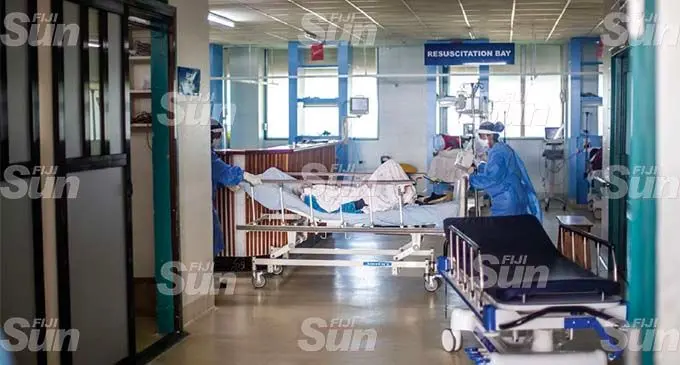
Frontline health workers attend to another patients at the Colonial War Memorial Hospital in Suva on July 22, 2021. Photo: Leon Lord
WHO RESPONSE
MOH has been working with the support of WHO and partners like Australia, the European Union, New Zealand and the United Kingdom to expand current capacity.
These included setting up remote monitoring systems for patients at home (focusing on the highest risk), expanding intensive care units, and establishing intermediate care sites such as the ones at Vodafone Arena and the FMF Gymnasium.
This was the response from WHO Technical Officer, Risk Communication and Community Engagement Rose Aynsley to questions sent by Shine a Light.
Countries around the world have recognised that this virus would be with us for some time to come.
The only way to return to the old normal is to fully protect ourselves through vaccination.
“COVID-19 is a highly infectious disease and the new Delta variant spreads even more easily. Until enough people around the world are vaccinated, this virus will continue taking lives,” she said.
Ms Aynsley said the recent death of 15-year-old Semaema Rabukawaqa was a tragic reminder of how this virus does not discriminate.
“Although most cases reported in Fiji have occurred in younger age groups, people over 50 years of age have been most likely to experience severe disease and death; hence, their prioritisation for vaccination,” she said.
“The experience in Fiji is in line with global data (e.g. only 0.2 per cent of deaths worldwide have been reported in people under the age of 20 years).”
She reiterates that while younger people are at much less risk of suffering severe COVID-19, they must remember that low risk is not zero risk.
Practising COVID-safe measures is critical during this growing crisis.
Edited by Rosi Doviverata
Feedback: ivamere.nataro@fijisun.com.fj