From saving to growing: An investment strategy for Fijians
Financial security in Fiji is not determined by the size of your salary. It is determined by the decisions you make with what you earn.
Tuesday 30 June 2026 | 19:30

Warren Buffett once said, “Do not save what is left after spending; rather, spend what is left after saving.”
However, real-world practice is somewhat different. Recently, the Honourable Minister for Finance, Esrom Immanuel, raised concerns in Parliament about the early withdrawal of funds from the FNPF.
He highlighted multiple issues, including the level of contributions and the problem of early withdrawals.
Related stories
This raises an important question: why do individuals withdraw their savings before maturity? A simple explanation could be a lack of sufficient income and a tendency to overspend. However, the issue goes beyond that. It also points to broader concerns such as the diminishing value of money and a lack of investment awareness.
A quiet, slow-moving crisis is unfolding in many Fijian homes. It does not make headlines or trigger urgent meetings, nor does it arrive with dramatic warning. Instead, it builds gradually, day by day, month by month, as the value of hard-earned savings steadily declines. While some may call this the impact of inflation, the reality runs much deeper.
The real issue is this: many people work hard, earn income, and consistently set aside savings, yet still fall behind. This is not due to a lack of effort or discipline.
Rather, it is because we are taught to save but rarely taught how to invest. This issue becomes catastrophic in a world of rising costs, economic uncertainty, and increasing life expectancy. Now saving alone is no longer sufficient alone, and we must look for financial security.
This article explores why your money must work as hard as you do and how, with the right knowledge and habits, any Fijian, regardless of income level, can move from financial survival to financial security.
The Culture of Saving: Where Every Journey Begins
Across the Pacific and beyond, communities that have maintained a strong culture of saving have consistently shown better resilience in the time of economic shocks.
When Tropical Cyclone Winston devastated parts of Fiji in 2016, families with financial reserves were better positioned to rebuild. When the COVID-19 pandemic brought global economies to a standstill in 2020, households with savings were able to absorb the disruption far better than those living paycheck to paycheck.
Saving is the act of deliberately spending less than you earn and setting aside the difference for future use. Question is how do you begin? The answer is simpler than most people expect.
Start with a budget. Track your income and your expenses honestly. Identify areas where spending can be reduced.
Then commit to transferring a fixed amount into a separate savings account every payday, before you are tempted to spend it. Even $20 a week compounds into something meaningful over time. The habit, not the amount, is what matters most at the beginning.
Why Saving Alone Is No Longer Enough
Here is an uncomfortable truth, inflation is working against your savings account’. Inflation is the gradual rise in the price of goods and services over time.
In Fiji, as in most countries, everyday essentials have been rising in cost year after year. When the price of rice, school fees, fuel price, or a doctor's visit increases by 4 or 5 per cent annually but your savings account is earning only 1 or 2 per cent interest, your money is actually losing purchasing power.
You may have more dollars in the account, but each of those dollars buys you less than it did the year before.
I am not saying that bank savings accounts are bad. They are safe, accessible, and essential, particularly for your emergency fund, which we will discuss shortly. But as a long-term strategy for wealth creation, a savings account alone is a vehicle that will not take you far enough, so you need another vehicle called ‘investment’.
Before You Invest: Build Your Emergency Fund
Have you ever seen a father standing outside a credit union, seeking a loan just to buy school stationery for his children, or selling household items to cover an unexpected expense? The reason is simple: there is a lack of money, often because there is no emergency fund in place.
An emergency fund is not a luxury; it is a financial safety net, readily accessible cash set aside to handle unexpected shocks such as job loss, medical emergencies, urgent repairs, or natural disasters. In Fiji, where employment can be uncertain and cyclones are a recurring threat, having an emergency fund is not optional but it is essential.
This should be your first line of defence before investing. Without it, any unexpected expense can force you to borrow at high interest rates or sell investments at the wrong time.
Remember what Albert Einstein (disputed) said.
‘Compound interest is the eighth wonder of the world. He who understands it earns it. He who does not, pays it’. Borrowing is perfect example of it, and you should avoid borrowing to your best. Simply put, an emergency fund is the shield that protects your financial stability and allows your investments to grow strategically.
Where Can Fijians Invest? A Practical Overview
Once your emergency fund is in place, the next question becomes: where should you invest? The good news is that there are real opportunities available for ordinary Fijians, regardless of income level or risk appetite.
The South Pacific Stock Exchange (SPX) allows individuals to buy shares in listed companies and become part-owners, earning returns through dividends and long-term growth.
However, patience is key, as share prices can fluctuate in the short term. For those who prefer a simpler, hands-off approach, the Unit Trust of Fiji (UTOF) offers a practical option.
It pools your money with other investors and spreads it across a range of assets, making it a good starting point for beginners.
For more conservative investors, government bonds, such as Viti Bonds, provide steady and predictable returns, making them suitable for those nearing retirement or those who prefer lower risk.
Beyond financial markets, property remains a popular investment in Fiji, offering both capital growth and rental income. That said, it requires significant upfront capital and careful borrowing. Entrepreneurship, whether starting your own business or investing as a silent partner, can deliver higher returns, but it also comes with higher risk and demands strong planning and discipline.
Finally, do not overlook a simple but powerful option: making voluntary contributions to your FNPF account. With average returns of over 7 per cent, it remains one of the most reliable ways to build long-term retirement savings and a personal favourite for steady wealth accumulation.
Remember a final suggestion that do not put all your eggs in one basket rather diversify, meaning spreading your money across different asset types so that the poor performance of one does not devastate your entire financial position.
Also make sure that you have a proper retirement plan. I personally suggest that FNPF can give you a perfect retirement plan.
Your Financial Roadmap: A Step-by-Step Journey to Wealth
Building wealth is not a single dramatic decision. It is a series of small, disciplined choices made consistently over time.
Below is a practical roadmap every Fijian can follow:
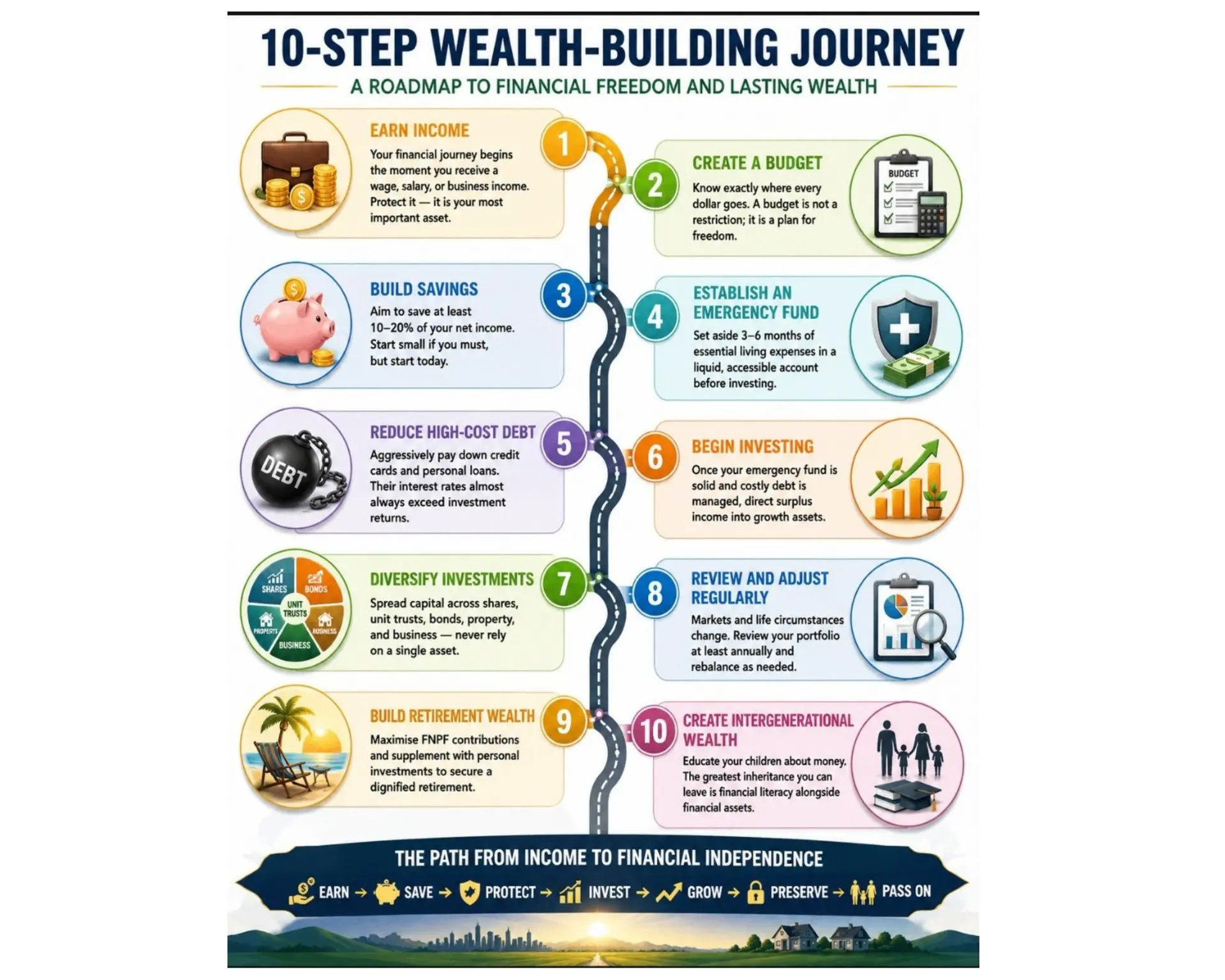
This roadmap is not reserved for the wealthy. It is designed for any person who earns an income and is willing to make intentional choices about how that income is managed.
The Most Important Investment You Can Make
I started by saying that your money is losing value while you sleep. But here is the empowering truth on the other side of that statement: you have the ability to change that.
Financial security in Fiji is not determined by the size of your salary. It is determined by the decisions you make with what you earn. Start today. Open a savings account if you do not have one.
Calculate what three months of living expenses looks like and set a plan to build that emergency fund. Speak to someone who can guide you.
Your future self and your children will thank you for the decisions you make right now.
(Dr. Shukla is a Lecturer in Accounting at the Graduate School of Business at the University of the South Pacific, and the opinions presented above do not reflect his employer but rather his own.)