October 1 ruling on whether 2011 health tender case proceeds
Defence teams seek acquittal, while the State says witness testimony and documentary evidence give the three accused a case to answer.
Tuesday 11 August 2026 | 16:00

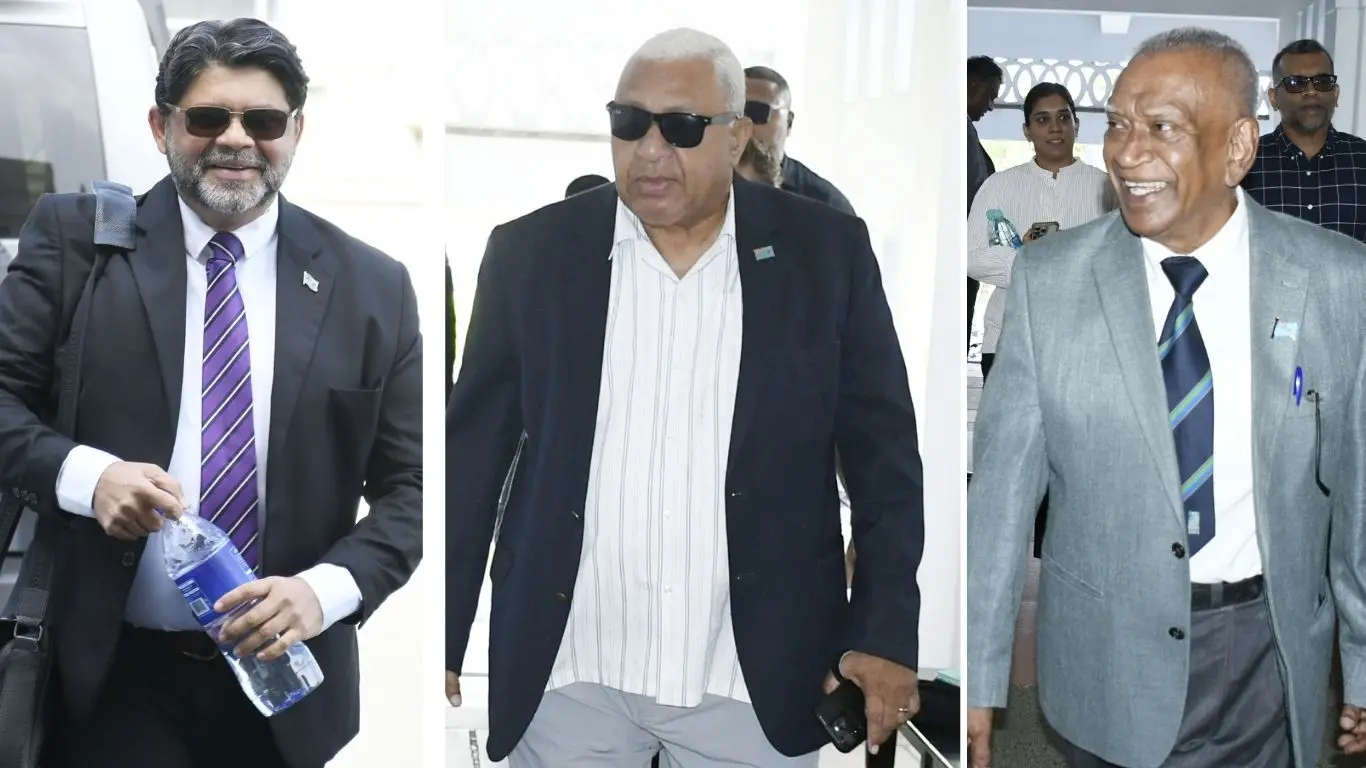
From left: Former Attorney-General Aiyaz Sayed-Khaiyum, former Prime Minister Voreqe Bainimarama and former Health Minister Dr Neil Sharma.
Photos: Ronald Kumar
Whether the 2011 health tender case proceeds to trial will be determined on October 1 when the High Court in Suva delivers its ruling on the no-case application.
Former Health Minister Neil Sharma, former Prime Minister Voreqe Bainimarama and former Attorney-General Aiyaz Sayed-Khaiyum appeared before Justice Usaia Ratuvili today for the hearing.
Both defence teams argued that the State had failed to establish a case against their clients and asked the court to acquit them.
Related stories
Sharma’s defence
Senior lawyer Wylie Clarke argued that the State had failed to establish abuse of office or breach of trust against Sharma.
Mr Clarke said Sharma had genuine concerns about Fiji’s healthcare system, including Roche Diagnostics allegedly having a monopoly on reagents and services, high reagent costs and wastage, ageing or unsuitable equipment, equipment breakdowns and poor laboratory services, particularly in rural areas.
He argued that these concerns provided a public health and procurement basis for Sharma’s actions and did not establish criminal intent.
Mr Clarke said the State was attempting to turn a procurement disagreement into a criminal case.
He argued that administrative decisions, waivers or differences of opinion did not automatically amount to abuse of office or breach of trust.
On counts one and three in CT66/2011, Mr Clarke said the State could not prove its case because the original bid documents were not before the court.
He said this meant the court could not determine what bidders had offered, whether the Technical Evaluation Committee’s recommendations were accurate, whether Hospineer was improperly favoured or whether any bidder had been disadvantaged.
Mr Clarke said there was no law preventing Sharma from seeking a waiver and that the committee’s recommendations were not final.
He argued that the waiver process was proper and that the State had failed to prove dishonest conduct, criminal intent or a breach of public trust.
Bainimarama and Sayed-Khaiyum
Lawyer Devanesh Sharma, representing Bainimarama and Sayed-Khaiyum, argued that the charges against his clients were defective.
He said the State relied on the phrase “employed in the public service”, although the relevant law had been amended to refer to the civil service.
Mr Sharma said the State had failed to prove the essential elements of counts five, six and seven.
He argued that the waivers were lawfully granted under Regulation 48(4), which allowed exemptions for urgent infrastructure development and services.
He said both accused acted on formal written requests and exercised powers provided by law.
Neither man was involved in the tender process itself, he said.
Mr Sharma argued that saying they “should have known” the rules was not enough to prove recklessness, as required by law.
He also said the State had not proved that Sayed-Khaiyum gave a directive or intended to obstruct justice.
State opposes no-case application
Assistant Director of Public Prosecutions Laisani Tabuakuro opposed the no-case application, saying the State had presented sufficient evidence through 14 witnesses.
In relation to Sharma, Ms Tabuakuro said evidence from former Health Permanent Secretary Dr Salanieta Saketa and former Fiji Pharmaceutical and Biomedical Services procurement officer Solomoni Suguta had not been challenged during cross-examination.
The State also relied on Sharma’s caution interview, in which he acknowledged that emails tendered in evidence were his. Ms Tabuakuro said the emails showed a relationship between Sharma and Hospineer owner Vashu Devan.
She argued that Sharma interfered in the tender process to ensure Hospineer received the contracts.
Ms Tabuakuro disputed the defence interpretation of Regulation 48(4), saying a waiver could only be granted when it was impractical to comply with procurement requirements and that the provision applied only to urgent infrastructure development and services.
The State argued that Bainimarama and Sayed-Khaiyum should have known the limits of the regulation because of their responsibility for procurement legislation.
Ms Tabuakuro said they were reckless because they should have known the conditions for granting a waiver had not been met. On the allegation that Sayed-Khaiyum obstructed justice by causing a Fiji Independent Commission Against Corruption (FICAC) investigation to be shelved, the State relied on investigation records and diary entries.
These recorded conversations indicating that the investigation was put on hold after discussions involving Sayed-Khaiyum.
The State argued that although Sayed-Khaiyum may not have had formal authority over FICAC investigations, his position as Attorney-General and line minister gave his views significant influence.
Ms Tabuakuro also rejected the defence reliance on constitutional immunity, arguing that the alleged offences of abuse of office and obstructing the course of justice could be prosecuted.
The State asked the court to dismiss the no-case application, arguing that witness testimony, caution interviews, emails, procurement records and investigation documents provided sufficient evidence for the accused to answer the charges.
All three accused remain on bail. The High Court will rule on the no-case application on October 1.