Digital technology brings splendour of Chinese civilisation to Fiji
Interactive AI exhibition at USP allows Fijian students to explore ancient Chinese artefacts, textiles, and classical texts in immersive digital form.
Monday 04 May 2026 | 14:00
Updated 04 May 2026 | 15:34 FJT

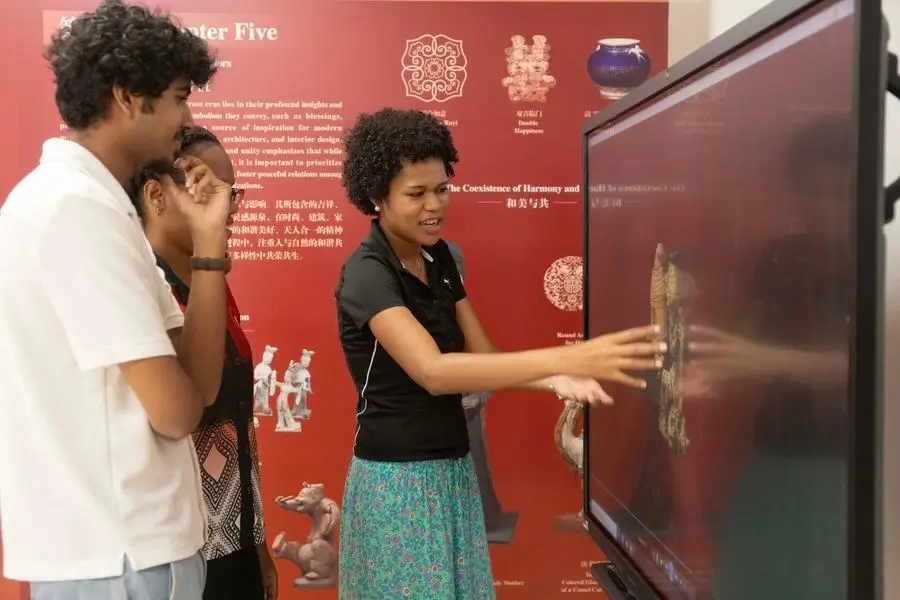
Visitors inspect a digital model of the Changxin Palace Lamp at the Confucius Institute at the University of the South Pacific in Suva, capital of Fiji, April 27, 2026.
Photo: Gao Xin/Xinhua
In a quiet corner of the Confucius Institute at the University of the South Pacific (USP) in Fiji, a touchscreen has become a portal to ancient China.
With a few light taps, the digital model of the Changxin Palace Lamp from the Western Han Dynasty over 2,000 years ago comes to life.
Users can rotate, zoom, and virtually disassemble the lamp, examining its intricate structure and craftsmanship from every angle.
Related stories
This immersive experience is part of the month-long digital cultural exhibition, "The Light of Chinese Civilization" -- "Seeing China" and the "Confucius Code", co-hosted by the Chinese Embassy in Fiji, the Centre for Language Education and Cooperation, Beijing University of Posts and Telecommunications (BUPT), the Confucius Museum, and organised by the Confucius Institute at USP.
The "Seeing China" section is also being shown at the China Cultural Canter in Fiji.
Leveraging artificial intelligence and digital technologies, the exhibition breaks free from the constraints of static displays, offering an interactive, multisensory experience that is "audible, tangible, and perceptible."
In the "Motifs and Colour" section of "Seeing China," Fijian student Rini is busy "embroidering" butterfly motifs onto a Ming Dynasty (1368-1644) robe. With a swipe of her finger across the robe, a trail of exquisite butterflies appears. "The patterns on ancient Chinese costumes are so beautiful," Renee exclaims.
Zhao Haiying, professor from the School of Artificial Intelligence at BUPT, told Xinhua that her team's digital technology can not only extract patterns and colours from cultural relics and costumes, but also analyse fabric textures, weaving techniques, and the symbolic meanings behind the ornaments. "This reveals the unique craftsmanship and aesthetic wisdom of ancient Chinese artisans," she said.
In the "Confucius Code" section, a digital interactive screen based on the Ming Dynasty painting "Portrait of the Three Sages" draws a crowd.
The three sages are Confucius and his disciples Yan Hui and Zeng Shen. The folds of their robes are filled with tiny lines of regular script, which turn out to be the entire text of The Analects of Confucius. From a distance, they appear as cloth patterns; up close, the characters become visible. Visitors can touch the screen to magnify the image and read the classical texts embedded in the robes.
"There's a replica of the Portrait of the Three Sages in our classroom," says Zion, a USP student. "I see it every time I come for Chinese lessons, but I never knew the secret. I thought it was just fabric decoration. The ancient Chinese were so wise. How did they do it?"
For this exhibition, Professor Zhao selected several cultural relics that had never been shown overseas and used digital technology to present them vividly.
"This allows local people to get up close with these historical treasures," she said.
Rini and Zion, both passionate about Chinese culture, were so captivated by the exhibition that they volunteered as live docents.
"We want more Fijians to see China, understand China, and experience its rich historical heritage through this exhibition," they said.