Opinion: Why I refuse to wear a smart watch in the age of tech fatigue
As workplaces become increasingly digital, Anal Kumar argues that constant connectivity is creating a hidden epidemic of tech fatigue — and explains why he chooses not to wear a smart watch.
Wednesday 10 June 2026 | 06:00
Updated 10 June 2026 | 12:14 FJT

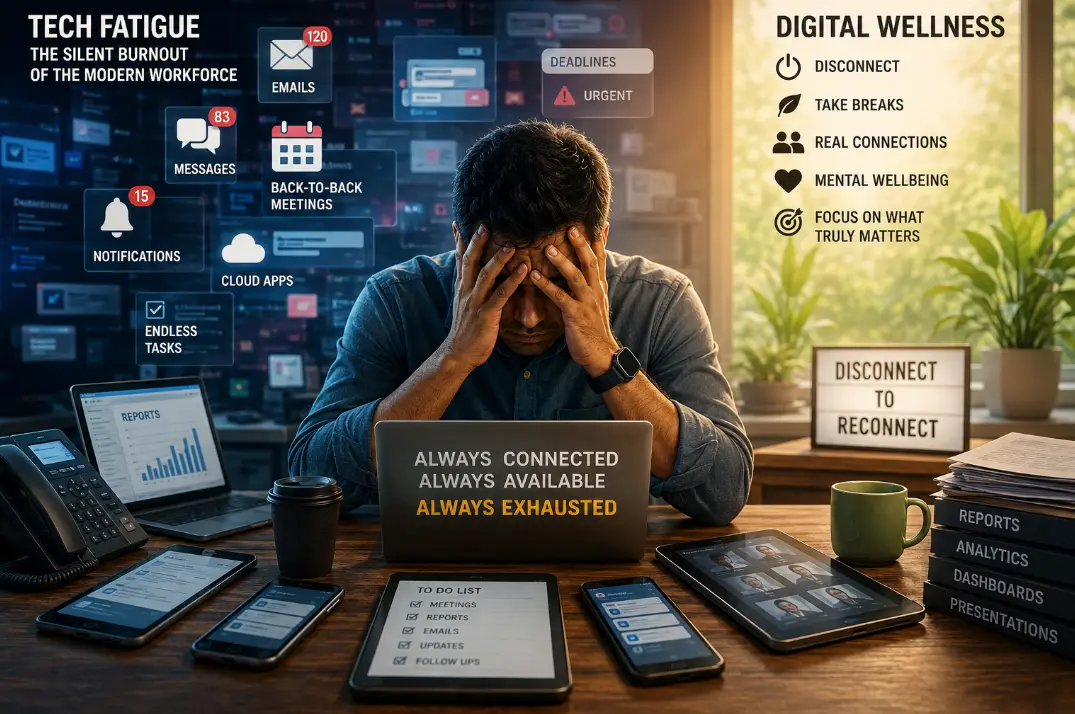
In this commentary, Fiji National University lecturer Anal Kumar explores the rise of tech fatigue, digital burnout and the challenges of constant connectivity in modern work environments.
Photo: AI Generated
My students often ask me why I refuse to use a smart watch.
In a world where technology continues to evolve rapidly and wearable devices have become symbols of modern living, many are surprised when I say that I intentionally choose not to wear one.
For some, a smart watch is convenient. It tracks fitness, monitors sleep, displays notifications, measures heart rate, counts steps, and keeps people digitally connected every minute of the day.
Related stories
But for me, it represents something much bigger.
It represents the growing problem of tech fatigue that is silently affecting workers across the modern workforce.
Technology today is no longer simply a tool that helps us complete tasks more efficiently. It has become deeply embedded into nearly every aspect of our lives. From the moment we wake up, we are surrounded by screens, notifications, emails, alerts, updates, and digital platforms demanding our attention.
For many workers, the digital world no longer pauses. The average employee today may begin the morning by checking work emails on their phone before even getting out of bed. Throughout the day, they move between laptops, mobile phones, online meetings, cloud systems, messaging applications, dashboards, reports, and endless streams of notifications. Even after work hours, communication often continues.
Technology has effectively removed the traditional boundaries between work life and personal life.
This constant digital engagement is creating what many experts now describe as “tech fatigue” which is the mental, emotional, and physical exhaustion caused by prolonged exposure to technology and continuous digital interaction. It is becoming one of the most overlooked workplace challenges of modern society.
The irony is that technology was originally designed to make life easier. In many ways, it has succeeded. Businesses operate faster, communication is instant, remote work has become possible, and access to information is greater than ever before. However, somewhere along the way, technology stopped being simply a support system and slowly became a source of pressure.
Today’s workers are expected to respond quickly, remain constantly available, adapt to new systems regularly, and manage multiple digital platforms simultaneously. Many employees spend entire days switching between tasks without any real mental pause. This continuous cognitive overload gradually drains concentration, creativity, motivation, and emotional energy.
The education sector provides a strong example of this reality. Teachers and lecturers are no longer responsible only for classroom teaching. They are now required to manage learning management systems, online assessments, virtual classes, digital attendance, plagiarism software, student emails, academic reporting systems, and various administrative platforms.
While these technologies bring many benefits, they have also increased screen time and workload expectations significantly. Sometimes, people are mentally exhausted before the day has even properly begun.
This is one reason why I refuse to wear a smart watch. I do not want another device vibrating on my wrist every few minutes reminding me about emails, missed calls, health targets, notifications, messages, or unfinished tasks.
I believe many people underestimate the psychological impact of being digitally connected every second of the day. Even silence has become rare.
One of the most concerning aspects of tech fatigue is that it develops quietly. Unlike physical exhaustion, digital burnout is not always visible.
Employees continue working, attending meetings, replying to messages, and completing tasks while slowly becoming mentally drained. Over time, this can lead to stress, anxiety, sleep disruption, reduced attention span, headaches, eye strain, and emotional burnout.
Ironically, the very technologies designed to improve productivity can sometimes reduce human efficiency when overused.
Artificial Intelligence (AI) is expected to intensify this issue further in the coming years. AI systems are rapidly entering workplaces to automate tasks, monitor productivity, generate reports, analyse data, and support decision-making. While AI offers enormous opportunities, it also increases the pace of digital transformation. Workers are now expected to continuously upskill, adapt, and learn new technologies faster than ever before.
In Fiji and across the Pacific region, digital transformation continues to accelerate rapidly. Government services, banking, education, tourism, retail, and communication systems are increasingly moving online.
Businesses are embracing automation, cloud computing, e-commerce, and AI-powered systems as part of national development and global competitiveness.
This progress is necessary, however, while organisations focus heavily on digital transformation, equal attention must also be given to human wellbeing.
Employees themselves need to learn how to disconnect. Spending time away from screens, engaging in physical activity, maintaining personal hobbies, and preserving face-to-face social interaction are becoming increasingly important in today’s digital society.
As we continue moving deeper into the digital age, perhaps success should no longer be measured only by how connected we are, but also by how well we manage our connection with technology.
Technology should support humanity, not dominate it. So yes, I refuse to use a smart watch. Not because I reject technology, but because sometimes choosing when not to connect may be one of the healthiest decisions a person can make in the modern workforce.
(Anal Kumar is a Senior Computing Lecturer, and Head of the Department of Computing Science and Information Systems (CSIS) at Fiji National University. His work focuses on Digital Marketplaces and Emerging technologies. The views expressed in this article are solely those of the author.)