Alice Queen Takes Over Viti Mining
Viti Mining will continue to manage the Fiji assets for Alice Queen, in an agreement where the purchase price was said to be confidential in nature.
Saturday 13 March 2021 | 12:21


Alice Queen managing director, Andrew Buxton and Viti Mining executive chair, John Sanday.
Alice Queen (AQX), an Australian mineral exploration company, has signed a binding, conditional share sale agreement for the acquisition of Viti Mining in Fiji.
The announcement on the Australian Stock Exchange means Viti Mining will own title and right of repossession until the purchase price is paid in full.
Viti Mining will continue to manage the Fiji assets for Alice Queen, in an agreement where the purchase price was said to be confidential in nature.
Related stories
Under the agreement, the company will acquire all the shares in the Fiji-domiciled exploration corporation, Alice Queen said in a statement released on the Australian Stock Exchange.
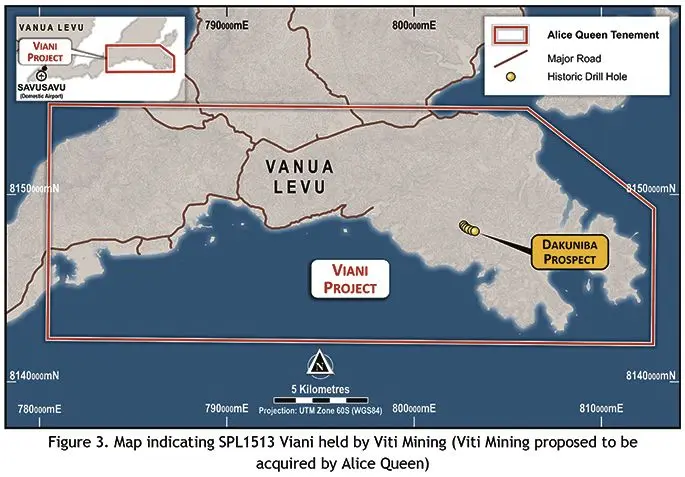
Viani site in Vanua Levu.
Juniors
“These are usually called “juniors”, who are the risk takers that spend enough money to identify a potentially mineable deposit.”
Upon identity of a mineable deposit, these are either on-sold to the senior end of the industry, the mining companies, Mr Sanday said.
“They have the engineers, geologists, metallurgists and the vast cash resources available to bring a potential project into a full scale mining operation,” he said.
“It is important to discern the difference in these two asset classes within the same industry.
“When I say asset class, I am talking from an investment point of view.
“It is a sub sector within the industry in which we can invest in.”
Given that junior exploration companies operate in the very risky end of the investment spectrum, they are usually high risk investments, he explained.
“But if the junior exploration company has good, proven geologists who can do the work to define a potentially large mineable resource within a tenement, it places itself out in the marketplace as a potentially worthy, “high risk” investment,” Mr Sanday said.
All it needs is for the junior company to intersect a drill hole containing good grades of minerals, and proves up the mineralisation theory, then it will send the share price soaring.
The play
“That really is the play.
“The same could be said of the opposite, if the drilling doesn’t intersect anything exciting then the share price won’t rise and that could potentially be a failure.”
Mr Sanday said: “As an example, a junior exploration company is listed on the Australian Stock Exchange, and carries out exploration in Fiji.
“It has been working on a tenement or a prospect in Fiji for a year or so, and has developed a theory for the way the gold has been deposited.
“They then decide to invest in several drill holes to prove the existence of the ore-body deep down in the earth to prove the theory they have developed.
“Let’s then say that prior to drilling, the share price is A$0.05cents(FJ$0.07)/share.
Game changer
“If the drill hole intersects a vein of gold mineralisation that supports the theory, it immediately changes the whole perception around this junior exploration company.
“This will have the effect of increasing the share price.”
When the share price rises to say $7.5cents/share, you would have gained a 50 per cent growth in value of your initial investment, Mr Sanday said.
Either way
But if the drill hole intersects a very thick vein carrying very high grades, the share price could end up increasing like 300 per cent, as an example,he said.
“It could also end up the other way, where the drill holes misses everything,” Mr Sanday said.
“This is where the quality of the people involved becomes important.
“It is important that I set this out clearly so that we stay focused on the investment aspects of this first, before we dived deeper.”
Feedback: frederica.elbourne@fijisun.com.fj








