Fiji’s $1.1b food import bill highlights agricultural imbalance
Government launches $26.5m investment plan to strengthen local food production
Tuesday 18 August 2026 | 08:00

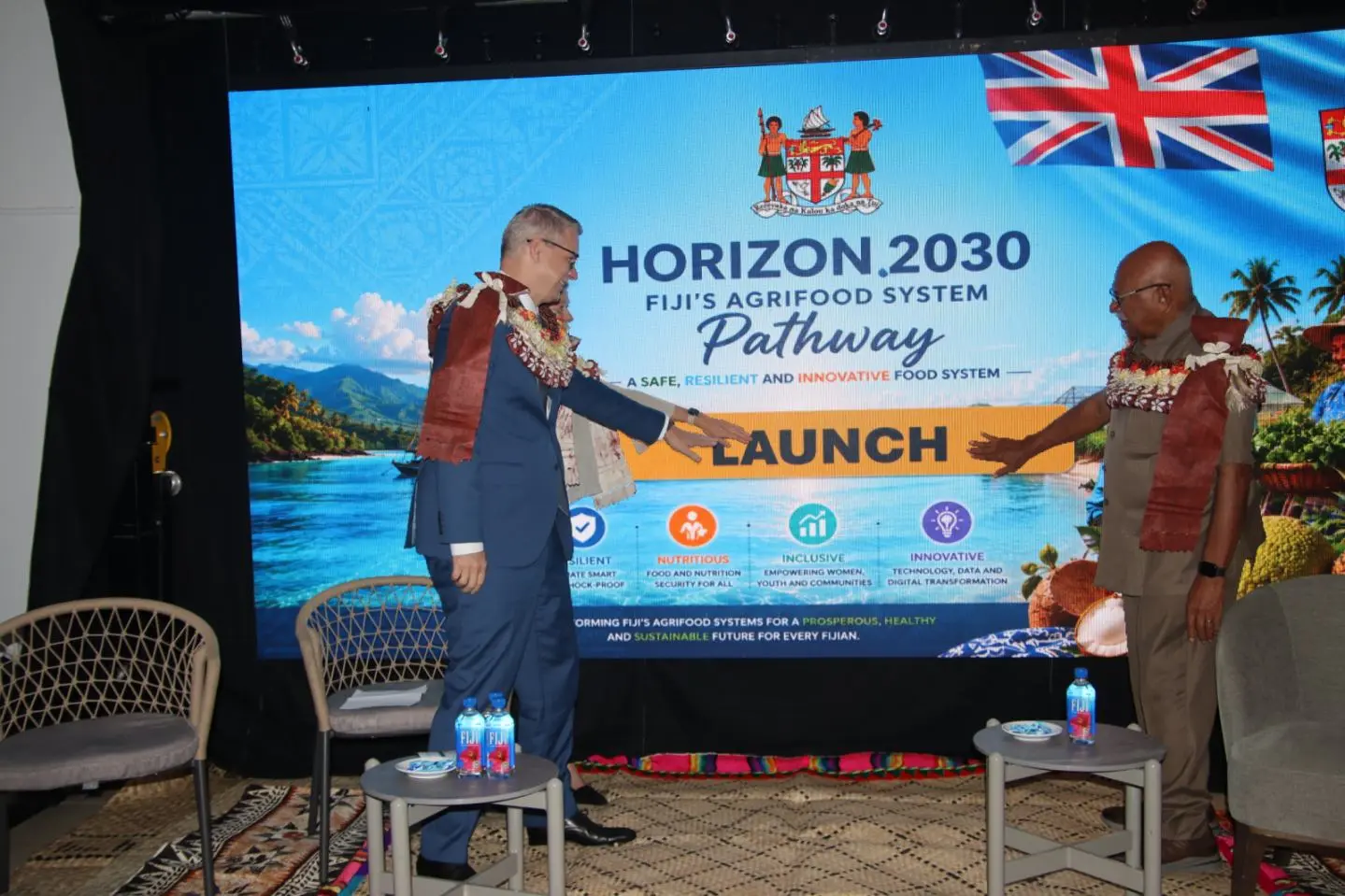
From left: UN Resident Representative Dirk Wagner and Prime Minister Sitiveni Rabuka.
Photo: Kaneta Naimatau
Fiji imported approximately $1.106 billion worth of food in 2023 while exporting only $343.4 million in crop and livestock products, highlighting the country’s heavy reliance on imported food.
Prime Minister Sitiveni Rabuka revealed the figures on Friday as he launched the Horizon 2030 National Food System Pathway at the Novotel Hotel in Lami.
Mr Rabuka said the country’s food import bill was more than three times the value of its exports, pointing to a container ship he saw arriving in Suva Harbour as he sailed in that morning.
“We saw this big container ship that called once every three months, importing wheat to Fiji,” he said, adding that he had seen breadfruit “laden with fruit” going unused elsewhere.
“A paradox, a paradox, a most ingenious paradox.”
The Prime Minister officially launched three instruments – Horizon 2030, the Fiji Food System Investment Plan Framework, and a Short-Term Investment Plan worth $26.5 million – aimed at cutting Fiji’s reliance on imported food.
The $26.5 million plan will be funded 40 per cent by Government, 35 per cent by development partner grants, 15 per cent by private sector investment and 10 per cent through climate finance.
Permanent Secretary for Agriculture Andrew Tukana said 63 per cent of Fiji’s youngest children suffer from multidimensional deprivation, while non-communicable diseases account for around 80 per cent of deaths in Fiji.
European Union Ambassador Barbara Plinkert said the EU’s agriculture support to Fiji, Samoa and Solomon Islands totalled more than $25 million from 2023 to 2028, with Fijian exporters enjoying duty-free access to the EU’s 450 million consumers.
UN Resident Coordinator Dirk Wagener said nearly a third of the world’s population could not afford a healthy diet, urging Fiji to rely more on local root crops, fish and seafood rather than imported processed food.
Agriculture Minister Tomasi Tunabuna admitted the food system “has not really been planned the way it should have been” and called for greater private and community investment.