Debugging Those Disappearing Developers
Whether you are hiring a freelancer or an in-house developer, it’s crucial to be aware of common scams that could cost your company time, money, and data security.
Saturday 31 August 2024 | 13:09
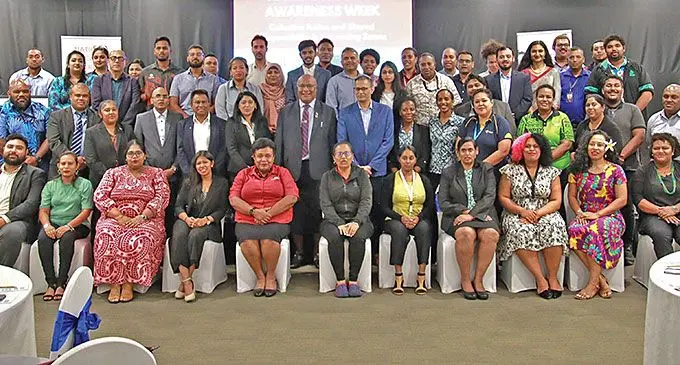
Deputy Prime and Minister and Minister for Trade, Cooperatives, Small and Medium Enterprises, and Communications, Manoa Kamikamica with participants at the first National Scams Awareness Week. Photo: Consumer Council of Fiji
This week I was fortunate to attend the launch of the first National Scams Awareness Week co-organised by the Consumer Council Of Fiji and the United Nations Capital Development Fund (UNCDF), UNDP Pacific Office in Fiji, and UN Trade and Development (UNCTAD) through the joint Pacific Digital Economy Programme.
It brought to mind the common scam stories I’ve heard from business owners who have built a website; such as those whose developers disappeared, delivered a half-working website, or secured digital assets under their name instead of the business’.
Hiring a developer can be a pivotal moment for any business, as the right developer can bring innovation and efficiency to your projects.
Related stories
However, the process is not without risks, and one of the most significant dangers is falling victim to scams.
Whether you are hiring a freelancer or an in-house developer, it’s crucial to be aware of common scams that could cost your company time, money, and data security.
FAKE PORTFOLIOS AND REFERENCES
One of the most common scams involves developers presenting fake portfolios and references.
These scammers often steal or fabricate impressive-looking work samples, hoping to lure in unsuspecting employers.
They might also provide contact information for fake references who will vouch for them.
Always verify the authenticity of the work presented. This can involve contacting previous employers through verified channels, asking for detailed explanations of past projects, and even conducting technical assessments to determine if the developer’s skills align with their claimed experience.
OVERPROMISING AND UNDER-DELIVERING
Some developers might promise the moon to secure a contract, only to underdeliver once they have been hired.
These scammers often inflate their abilities, claiming to have skills they don’t possess or to be able to meet impossible deadlines.
As a result, projects can suffer from delays, cost overruns, or poor-quality output.
DISAPPEARING ACT
Another common scam involves developers disappearing after receiving an upfront payment.
They may start work on a project, ask for an advance, and then vanish without completing the job. To avoid this, it’s advisable to structure payments based on milestones or to use escrow services where the funds are held until the work is completed to satisfaction.
Additionally, consider working with developers who have a verifiable track record.
ASSET OWNERSHIP AND INTELLECTUAL PROPERTY THEFT
A more sophisticated scam involves developers who claim ownership of the code they write for your project or who fail to transfer intellectual property rights properly.
This can lead to legal battles or the inability to use the software for your intended purposes.
To prevent this, ensure that your contract clearly outlines the ownership of the code and any associated intellectual property.
Where no-code tools or other subscription services are used, ensure any accounts are created with an email address that you have access to.
You want to be able to access your domain, website, and other assets in the event the developer disappears.
UNSECURED CODE AND DATA BREACHES
Security is a critical concern when hiring a developer, especially if your project involves sensitive data.
Some developers may not follow best practices for security, leaving your project vulnerable to attacks. In the worst cases, a scammer might intentionally introduce vulnerabilities to exploit later.
Hiring a developer requires due diligence to avoid falling victim to scams.
By verifying portfolios and references, setting clear expectations, structuring payments wisely, ensuring legal protections, maintaining communication, and prioritising security, you can minimise the risk of scams and hire a developer who will be a valuable asset to your team.
Remember, taking the time to vet candidates thoroughly is always better than rushing into a decision and regretting it later.
By: Shenal Harakh
- Shenal Harakh is an Australian-award winning digital entrepreneur, children’s book author, and previous consultant at firms like PwC in Australia, Bermuda, and New York City. She is the Founder of Sunset Studio which is a community and creative agency creating pathways for everyday Fijians to create software through workshops, networking, and storytelling.Join the community at www.sunsetfiji.com.Connect with her work and follow for upskilling workshops on Facebook/LinkedIn: Shenal Harakh or on X (formerly Twitter): @shenalyo








