Fiji ‘forfeited $10bn’ in growth due to political instability, says MP
Business leaders say repeated political disruptions have suppressed investor confidence and economic growth.
Monday 11 May 2026 | 08:30
Updated 11 May 2026 | 14:05 FJT

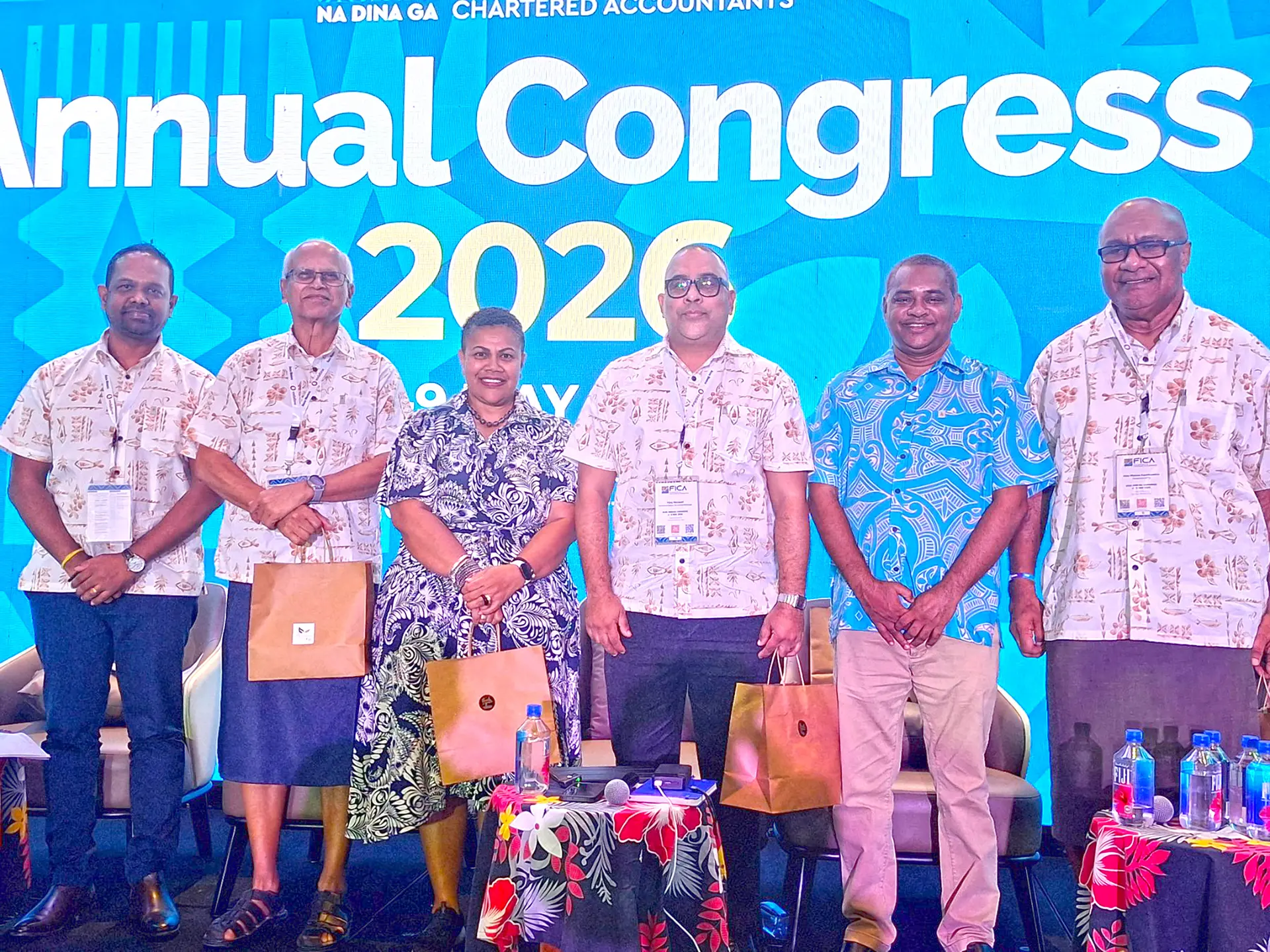
From left: Fiji Institute of Chartered Accountants (FICA) president Sharvek Naidu, Golden Manufacturers PTE Limited chief executive officer Ram Bajekal, lawyer Tanya Waqanika, Fijivillage news director Vijay Narayan, Mai TV director Stanley Simpson, Standing Committee on Public Accounts chairperson Manoa Kamikamica.
Photo: Katherine Naidu
Fiji has forfeited an estimated $10 billion in potential economic development due to repeated political instability, with business leaders warning the long-term cost continues to weigh on growth, investment and confidence.
The assessment was highlighted by chairperson of the Public Accounts Committee and Member of Parliament Manoa Kamikamica during a strategic session at the 51st Fiji Institute of Chartered Accountants Annual Congress 2026 in Nadi last Saturday.
Mr Kamikamica said successive coups and disruptions had significantly constrained Fiji’s economic trajectory, suppressing investor confidence and delaying expansion across key sectors.
Related stories
“In terms of the cost of the coups, there is no argument. Dr Wadan Narsey says it cost us $10 billion. So our gross domestic product could have been double,” he said.
He said while Fiji had demonstrated resilience, repeated disruptions had come at a measurable economic cost, limiting the country’s ability to fully capitalise on growth opportunities.
“Every time we get knocked down, we stand up again. But we must now focus on unlocking that potential in a stable environment,” he said, citing Mauritius as an example of sustained growth under political consistency.
The discussion comes amid growing concern within the business community over skilled migration, constitutional uncertainty and cost-of-living pressures, which are shaping investor sentiment ahead of the next election cycle.
Session moderator Vijay Narayan said the pattern of political disruption had consistently undermined development momentum and institutional strength.
“Since 1970, four coups, four constitutions, and now another constitutional amendment ahead of elections—each disruption has come with an economic cost. Investor confidence drops, institutions weaken, and progress stalls,” he said.
He questioned whether Fiji had fully accounted for the real economic toll of instability, urging a more honest national assessment.
Congress participants said restoring long-term political stability, strengthening governance frameworks and retaining skilled professionals would be critical to rebuilding investor trust and accelerating sustainable growth.