Fiji's GDP to Grow By 7.5%
“The delegation revealed where they clearly have a reform agenda, which is preparing Fiji for the years to come in terms of a sound macro fiscal position and so that’s all very promising,” he said.
Thursday 19 October 2023 | 09:52

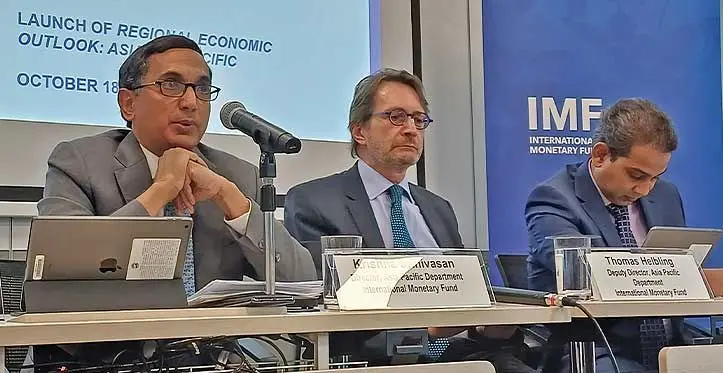
From left: International Monetary Fund (IMF) Asia and Pacific department director Krishna Srinivasan, deputy director Thomas Helbling and division chief of Regional studies Shanaka Peiris during the launch of their latest regional economic outlook for Asia and the Pacific in Singapore on October 18, 2023. Photo: Shratika Naidu
With the tourism rebound, Fiji’s real Gross Domestic Product (GDP) is projected to grow by 7.5 per cent in 2023 and 3.9 per cent in 2024.
International Monetary Fund (IMF) Asia and Pacific department director Krishna Srinivasan said this during the launch of IMF’s latest regional economic outlook for Asia and the Pacific in Singapore on October 18.
He said this partly reflected the sharp rebound in the tourism arrivals and that Fiji was back to those 2019 levels.
Related stories
“Fiji is one country where if you look at our losses from the multiple shocks, it’s actually gone back upwards, meaning gone back into those 19 levels,” he said.
Mr Srinivasan said recent IMF meetings with the Fiji’s delegation in Marrakesh, Morocco was positive.
“The delegation revealed where they clearly have a reform agenda, which is preparing Fiji for the years to come in terms of a sound macro fiscal position and so that’s all very promising,” he said.
“Inflation again needs to be kept in check. Our advice to region countries is to keep the monetary tightening, until inflation comes back to target.”
Mr Srinivasan said this was very important to control inflation.
Asia and Pacific inflation rate
According to the IMF latest regional economic outlook report, the inflation patterns suggest the following groupings:-
In the advanced economies of Australia, Korea, New Zealand, and Singapore, inflation patterns are similar to those in the United States and the euro area (though varying in amplitude): headline Consumer Price Index (CPI) inflation dipped early in the pandemic, then increased steadily; producer price index and imported inflation led CPI inflation, but there is little sign that wage-price spirals drove the inflation cycle.
The report said in several low-income and emerging markets in the region (such as Bangladesh, Bhutan, Cambodia, Fiji, Indonesia, Malaysia, Nepal, Philippines, and Thailand), inflation increases were less striking compared with those in previous cycles.
Feedback: shratikan@fijisun.com.fj