Kala Gold May Have To Dig Deep
This is big news for the Canadian company and a strong message of Fiji's potential in gold and copper deposits.
Friday 22 October 2021 | 09:00

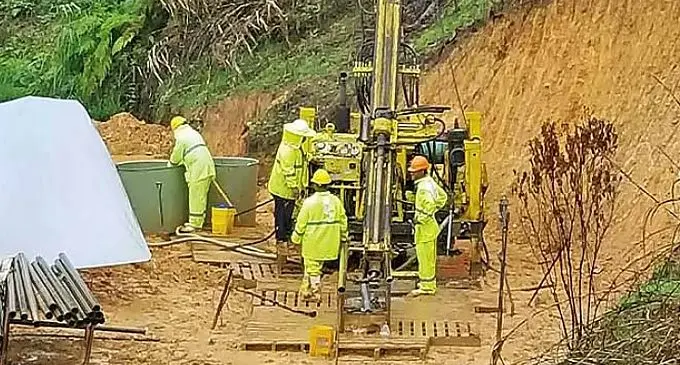
Kalo Gold Corporation has carried out mineral exploration in Vanua Levu over the past 10 years. (Photo: From File.)
Kalo Gold Corporation may have to drill deeper to test the rocks at Qiriyaga Hill, in its stride to locate high grade ore zones.
The summary emanated from an updated report issued by the company.
Kalo Gold, a mineral exploration company operating out of Labasa for the past 10 years, has discovered two large magnetic anomalies from its latest ground magnetic survey, the results of which it has just announced to the Toronto Stock Exchange Deeper drilling is therefore required to confirm the copper/ gold porphyry system that their latest ground magnetic survey has indicated to exist at depth.
Related stories
This is big news for the Canadian company and a strong message of Fiji's potential in gold and copper deposits.
By tradition, gold mineralisation occurs in non-magnetic or de-magnetised zones, Kalo Gold's chief executive director, Fred Tejada said.
"The magnetic anomalies open-up an other potential target area at the Qiriyaga Zone," hesaid.
"Drill testing of these targets will commence as soon as Fiji inter-island travel is lifted.
"In July, our induced polarisation survey indicated that the Qiriyaga Zone had the potential to bea large mineralised system."
"Qiriyaga Hill could just be the tip of the iceberg."
The survey was conducted under the supervision of Fender Geophysics of New South Wales, Australia.
The results confirm what they have understood about the mineral potential of their Vatu Aurum Prospect (SPL) in Macuata, Vanua Levu.
An industry spokesman said the findings supported the theory that a copper gold porphyry mineralising system had generated the mineralisation.
"In other words, the porphyry system is what has been feeding the mineralising event located there," SunBiz was told.
"Porphyry systems are located very deep, which has led them to believe that previous drillings were too shallow to have hit the big ore zones."
Feedback: shreya.kumar@fijisun.com.fj








