Steel Quality Under Spotlight
Engineers Fiji confirmed the ‘due diligence exercise’, after SunBiz queries relating to the quality of a local steel manufacture.
Tuesday 20 August 2024 | 16:31

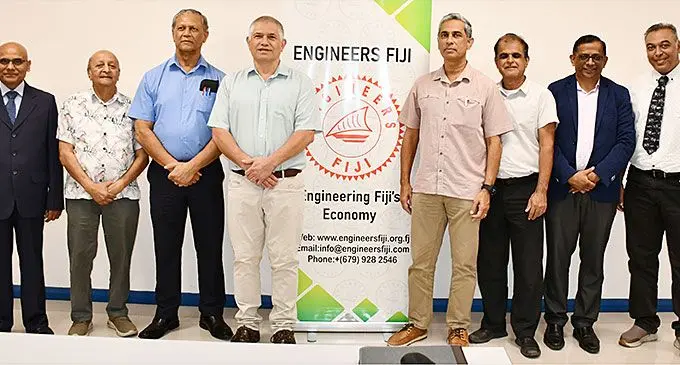
Members of Engineers Fiji Council 2004/2005 .... From left, Doctor in Engineering Satyanand Singh, Hamen Lodhia (immediate past president), Vjiay Krishnan (vice president), Terence Erasito (president), James Raman, Anil Kapadia, Satish Patel and Abhinesh Chand at the second Engineers Fiji Council meeting.
Investigation on steel reinforcement that is manufactured and distributed in Fiji is underway.
Engineers Fiji confirmed the ‘due diligence exercise’, after SunBiz queries relating to the quality of a local steel manufacture.
“On behalf of the Ministry of Trade, Co-operatives, Small and Medium Enterprises and Communications (who work under Fiji Standards), Engineers Fiji will be in a position to provide a more detailed response to this query once this exercise has been completed,” Engineers Fiji president Terence Erasito said.
Related stories
Red flags about using substandard reinforcement steel in construction
Seismic design of structures in Fiji are typically designed and constructed to New Zealand Standards, Mr Erasito said.
“The use of substandard steel reinforcement would render structures being non-compliant with the Fiji National Building Code and the New Zealand Standards,” he said.
“Non-compliant structures will not be able to perform in the way they were engineered.
“The resulting performance of the non-compliant structures would depend on the degree of non-compliance.”
For structures - such as buildings, bridges, towers, wharves - which are constructed with reinforced concrete, the structure must be capable of withstanding the induced lateral loads from seismic events, such as earthquake forces, in a ductile manner, Mr Erasito said.
“The occupants of such structures must be able to exit the said structure in a safe manner during earthquakes,” he said.
“For this to occur, it is necessary and essential that the reinforcing steel that is utilised in the construction of the structures is ductile.
“By that, we mean the chemical composition of the steel reinforcing bar needs to be such that when the bar deforms, under say, swaying action, tension and shear, the bar does not lose strength or fail.”
If the steel reinforcement bars contain too much carbon or, excessive amounts of chemical impurities, the bar will fail prematurely (that is, break) and the structure will likely experience a catastrophic failure, he said.
Hence, the importance of Fiji utilising compliant, ductile steel, he said.
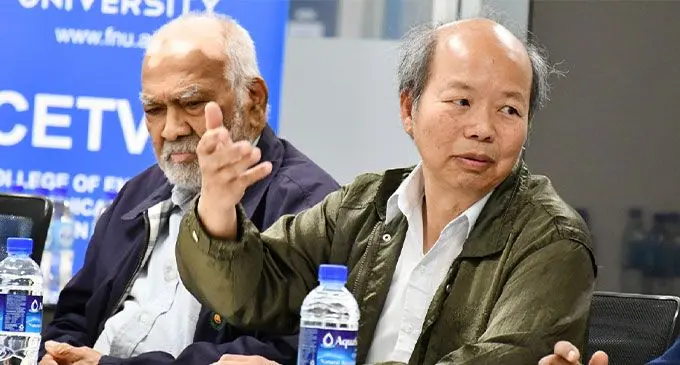
Professor Engineering Ankim Swamy and Professor Engineering Jon Mo (Melbourne University) deliberating with Engineers Fiji Council members at its second Council meeting. Both Prof John Mo and Mr Ankim Swamy are assisting Fiji National University with developing its Engineering programmes and working towards attaining Washington Accord accreditation for the university.
Two important oustanding items
Mr Erasito resounded the call for the Government to finalise and endorse the Chartered Professional Engineers of Fiji Act.
But the Government said Fiji had an Engineers Registration Act 1976.
The Attorney-General’s office has yet to respond to SunBiz queries about amendments for a Bill dated 2020.
Mr Erasito said the Ministry for Local Government which oversees 13 municipal councils - two city councils and 11 town councils - should ensure there is uniformity in requiring all developments in Fiji, to be endorsed by a Chartered Professional Engineer.
“This includes projects ranging from certification of residential homes to the development of Fiji’s infrastructure, such as airfields, ports, roads, jetties and bridges,” he said.
“Professional engineers essentially hold the important position of being the guardians of civil society.
“It is important that the Fiji Government recognise this responsibility and creates an environment through which the high professional standing and integrity of Engineers in Fiji is recognised.”
Mr Erasito said there were a number of anomalies and inconsistencies with the manner in which applications for permission to develop were being handled within the various municipal councils.
“The consequence of these inconsistencies are being carried by developers, investors and home owners and this needs to be addressed. business practices in Fiji,” he said.
Feedback: frederica.elbourne@fijisun.com.fj