‘There Is A Lot That Isn’t Right, Fashion Is Still A Side Hustle’
Stylish, poised, articulate, and classy, Sandhya Nand – a supermodel of Fiji in the 90s, does not pull her punches.
Saturday 28 May 2022 | 13:11

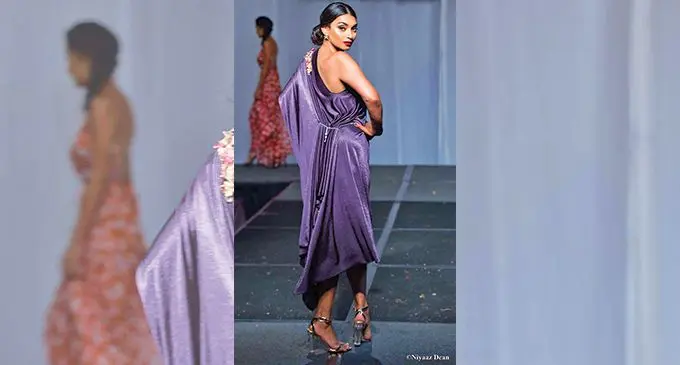
Stylish, poised, articulate, and classy, Sandhya Nand – a supermodel of Fiji in the 90s, does not pull her punches.
In an exclusive interview with SunBiz, she reflects on the evolution or lack thereof of Fiji’s fashion industry, since her early days in the local industry.
A formidable figure in her own right, Ms Nand is a multimedia specialist with experience in public relations, photography and music.
Related stories
In essence, she lives up to her role as the multicultural provocateur she says she is.
Now in her 50s - a fact that is often thrown off by her great physique, careful selection of the appropriate wear, and her sheer youthfulness, and zest for life - the closest hint one would get of her age, is the few grey hairs that she proudly flaunts.
Early beginnings
Born in Suva, she spent her formative years in England and India, before she returned to Fiji.
She attended Veiuto Primary and Suva Grammar School, before she furthered her education at an Australian boarding school in the late 80s.
“Sadly, this coincided with the first coup, making it difficult to return home, to Fiji, for over two years,” Ms Nand said.
“As soon as I could, I deferred university studies, and sped back.”
In her younger years, she had stints on air through Aunty Adi Koroi’s show.
“I walked back into Fiji Broadcasting Commission (FBC) the second day I was back, and got a job on air, on the main English station,” she said.
Ms Nand worked for FBC for a few years, before she started at Fiji National Video Centre in 1992, as one of the first newsreaders for Fiji One news.
“I had already become well-known as a model, as I was discovered in 1989 by Anna Sweetman, and Tanya Whiteside,” she said.
“I had also started singing with Tui Ravai and The Freelancers in Traps around 1991, before Ken Janson invited me to join his new band, The Hearts in 1992.
A prestigious event of its time, was the Hibiscus Fashion Parade was organised by Anna Sweetman.
“I made my debut in 1989,” Ms Nand said.
“There were other fashion shows; a weekly one at the Sheraton that I was asked to walk for, a few times.
“Many smaller prestigious ones organised by Anna Sweetman and Bernadette Rounds, who also had a newspaper magazine called Fiji Women.
“There were also a lot of photo shoots, for all the main dailies.”
The face of Tiki Togs
Ms Nand went on to become the face of Tiki Togs and its heir, Tanya Whiteside’s eponymous label.
She recalled the many fun campaigns, ‘lookbooks’ and shoots.
By the early 90s, there existed a fairly well established group of models, who walked all the top shows.
“We are all still remembered, me more than most, because of my television, radio and singing appearances,” Ms Nand said.
Back then, branding was held in high regard.
Many people used fashion events as a medium to draw crowds and gain attention, she said.
“These events were free to the public,” Ms Nand said.
In the mid-90s, the then Tradewinds hosted weekly fashion shows, featuring top models and top labels, she said.
“There were many top design labels and stores then,” Ms Nand said.
Wella Design Show
The mid-90s was also when Ms Nand first produced the Wella Design Shows, the first major collective fashion events that were award shows.
“This was for a strategic reason,” she said.

Tanya Whiteside, heir of Tiki Togs brand.
However, I am not throwing shade at anyone.
This is easier said than done, because it is an expensive exercise.
Our contemporary designers do not have the capacity to create in volume, which is what international boutiques require.
The designers that could, that seemed to have a mass production system in place pre COVID-19, are not suitable for ‘mainstream’ markets, they create for their ‘island customer’.
There is a way to feature island motifs without being literal, pairing traditionally inspired patterns with modern silhouettes.
Designers shouldn’t limit themselves to being ‘island designers’.
They need to think of themselves as designers first.
Australian industry
I wish the Australian industry actively nurtured the Pacific creative industries, especially the Fiji fashion industry.
This is something we all strive for, to be seen as a viable source of urban product, rather than just a manufacturing country.
That is what I would love to see.
Fijian designers stocked internationally, if not household names then as chic, independent labels.
I have recommendations.
But I would like to be in a position to implement these.
I want to give back to this country that gave me so much.
But I would like to be respected for my three decades-plus of accumulated knowledge, before I start giving away my ideas.
The misuse of couture is almost a given in certain spheres. What is your position on the matter?
Couture, by itself, is the French word for dressmaking.
It is a designer label, one-of-a-kind, exceptionally well-made, ready-to-wear pieces, in standard sizes, known as prêt-à-porter (pronounced ‘prrett-a-porrtay’).
This is high-end fast fashion.
Haute couture (pronounced oat-coo-tyuurr) is the term that gets misused.
Haute couture is a French government regulated term and designation.
Very few fashion houses and labels have this prestige.
The fashion world is still governed by the French, even though fashion’s history stems from India.
To be considered an haute couture house, fashion houses must own an atelier, or workshop, in Paris, with at least 15 full-time employees.
They must present at least 35 looks in a show, twice a year.
Every haute couture piece is made to measure for a single client, who goes to the Parisian atelier, for measurements and fittings.
Regardless of how expensive and exclusive a piece is, it is not haute couture, until the Chambre Syndicale de la Haute Couture says it is.
It is very elitist, but it is an artform.
Haute couture pieces are works of art, painstakingly handmade by one of “les petites mains”, or small hands, one of the 2200 current seamstresses who painstakingly bring haute couture creations to life.
While I appreciate exclusivity, I loathe elitism.
I feel that Pacific fashion should not be dictated to by a society on the other side of the world.
I believe we could have an haute couture system in place here.
Fashion Designers Alliance of Fiji were contacted for comment.
Feedback : frederica.elbourne@fijisun.com.fj








