Defence calls for charges over missing drug exhibits
Justice Hamza says stronger accountability measures are needed when exhibits disappear.
Friday 22 May 2026 | 12:30
Updated 22 May 2026 | 14:36 FJT

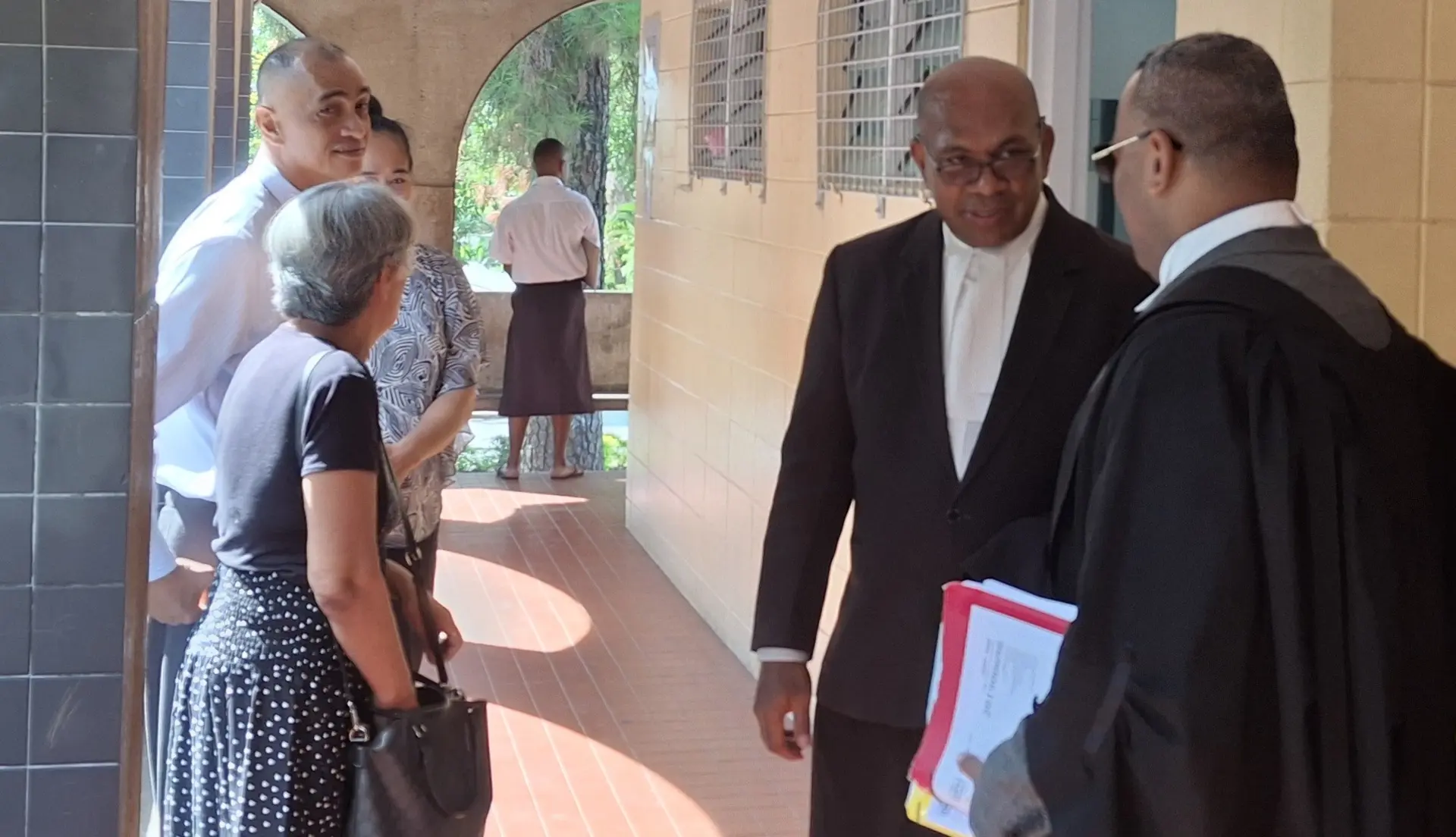
Accused Fredrick Epeli with family members (left) and lawyers, Aca Rayawa and John Rabuku outside the High Court in Lautoka.
Photo: Mereleki Nai
A defence lawyer has called for those responsible for the disappearance of drug exhibits from Namaka Police Station to be charged, as a High Court judge also raised concerns about accountability.
Lawyer Aca Rayawa, representing drug accused Fredrick Epeli, made the submission during proceedings before Justice Riyaz Hamza at the High Court in Lautoka this morning.
Epeli and co-accused Justin Ho, who is represented by Samuela Heritage, are facing drug-related charges in a case previously discontinued after exhibits went missing from the police station.
Related stories
The matter was earlier discontinued in 2020 following the disappearance of key drug exhibits, prompting a nolle prosequi by the Office of the Director of Public Prosecutions (ODPP) and an order for further police investigations.
Both men now face one count each of unlawful exportation of illicit drugs and unlawful possession of illicit drugs.
It is alleged that on December 23, 2018, the two attempted to export 2,015.7 grams of cocaine to Sydney, Australia, without lawful authority. They are also accused of involvement in the transfer, transport, supply and sale of illicit drugs.
Epeli, a former Fiji Airways senior flight attendant, is alleged to have arranged a bag containing the drugs in connection with Ho. A female flight attendant, who reportedly checked the bag under Epeli’s direction, allegedly discovered the drugs and alerted police.
The State is represented by prosecutor John Rabuku.
During proceedings, the defence’s application for a permanent stay of proceedings was vigorously argued.
Mr Rayawa submitted that the case should be permanently stayed due to missing evidence, lack of disclosure and alleged prosecutorial misconduct. He argued that the accused were never shown the alleged drugs, which undermined their ability to prepare a proper defence.
Concerns were also raised about the chain of custody, with the defence maintaining that the disappearance of the exhibits could not be remedied during trial.
The defence further highlighted alleged attempts to offer immunity to the accused without their lawyers’ knowledge as evidence of abuse of process.
Reference was made to prior rulings and affidavits detailing procedural failures and their impact on the right to a fair trial.
Mr Rabuku opposed the permanent stay application, arguing the issues raised by the defence were matters for trial and not grounds to halt proceedings.
He submitted there was no strict legal requirement for exhibits to be shown to accused persons during investigations.
The prosecution maintained the chain of custody remained intact up to the point of testing, despite the subsequent disappearance of the drugs.
The State also argued the defence’s claim of lack of knowledge weakened the relevance of the missing exhibit to their case.
Justice Hamza and the prosecution agreed that a permanent stay was an order of last resort and required a high threshold to establish abuse of process.
He reiterated the importance of procedural integrity and the high bar required for granting a permanent stay.
The court clarified that only the current charges and evidence would be considered, excluding unrelated prior parcels.
Key dates were set for future hearings, including June 2 for the consolidated case and June 24 for a ruling on the stay application.
Mr Rayawa said someone should be charged over the missing evidence. Justice Hamza agreed the disappearance of drug exhibits from police stations was a serious issue.
The judge and the defence acknowledged the broader implications for public trust in the justice system when evidence goes missing.
He stressed the need for stronger procedures and accountability measures to prevent similar incidents.
“This is a serious problem when drugs are missing from police stations. There were two people investigated over this, but nothing was done. They were exonerated from that report. Nothing was done. They should be charged and dealt with so this will never happen again,” Justice Hamza said.
Justice Hamza said the disappearance of drug evidence from police custody highlighted a serious systemic issue and renewed calls for stricter accountability.
June 24 was set for ruling, while bail was extended for Epeli. Ho remains in custody.








