Awareness Key to Protect Seagrass, the Lungs of our Ocean
Seagrass has the ability to help fight climate change. But not much study and awareness are being carried out to protect these valuable habitats.
Wednesday 30 March 2022 | 06:46
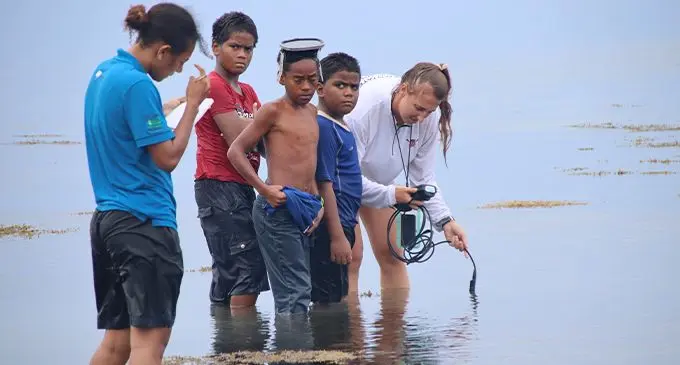
Seagrass researcher Carrie Wentzel with Marine Scientist Susana Tauyavuca being assisted by a few children of Waiqori village, Oneata on March 19, 2022. Photo: Kelera Sovasiga
For decades seagrass has often been seen as an eyesore among Fiji’s coastal communities.
But the role it plays in the ocean ecosystem is unmatched.
In fact, scientists have described seagrass as the lungs of the ocean.
Related stories
It has the ability to help fight climate change. But not much study and awareness are being carried out to protect these valuable habitats.
Its very existence is under threat if awareness at community level is not maintained.
Rusila Tauyavu, 71, of Muanaicake Village in Fulaga, is one of many who are not aware of the specific roles of seagrass in their ecosystems.
“I grew up seeing it but to be told of how seagrasses act as a natural sediment trap in capturing carbon, storing it, and eventually putting it back onto the seafloor is news to me.
“I only wish more awareness was made so that this generation and those to come understand the risk at hand in terms of tackling climate change in our village,” Ms Tauyavu said.
According to the World Resources Institute, blue carbon ecosystems — namely mangroves, salt marshes and seagrasses — are valuable habitats for sequestering and storing carbon. Estimates indicate that these ecosystems can sequester more than double the carbon per area than terrestrial forests.

Seagrass researcher Carrie Wentzel showing her findings to 71-year-old, Rusila Tauyavu of Muanaicake village in Fulaga. Photo: Kelera Sovasiga
Feedback: kelera.sovasiga@fijisun.com.fj