Children U10 Caught Peddling Drugs, Juvenile Arrests Peak
“If anyone is found in possession, there will be no reconciliation, there is a ‘No-Drop Policy’ for drug cases, and we will charge them and take them to court.”
Thursday 18 July 2024 | 13:59

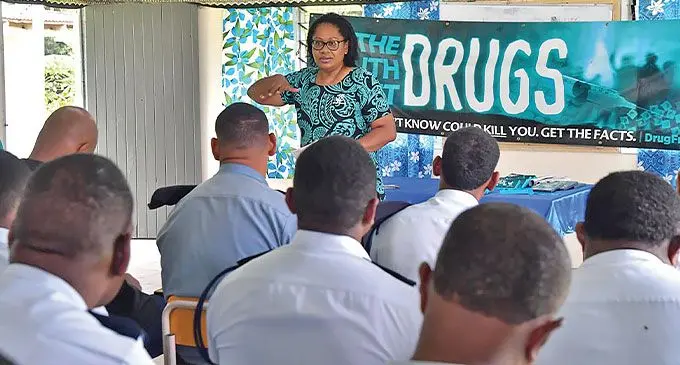
Drug-Free World Fiji founder Kalesi Volatabu during an awareness session with Police officers.
Assistant Commissioner of Police - Operations Livai Driu says they continue to arrest juveniles who are allegedly caught in possession of illicit drugs for the purposes of peddling and consumption.
ACP Driu said while they were arresting those from ages 18 to 10, the worrying trend was the arrest of those under the age of 10.
“They (children) are vulnerable, they are soft targets for these drug lords,” ACP Driu said.
Related stories
“When you promise a child that if they sell this, you will give them $100, they will do it because they want money,” he said.
“We are seeing marijuana, methamphetamine, cocaine and the latest one is ketamine. We are also analysing ketamine, but no arrests have been made.”
ACP Driu said the public needs to know that on one, regardless of age was above the law.
“If anyone is found in possession, there will be no reconciliation, there is a ‘No-Drop Policy’ for drug cases, and we will charge them and take them to court.”
He said the continuation of arrests made on juveniles was a worrying trend.
“We have been conducting so much awareness and also other government organisations, such as the Ministry of Women have been doing the same but still we are noticing these issues happen.
“We are mandated to keep enforcing laws against drugs, the impact of arrests we’ve been making so far is one of the reasons why the remand centers are getting overcrowded, and most offenders are those who have been charged with drug offences.”
Drug Free World Fiji
Drug-Free World Fiji founder Kalesi Volatabu said drug peddlers were enticing kids with money they would get from the sale of illicit substances.
She said they glamourized it, but they did not tell them what would happen to them because it was all about sales for them.
“There are certain things that will drive them to do it. If the home is not safe, they end up on the street. If you look at social economics, who would experiment with this, you can’t even say it’s only one particular cohort,” Ms Volatabu said.
“From what we’ve gathered, drugs does not discriminate because these drug peddlers will target anybody and anyone, as long as they can make a sale,” she said.
“We’re trying to push the parents to spend some time, sit down with your children, have a talanoa and you would be amazed what they come up with, what they’ve seen around them, what they’ve learned from their friends.
“Recently in one of the villages, I spent some time with the children and I asked them, what are some of the things they have heard about drugs and I asked them if they know what bluetoothing is, I was quite amazed what they’ve been told, or what bluetoothing is.”
Ministry of Education
Permanent Secretary of Education Selina Kuruleca said the ministry was concerned with the issues of drugs in schools found on students as young as 10.
“There are several allegations in various forms and we are aware of these cases also, we are mindful some of these cases are before the courts that process needs to be completed, we appreciate the launch of the narcotics strategy, we had meetings with the Ministry of Home Affairs,” Ms Kuruleca said.
“Pillar One is harm reduction and the Ministry of Education is taking the lead. It’s important that we teach our kids to make right decisions, and adults need to role model their children. We need to be leading in the fight against illicit drugs,” she said.
“And not only it should start from schools, but right down to community. It needs to be community-driven because the ministry can only do so much.
Ministry on tackling issue
One is the set-up of the Narcotics Bureau which will safeguard and guide us on the necessary steps to mitigate the issue, Ms Kuruleca said.
She said there were trainings in place to equip school counsellors on the next necessary steps on how they can deal with the behaviour of students.
“And with drug-related issues, we have seen a lot young people occupying the St Giles Hospital which was meant for psychiatric patients,” she said.
“The trend we are seeing now that when these young ones are admitted, they tend to influence other patients to consume drugs which is a worrying factor.”
Feedback: salote.qalubau@fijisun.com.fj